Dance in the City Auction History
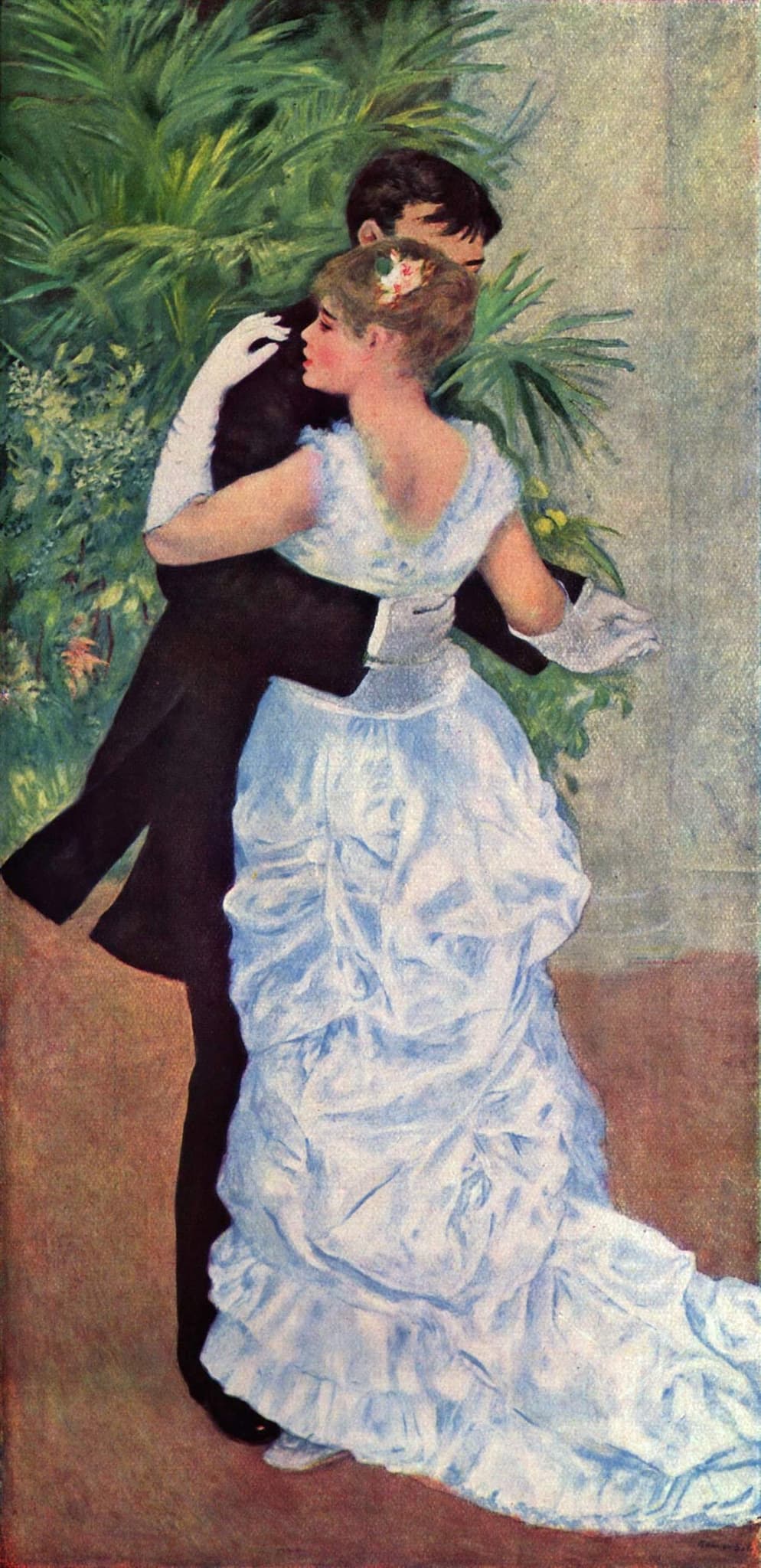
No public auction is recorded for Renoir’s Dance in the City. The painting remained with Durand‑Ruel for decades and entered the French national collections in 1978 via dation en paiement; it is now at the Musée d’Orsay. As a French state museum work, it is inalienable and not on the market.
- Artwork
- Dance in the City
- Artist
- Pierre-Auguste Renoir
- Sale type
- No known public sale
- Current location / owner
- Musée d’Orsay, Paris
Auction and Ownership Timeline
Painted and signed by Renoir
Paris
Renoir completes Dance in the City, oil on canvas, signed “Renoir 83.” [1]
Deposited and exhibited at Durand‑Ruel
Galerie Durand‑Ruel, Paris
From 1883 the work is on deposit with Galerie Durand‑Ruel, Paris; exhibited there that year (cat. no. 26). [1]
Durand‑Ruel ownership; Salon des XX exhibition
Brussels
By 1886 the painting is recorded as Durand‑Ruel property and is shown at the Salon des XX in Brussels. [1]
Included in ‘Exposition A. Renoir’
Galerie Durand‑Ruel, Paris
Featured in Durand‑Ruel’s 1892 Renoir exhibition in Paris (cat. no. 81), consistent with long Durand‑Ruel custody. [1]
Accepted by the French State via dation en paiement
French State, Paris
The painting is accepted in lieu of taxes for the national museums (committee 12 Jan 1978; council 18 Jan 1978; ministerial order 13 Mar 1978) and attributed to the Musée du Louvre. [1][2]
Displayed at the Galerie du Jeu de Paume
Galerie du Jeu de Paume, Paris
Post‑acquisition, the work is displayed at the Galerie du Jeu de Paume (then housing the Louvre’s Impressionist collections), 1978–1986. [1]
Assigned to the Musée d’Orsay
Musée d’Orsay, Paris
Upon the opening of the Musée d’Orsay, the painting is assigned there; property of the French State (RF 1978 13). [1]
Provenance and Ownership
Painted and signed in 1883, the work entered Galerie Durand‑Ruel on deposit that year and by 1886 was recorded as the dealer’s property; it was shown at the Salon des XX in Brussels and later featured in Durand‑Ruel’s 1892 Renoir exhibition in Paris [1].
In 1978 the painting was accepted by the French State as dation en paiement for transfer to the national museums (committee 12 Jan; council 18 Jan; ministerial order 13 Mar), initially attributed to the Musée du Louvre and displayed at the Galerie du Jeu de Paume (1978–1986) [1][2]. Since 1986 it has been assigned to the Musée d’Orsay, Paris (RF 1978 13) [1].
As part of a French national museum collection, the work is inalienable and imprescriptible under the Code du patrimoine; it is not for sale [3].
Quick Facts
- Last known sale
- Not publicly reported
- Known sale price
- Not publicly reported
- Sale type
- No known public sale
- Venue / institution
- Musée d’Orsay, Paris
- Current owner or location
- French State; Musée d’Orsay, Paris
- Publicly viewable?
- Yes
Why This Sale Matters
There is no recorded public sale for Dance in the City; the painting remained with Durand‑Ruel for decades and entered the French national collections in 1978 via dation en paiement, a tax settlement in kind that does not disclose a public price [1][2]. As a work now held by a French state museum, it is inalienable and cannot be deaccessioned under the Code du patrimoine, effectively removing it from the art market [3]. Its significance is therefore art‑historical—part of Renoir’s celebrated trio of full‑length dance pictures alongside Dance in the Country (Musée d’Orsay) and Dance at Bougival (MFA Boston)—rather than transactional [1][4].
For market insight, collectors and scholars look to comparable Renoir masterpieces that have appeared at auction. Renoir’s auction record remains Bal du moulin de la Galette (1876), sold for $78.1 million at Sotheby’s New York in 1990, a landmark that established the upper tier for the artist’s most iconic subjects [5]. More recently, demand for late‑19th‑century figural Renoirs has been reaffirmed by eight‑figure results such as Berthe Morisot et sa fille, Julie Manet (1894), which achieved $24,435,000 at Christie’s New York in May 2022 [6].
Because all three “Dance” pictures are in major museum collections, direct comparables for Dance in the City are scarce, and any hypothetical valuation must be inferred from subject, scale, condition, date, and market momentum seen in other top Renoirs. Its museum status, canonical subject, and extensive exhibition history situate the work among Renoir’s most admired achievements, but its inalienability means it exerts influence on the artist’s market primarily through scholarship and exhibitions rather than sales events [1][3][4].
Related Pages
Other auction histories by Pierre-Auguste Renoir
Sources
- Musée d’Orsay — Danse à la ville (Dance in the City), RF 1978 13 — Musée d’Orsay
- POP/Joconde — Danse à la ville (Notice M5060000085) — Ministère de la Culture
- Code du patrimoine — Inalienability of public collections — Legifrance
- Renoir, Impressionism, and Full‑Length Painting — Curatorial text — The Frick Collection
- Most expensive painting by Renoir sold at auction — Guinness World Records
- Christie’s — 20th Century Evening Sales results (May 2022) — Christie’s