How Much Is Madame Georges Charpentier and Her Children Worth?
Last updated: March 10, 2026
Quick Facts
- Methodology
- comparable analysis
Hypothetical market value if deaccessioned: $100–150 million. This assumes an evening‑sale placement, pristine condition, active museum and UHNW buyer participation, and guarantees/underwriting to create competitive bidding.
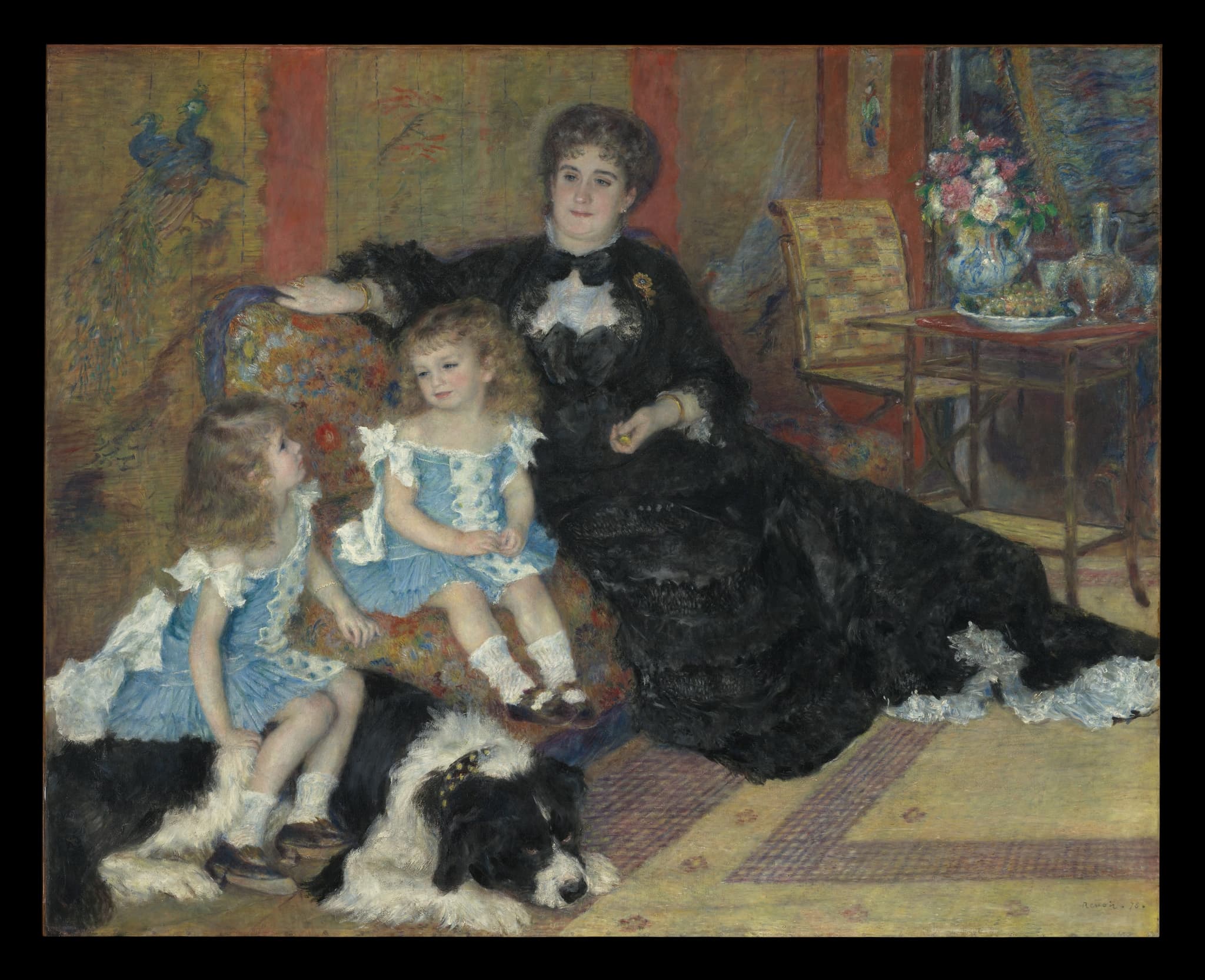
Madame Georges Charpentier and Her Children
Pierre-Auguste Renoir, 1878 • Oil on canvas
View more by Pierre-Auguste Renoir →Valuation Analysis
Valuation conclusion: I place a hypothetical market value for Pierre‑Auguste Renoir's 'Madame Georges Charpentier and Her Children' (1878) at $100–150 million if it were ever deaccessioned and sold on the open market under optimal commercial conditions. This estimate reflects the painting's museum provenance, salon scale, exceptional art‑historical importance, and the ceiling implied by Renoir's highest recorded sale when adjusted for market context and competition.
Basis and comparables: The work is in The Metropolitan Museum of Art (acc. no. 07.122), a century‑long public ownership that both protects the work and concentrates its value if released to market [1]. Its acquisition via the Catharine Lorillard Wolfe Fund in 1907 and an extended exhibition history increase canonical recognition yet make a market offering exceptionally rare. Renoir's auction ceiling is anchored by the 1990 sale of Au Moulin de la Galette, which realized reported proceeds in the high tens of millions and establishes a demonstrable upper boundary for the artist in peak conditions; adjusted comparisons to that sale and to large, museum‑quality Impressionist trophies inform the top end of this range [2]. More recent, well‑conditioned late‑1870s Renoirs have sold in the low tens of millions (e.g., Square de la Trinité), illustrating the gap between routine high‑quality results and the exceptional trophy sale this estimate assumes [3].
Value drivers: Key positive drivers supporting a $100–150M valuation are (a) canonical status within Renoir's portraiture and direct relevance to major Impressionist exhibition narratives; (b) unbroken, museum‑grade provenance and institutional exhibition history that signal authenticity and desirability; and (c) extreme scarcity — very few salon‑scale Renoir portraits with Met‑level provenance exist in the private market. Institutional loans to marquee retrospectives, catalog inclusion, and authoritative scholarship would materially enhance competitive tension at sale. To realize the top of the range the sale would require an evening‑sale placement, active museum and ultra‑high‑net‑worth bidder participation, guarantees or third‑party underwriting, and a pristine technical condition.
Risks and adjustments: Material negative factors that would reduce realized value include conservation or structural issues revealed in a technical report, donor or legal restrictions on sale, national export controls, or an unfavorable auction climate. The painting's museum‑held status introduces political and ethical obstacles that frequently channel offers into private treaty or inter‑museum negotiation — routes that tend to compress competitive public bidding and price discovery. Pricing sensitivity to guarantees, underwriting and the presence (or absence) of institutional bidders is high; without those market supports a public sale would likely clear well below the base of the range.
Final assessment and next steps: Given these drivers and constraints, $100–150M represents an informed, conditional ceiling‑to‑floor range for a hypothetical, contested, best‑case sale. Realization at this level would be atypical and contingent on exceptional market circumstances, but the painting's rarity, provenance and art‑historical weight justify the premium over routine Renoir results. Recommended pre‑sale actions: obtain a full conservation and condition report, compile an exhibition/provenance dossier, secure institutional expression of interest or guarantees, and plan an evening‑sale strategy to maximize competitive bidding.
Key Valuation Factors
Art Historical Significance
High ImpactMadame Georges Charpentier and Her Children is a central example of Renoir’s late‑1870s salon portraiture and is widely cited in scholarship as a defining illustration of his approach to society portraiture, fashion, and interior space. The work’s subject — the Charpentiers — were prominent patrons and arbiters of taste in Belle Époque Paris, which increases the painting’s contextual importance for museum narratives and cataloguing. As a canonical composition that routinely appears in exhibition histories and academic literature, it commands a premium relative to studio works or privately circulated pieces. The art‑historical rank elevates both perceived cultural value and the pool of likely buyers (chiefly major museums and deep‑pocketed private collectors), supporting a substantial valuation uplift.
Provenance & Museum Ownership
High ImpactThe painting's provenance is exceptionally strong: commissioned by Georges Charpentier, it remained in the Charpentier family until the 1907 Drouot sale and was then acquired by The Metropolitan Museum of Art via the Catharine Lorillard Wolfe Fund (acc. no. 07.122). Continuous public ownership since 1907 reduces attribution and authenticity risk and enhances scholarly acceptance, both of which normally elevate market value. Conversely, long museum tenure introduces deaccession complexity, donor or legal constraints and limited liquidity; those factors can restrict or delay marketability. If a public, contested sale were achievable, the Met provenance would significantly increase competing institutional interest and justify higher reserve levels and guarantee offers.
Condition & Conservation
High ImpactRealized value will be highly sensitive to the painting’s technical condition. A pristine canvas with original paint layers, minimal retouching, stable support and comprehensive technical imaging (X‑radiography, infrared reflectography, pigment analysis) will sustain premium bidding; evidence of heavy restoration, past overpaint or structural instability will materially reduce buyer confidence and price. Institutions and major private buyers require independent conservation reports prior to bidding, and condition issues can affect export permits, insurability and sale method. A clean technical dossier is therefore a prerequisite to reach the upper portion of the valuation range.
Market Demand & Comparables
High ImpactComparable auction results show a wide dispersion: quality Renoirs commonly trade in the mid‑seven to low‑eight figure band, while the historical auction ceiling demonstrates much higher rare outcomes. A Met‑provenance salon portrait would attract museum and UHNW interest globally, but attaining $100–150M requires concentrated competition, cross‑regional bidder participation and sale guarantees or consortium bidding. The painting’s scarcity and exhibition potential justify an uplift above normal comparables, yet converting theoretical premium into realized price is conditional on timing, marketing, and institutional participation during the sale.
Legal / Deaccession Risk
High ImpactThe painting’s residency in a major public collection creates legal, ethical and policy constraints that can materially depress marketability. Donor restrictions, museum deaccession policies, national patrimony regimes and export controls may prohibit or delay sale. Political opposition to deaccession for revenue purposes is frequent and can force transfers rather than open auctions. Even when legally permissible, reputational and procedural hurdles make a public contested auction less likely and increase the probability of private treaty or inter‑museum resolution, both of which typically produce lower price discovery than a competitive evening sale.
Sale History
Madame Georges Charpentier and Her Children has never been sold at public auction.
Pierre-Auguste Renoir's Market
Pierre‑Auguste Renoir is a blue‑chip Impressionist whose works occupy a prominent place in major museums worldwide and command durable demand among collectors. The artist’s market is bifurcated: numerous smaller works and studies trade in the mid‑six to low‑seven‑figure range, while rare, museum‑quality salon pieces can break into the high single‑ or low double‑figure millions and — in exceptional cases — into the tens of millions. Renoir’s auction record (Au Moulin de la Galette, 1990) sets a historical ceiling and informs valuations for top‑tier works. Collector appetite remains strong for canonical subjects (café scenes, bathers, major portraits), but realized prices depend heavily on condition, provenance and exhibition history.
Comparable Sales
Au Moulin de la Galette
Pierre-Auguste Renoir
Renoir's auction record and an iconic, salon-scale social scene; provides the upper-end market ceiling for the artist.
$78.1M
1990, Sotheby's New York
~$185.1M adjusted
Square de la Trinité
Pierre-Auguste Renoir
Late-1870s multi-figure figural scene close in date and scale to Madame Charpentier; recent evening-sale benchmark for high-quality works of the same period.
$11.9M
2023, Christie's New York
~$12.4M adjusted
Baigneuse
Pierre-Auguste Renoir
High-quality late-career Renoir realized a strong mid-eight-figure price in 2025; demonstrates that top-condition works can drive eight-figure results.
$10.4M
2025, Christie's New York
Bouquet de lilas
Pierre-Auguste Renoir
Same-year (1878) work by Renoir sold strongly in London — useful for calibrating demand for works from the same period, though subject (still life) differs.
$8.7M
2024, Sotheby's London
~$8.9M adjusted
Baigneuse accoudée
Pierre-Auguste Renoir
Regional sale result for a Renoir bather showing the lower end of realized prices and geographic/subject-driven dispersion in the market.
$3.0M
2025, Sotheby's Hong Kong
Current Market Trends
Current market conditions are selective: demand for blue‑chip Impressionist works remains robust, but the broader market is bifurcated with fewer trophy consignments and sensitivity to macroeconomic volatility. Institutions and UHNW buyers continue to compete for museum‑quality canvases, especially when works are tied to major exhibitions and have pristine provenance. Auction houses now rely on guarantees and curated evening‑sale placement to achieve top results. Short term, expect sustained demand for canonical Renoirs but greater price dispersion; achieving premium outcomes will depend on sale preparation, visible institutional interest and a favorable global auction climate. Houses emphasize guarantees during spring and fall seasons.