How Much Is Two Sisters (On the Terrace) Worth?
Last updated: March 10, 2026
Quick Facts
- Last Sale
- $100K (1925, Durand‑Ruel (New York sale to Mrs. Lewis Larned Coburn))
- Methodology
- comparable analysis
Two Sisters (On the Terrace), 1881 by Pierre‑Auguste Renoir (Art Institute of Chicago, accession 1933.455) is museum‑held and effectively off‑market. If hypothetically offered from a private owner or via deaccession, a realistic market valuation is approximately USD 15,000,000–60,000,000 based on recent comparables, strong Durand‑Ruel → Coburn provenance, and the artist’s auction performance.
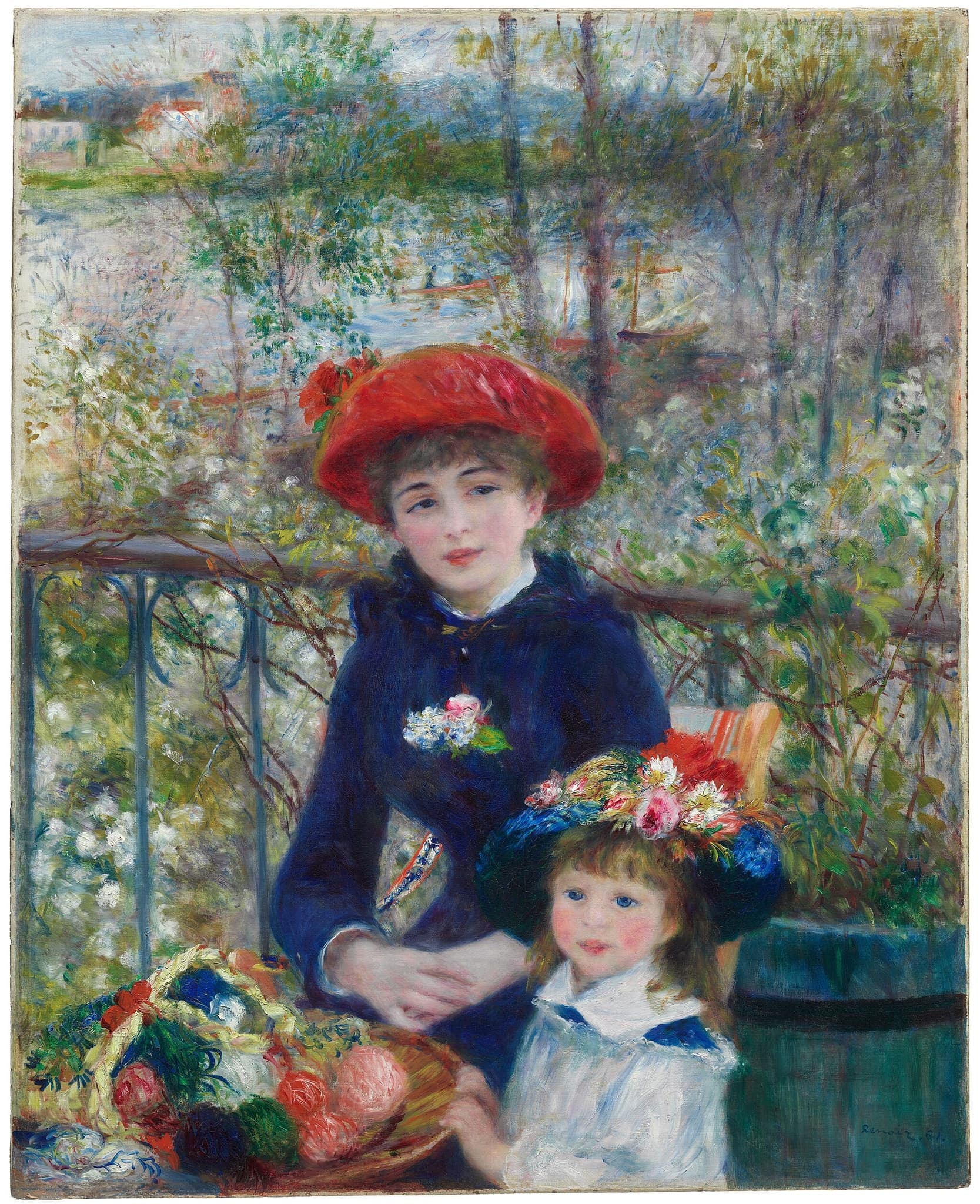
Two Sisters (On the Terrace)
Pierre-Auguste Renoir, 1881 • Oil on canvas
View more by Pierre-Auguste Renoir →Valuation Analysis
Valuation conclusion (short): Two Sisters (On the Terrace), 1881 by Pierre‑Auguste Renoir is in the permanent collection of the Art Institute of Chicago (accession 1933.455) and therefore is effectively not on the open market; institutional records and provenance documentation confirm long public ownership and exhibition history [1]. If an authenticated, museum‑quality 1881 Renoir of this subject were to come to market, a reasoned market valuation is provided below based on recent auction comparables, historical top results, and the painting’s documented provenance.
Comparable evidence and market context: Recent sale activity for prime Renoirs and strong late‑19th‑century French figure works shows buyer willingness to pay mid‑ to high single‑figure millions for well‑provenanced examples. For instance, a well‑provenanced late‑1870s/1880s Renoir still life realized c. $8.72M at Sotheby’s London in 2024, and major figure works in similar seasons have approached or exceeded $10M—supporting a multi‑million baseline for top examples [2]. The artist’s historic auction ceiling (Au Moulin de la Galette, 1990, $78.1M) illustrates the upper theoretical limit for a trophy Renoir, though such masterpieces rarely reappear publicly.
Estimate and rationale: Considering date (1881—Renoir’s desirable mature Impressionist period), subject (large double portrait/group figure), and exceptional provenance (Durand‑Ruel → Annie Swan Coburn → Art Institute), a preliminary market range if sold would be approximately USD 15,000,000–60,000,000. The lower band ($15M–$25M) corresponds to smaller scale works, modest exhibition history, or noticeable conservation issues; the mid band ($25M–$45M) to large autograph canvases in sound condition with strong exhibition/publication histories; the upper band ($45M–$60M+) would require pristine condition, exceptional exhibition provenance, and a highly competitive private or evening‑sale bidding environment.
Key qualifiers: This valuation assumes confirmed autograph status, favourable technical condition, and catalogue‑raisonné inclusion or expert attestation. Final value would be determined only after review of the conservation dossier (X‑rays, IR/UV, varnish/relining history), complete provenance documentation, and up‑to‑date catalogue references. The Art Institute’s internal records are likely to contain the technical information that would support a higher valuation [1].
Market route and liquidity: A work with this profile is most realistically sold by private treaty to a major collector or via a controlled auction structure with guarantees and pre‑sale marketing rather than in an open day sale. Institutional ownership makes public sale improbable; deaccession would be rare and legally/ethically sensitive and would materially affect market reception and price outcome.
Next steps to refine the figure: To tighten the estimate to a single figure I recommend providing: high‑resolution images, exact dimensions, the museum conservation report, and catalogue‑raisonné/exhibition citations. With those documents I will prepare a 5‑lot comparable matrix with dollar adjustments for scale, condition and provenance and recommend the optimal sale strategy.
Key Valuation Factors
Art Historical Significance
High ImpactTwo Sisters (On the Terrace) dates to Renoir’s mature 1881 period and exemplifies his hallmark treatment of light, color and intimate figure composition. While not on the level of his absolute marquee trophies (e.g., Luncheon of the Boating Party), this composition is a strong representative work—particularly as a large, finished double portrait/group scene. Its presence in standard survey literature and its role in illustrating Renoir’s portrait practice of the era increase scholarly interest, exhibition appeal, and therefore market desirability. High art‑historical significance supports movement toward the upper part of the estimated range, all else equal.
Provenance & Exhibition History
High ImpactProvenance is exceptionally strong: direct sale to Paul Durand‑Ruel in 1881, purchase by Annie Swan Coburn in 1925, and bequest to the Art Institute of Chicago in 1933. Continuous, well‑documented chain of ownership through a leading dealer and a prominent American collector reduces attribution and title risk and materially uplifts market value. Long museum ownership and likely exhibition/publication history increase buyer confidence and often shift valuations upward because institutional provenance is a major positive in the current selective market.
Condition & Technical State
High ImpactCondition drives value for high‑end Impressionist pictures. A painting with original paint, stable ground and minimal intrusive restoration commands premiums; conversely, relining, heavy inpainting, or structural instability can suppress bids substantially. Given the Art Institute’s conservation resources, the work likely benefits from professional care, but a formal condition report (X‑ray, IR, UV, pigment analysis) is required to confirm technical integrity. Any significant conservation issues would push a realistic market estimate toward the lower end of the provided range.
Comparables & Market Liquidity
Medium ImpactRecent comparables for museum‑quality Renoirs (still lifes and figure compositions) show a clustering in the mid‑ to high single‑figure millions at public sale; standout evening‑sale results approach or exceed $10M. Market liquidity for canonical Renoirs remains strong for the best quality, but the $10M+ public‑sale band has been more selective in recent seasons. Comparable performance therefore supports a multi‑million baseline but also demonstrates dispersion: scale, subject and provenance determine whether a work sits in the low, mid or upper bands of the estimate.
Legal / Institutional Constraints
Medium ImpactMuseum ownership imposes legal, ethical and practical constraints on marketability. Deaccessioning is uncommon and governed by institutional policy and sometimes public scrutiny, which can limit the likelihood and timing of a sale. If the work were offered by a private owner who acquired it lawfully, national patrimony rules, export permits and tax considerations could affect transaction speed and buyer universe. These constraints reduce liquidity and can influence realized price (sometimes downward if a sale is perceived as forced or controversial).
Sale History
Sale/invoice in Paris
Durand‑Ruel, New York
Bequest; accession no. 1933.455
Pierre-Auguste Renoir's Market
Pierre‑Auguste Renoir is a blue‑chip Impressionist whose prime late‑19th‑century figure compositions and major social scenes remain highly collectible. Historic auction highs (notably the 1990 Moulin de la Galette sale) establish an upper market ceiling, while contemporary sales show a healthy market for museum‑quality examples in the mid‑ to high single‑figure millions. Collectors and institutions prioritize autograph status, provenance and exhibition history—factors that materially affect whether a Renoir sits at the mid‑market level or competes among trophy‑work prices.
Comparable Sales
Au Moulin de la Galette (small version)
Pierre-Auguste Renoir
Artist's historic auction record and a large, high‑profile multi‑figure social scene — establishes the market ceiling for top‑tier Renoir trophies.
$78.1M
1990, Sotheby's New York
~$185.1M adjusted
Baigneuse (1891)
Pierre-Auguste Renoir
Major evening‑sale result for a museum‑quality nude/figure by Renoir (late period); a direct indicator of demand for prime figure subjects in the mid‑to‑high single‑figure millions.
$10.4M
2025, Christie's New York
Bouquet de lilas (1878)
Pierre-Auguste Renoir
Strong 2024 evening‑sale result for a prime‑period Renoir (still life); shows buyer willingness to pay high single‑figure millions for well‑provenanced, museum‑quality works of the 1870s–80s.
$8.7M
2024, Sotheby's London
~$8.9M adjusted
Roses dans un vase de cristal
Pierre-Auguste Renoir
Mid‑market example (2024) for a high‑quality floral/genre work — useful to mark the lower end of premium Renoir results in public sale channels.
$3.2M
2024, Sotheby's New York
~$3.3M adjusted
Baigneuse accoudée (1882)
Pierre-Auguste Renoir
Illustrates demand in the Asian market for late‑19th‑century Renoir figures; a lower‑mid‑millions result for a desirable figure composition.
$3.0M
2025, Sotheby's Hong Kong
Current Market Trends
The market for top Impressionist works has grown more selective: buyers concentrate capital on fresh, well‑provenanced, museum‑quality pictures while mid/upper tiers trade selectively. There has been a shift toward private placements and guaranteed structures for high‑value works, and public auction volume in the $10M+ band has contracted, making route‑to‑market an important determinant of final value.
Sources
- Art Institute of Chicago — catalogue entry for Two Sisters (On the Terrace), accession 1933.455
- Sotheby’s — lot/sale information and press coverage for recent Renoir comparables (example: Bouquet de lilas, June 25, 2024)
- UPI archive — historical coverage of Renoir auction record (Au Moulin de la Galette, Sotheby’s New York 1990)