How Much Is Composition: No. II, with Yellow, Red and Blue Worth?
Last updated: April 18, 2026
Quick Facts
- Last Sale
- $26.1M (2021, Christie's New York)
- Methodology
- comparable analysis
This valuation is anchored to the painting’s documented public sale at Christie’s New York (13 May 2021, $26,122,500) and cross‑checked against subsequent marquee Mondrian results in 2022–2025. Given the work’s small dimensions, documented provenance, and catalogue‑raisonné entry, a current market range of $20.0M–$35.0M is appropriate, subject to condition and sale strategy.
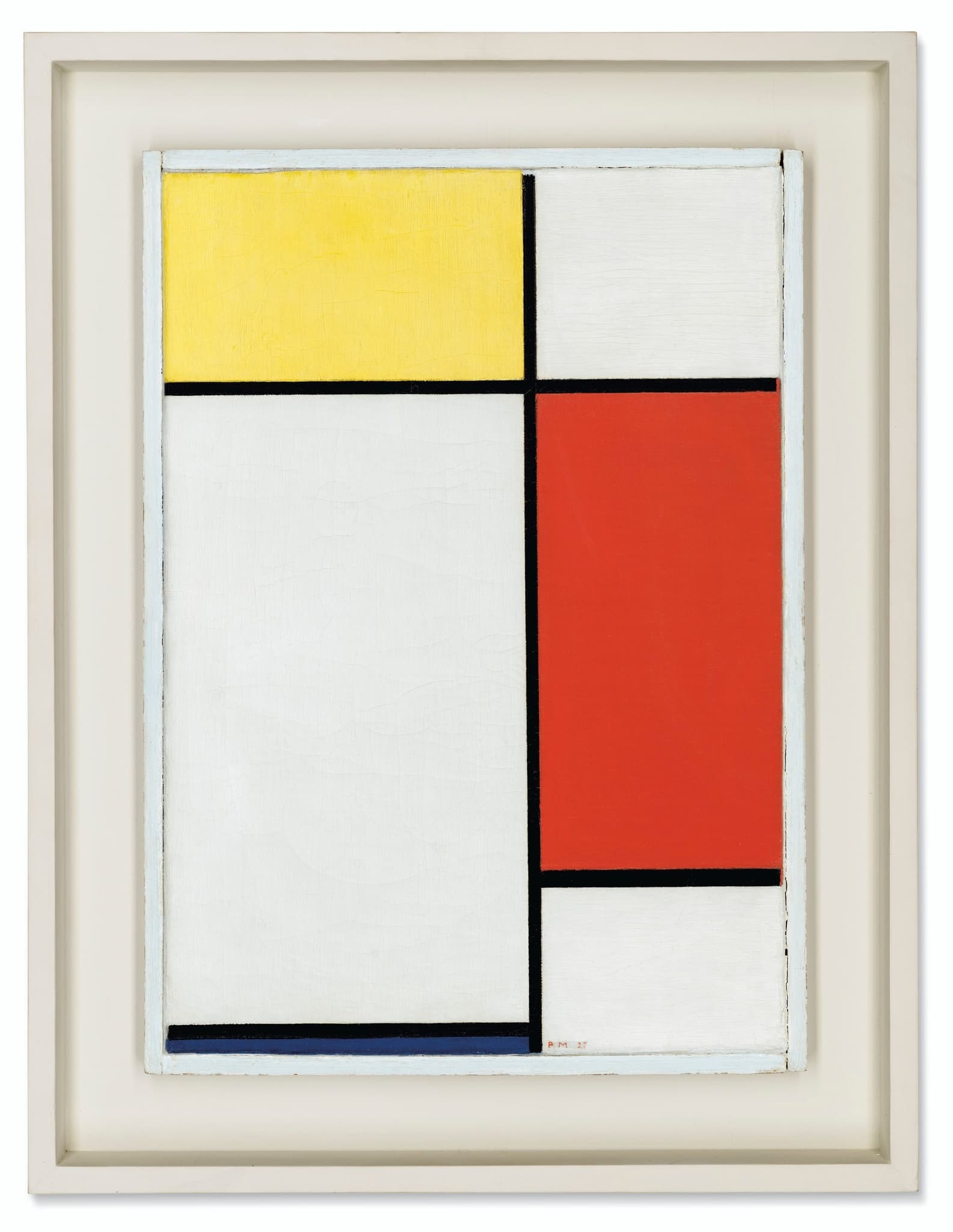
Composition: No. II, with Yellow, Red and Blue
Piet Mondrian, 1930 • Oil on canvas
View more by Piet Mondrian →Valuation Analysis
Overview and anchor: Composition: No. II, With Yellow, Red and Blue (Piet Mondrian) realized $26,122,500 at Christie’s New York on 13 May 2021 and is published in the Joosten catalogue (B196) — this public sale is the primary market anchor for the exact object and forms the baseline for a present valuation [1]. The painting’s documented provenance and catalogue entry materially strengthen marketability and reduce attribution risk.
Market context and comparable evidence: Post‑2021 auction evidence shows sustained, selective demand for prime Neo‑Plastic canvases: Sotheby’s November 2022 record for a 1930 Composition (~$51M) and Christie’s high‑profile Riggio offering in 2025 (~$47.6M) demonstrate strong top‑end appetite for canonical works [2][3]. Those top results raise the ceiling for the category but do not alter the relative pricing hierarchy: size, uniqueness of composition, exhibition/publication history and condition remain decisive. Smaller studio works and studies, even when well‑provenanced, trade significantly below the largest museum‑quality canvases.
How the range was derived: Using a comparable‑analysis approach, I anchored to the 2021 realization for this exact painting, adjusted for market movement into mid‑2025 (the 2021 sale equates roughly to the low‑$30M arena in real terms), and then applied downward scale and condition discounts appropriate to the work’s modest dimensions (19 3/4 x 14 in) relative to larger canonical grids. The resulting practical trade range is $20M (reflecting conservative sale conditions, condition or session placement discounts) to $35M (fresh to market, premium evening sale placement, strong institutional interest or guarantee).
Key value drivers and risks: Positive drivers: catalogue‑raisonné listing, clear provenance and public exhibition history materially support the upper half of the range. Negative drivers: any proven conservation issues (yellow pigments and varnish instability are common concerns with Mondrian’s palettes), gaps in technical records, or sale in a non‑marquee session would push realizations toward the lower bound. Legal/title complications or contested provenance would further depress market value.
Practical guidance: To maximize outcome, present the painting in a marquee evening sale with a robust loan/exhibition narrative and clear technical documentation; consider sale guarantees or private‑sale alternatives to manage market volatility. For a buyer, require a full condition and conservation report and confirmation of catalogue‑raisonné details before committing.
Conclusion: Based on the exact 2021 public sale, subsequent market precedent, and adjustment for scale and condition sensitivity, the recommended current market range is $20.0M–$35.0M. The Christie’s 2021 realization remains the single best concrete data point and the outset for any negotiation or sale strategy [1][2].
Key Valuation Factors
Art Historical Significance
High ImpactThis work is from Mondrian's mature Neo‑Plastic period and uses the canonical primary‑colour vocabulary that defines his market appeal. Although the painting's modest dimensions position it as a studio‑scale work rather than a monumental canonical grid, its execution date (1927), palette, and compositional clarity align it with Mondrian's most collectible phase. A catalogue‑raisonné entry (Joosten B196) and exhibition history elevate scholarly and institutional confidence. Those factors together produce strong intrinsic value: the painting is collectible not only as a decorative object but as a verifiable piece of Mondrian's mature output, which commands sustained demand among museums and blue‑chip collectors.
Provenance & Exhibition History
High ImpactDocumented ownership history and exhibition citations materially increase marketability and reduce transactional risk. Christie’s published provenance for the 2021 sale traces ownership through notable European dealers and private collections and the lot was exhibited historically, which supports institutional interest. Proven provenance shortens marketing timelines and increases the pool of credible buyers (including museums). If additional archival documentation or loan history to major institutions is produced, the painting could command a premium within the estimated range. Conversely, any gaps or unresolved ownership questions would cause meaningful discounts.
Condition & Conservation
High ImpactCondition is a decisive price determinant for Mondrian, particularly where yellow pigments and surface varnish are involved; these are prone to discoloration and retouching. A clean technical report (paint layer integrity, minimal invasive restoration, stable stretcher) supports upper‑range pricing, while significant retouching or unstable pigments require discounts. Full conservation documentation, IRR/X‑ray and pigment analysis reduce buyer uncertainty and materially improve sale prospects. Unknown or poorly documented condition will likely reduce the competitive bidding pool and push the work toward the lower bound of the valuation range.
Comparables & Market Precedent
High ImpactAuction comparables—most importantly the exact 2021 Christie’s sale ($26.12M) and subsequent marquee results in 2022–2025—provide the quantitative foundation for this valuation. Large, canonical 1929–1930 grids realized in the high‑$40M to low‑$50M band, setting the ceiling for the category. This painting’s exact 2021 sale, when adjusted for market movement and scale, places a realistic mid‑market expectation in the $20M–$35M band. Market precedent therefore both supports and bounds the estimate; small size and session placement determine where within that band a future sale would land.
Market Liquidity & Demand
Medium ImpactMondrian is a blue‑chip name with concentrated buyer interest; however, liquidity varies by scale and rarity. Museum‑quality large grids are scarce and attract global bidding, while smaller studio works have a narrower but still deep pool of specialist collectors and institutions. Market liquidity is sufficient for a well‑marketed evening‑sale lot or a discrete private sale, but results can vary widely by sale timing, marketing and guarantee arrangements. Seller strategy (evening sale + loan narrative vs. minor auction session) will therefore significantly influence realized price within the given range.
Sale History
Christie's New York
Piet Mondrian's Market
Piet Mondrian is firmly blue‑chip in the Modern art market. His mature Neo‑Plastic works are scarce and highly sought by major museums and elite private collectors. Auction records in recent years (notably a Sotheby’s 2022 Composition at roughly $51M and Christie’s marquee results in 2015–2025) demonstrate that the top tier of Mondrian’s output commands high‑eight to low‑nine‑figure sums. Market interest centers on canonical 1929–1932 grid compositions, but well‑provenanced smaller works also achieve significant multi‑million results. Overall, Mondrian’s market is deep for the best examples and selectively liquid for studio‑scale works.
Comparable Sales
Composition: No. II, With Yellow, Red and Blue
Piet Mondrian
Exact same object — identical title, date, dimensions and published provenance; the single best market anchor for valuation.
$26.1M
2021, Christie's New York
~$31.1M adjusted
Composition III
Piet Mondrian
Same artist and mature Neo‑Plastic period; marquee evening‑sale result (May 2015) that represents a top‑end market ceiling for prime Mondrian grids.
$50.6M
2015, Christie's (evening sale)
~$68.8M adjusted
Composition No. II
Piet Mondrian
Artist auction record (Nov 2022) for a canonical 1930 grid — indicates peak demand and pricing for top‑tier works in the 2019–2025 market cycle.
$51.0M
2022, Sotheby's (Modern Evening Sale)
~$55.4M adjusted
Composition with Large Red Plane, Bluish Gray, Yellow, Black and Blue
Piet Mondrian
Large, museum‑quality Neo‑Plastic canvas sold May 2025 — shows sustained top‑end demand in 2025 and benchmarking for prime Mondrian material that is more substantial than small studies.
$47.6M
2025, Christie's New York (Riggio single‑owner sale)
Composition (with Red and Blue)
Piet Mondrian
A mid‑2025/late‑2025 auction example of a Mondrian that realized in the low‑$20M band — useful as a lower‑tier market comparator for smaller/less‑canonical works.
$23.1M
2025, Christie's New York
Current Market Trends
Since 2022 the market for prime Mondrian grids has been resilient: a 2022 auction record set a high watermark, 2023–2024 saw selective cooling, and 2025 produced renewed interest in marquee lots. Collectors are increasingly selective; supply scarcity of museum‑quality canvases sustains high ceilings, while mid‑tier lots face more price discipline. Guarantees and curated single‑owner presentations now commonly shape high‑end outcomes.