Most Expensive Piet Mondrian Paintings
Piet Mondrian occupies a singular position in the art market: his pared-down grids and primary colors have become synonymous with modernist purity and remain intensely collectible for museums and private collectors alike. At the pinnacle sits Broadway Boogie Woogie, valued at an estimated $150–200 million, followed by the near-legendary Victory Boogie Woogie at $100–150 million—both canvases embody Mondrian’s late, jazz-influenced mastery and command top-tier prices. Earlier landmark works such as Composition with Red, Blue and Yellow (about $60–90 million) and Composition No. III, with Red, Blue, Yellow, and Black ($45–60 million) underline how provenance, exhibition history and their canonical status boost market standing. Even mid-range pieces—Picture No. III ($30–60 million), Composition No. IV ($30–55 million) and Composition with Large Red Plane, Bluish Gray, Yellow, Black and Blue ($42–55 million)—attract fierce bidding, while restrained works like Composition with Yellow and Blue still fetch $8–25 million. Collectibility hinges on rarity, condition, and the works’ role in the evolution of De Stijl, making Mondrian both a cornerstone of modernist collections and a perennial driver of high-end auction results.
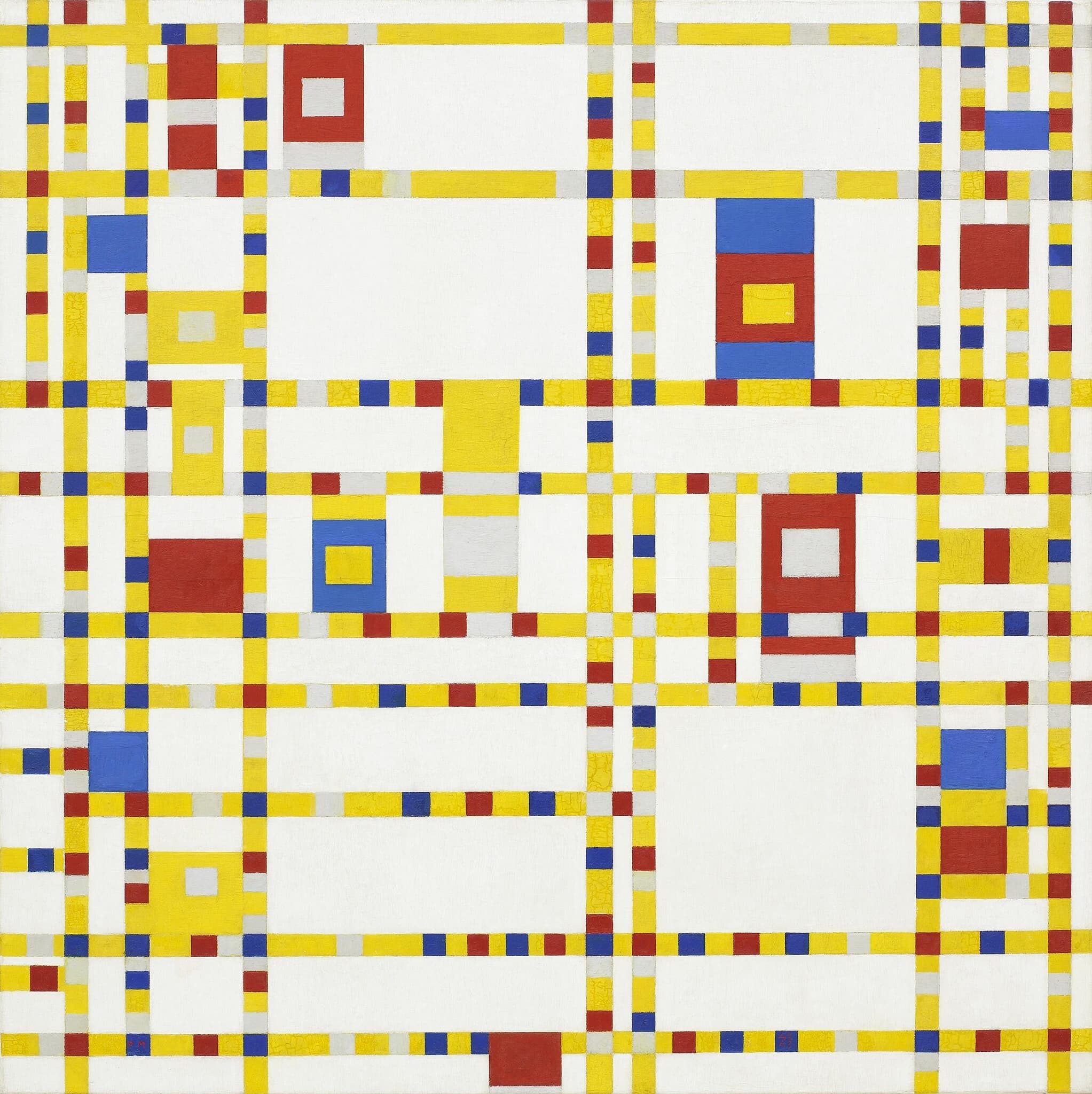
$150-200 million
Estimated at $150–200M, Broadway Boogie Woogie would far exceed Mondrian’s $51M auction record, reflecting its canonical status and extreme market scarcity.
$100-150 million
Valued $100–150M as Mondrian’s final major work, Victory Boogie Woogie’s range is anchored to top Mondrian auction results and its documented private/institutional history.
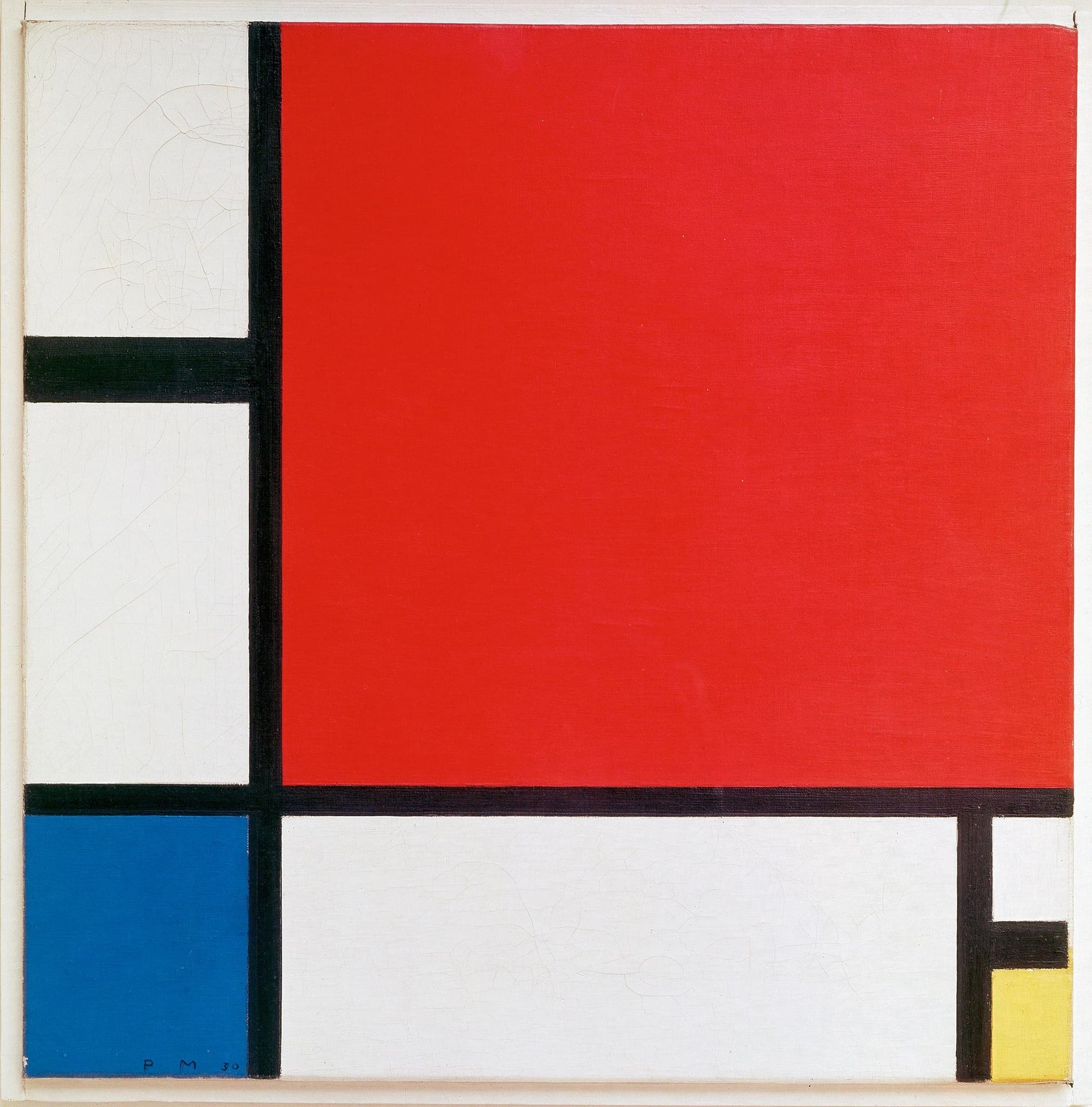
$60-90 million
Kunsthaus Zürich’s 1930 grid is estimated $60–90M, anchored to a 2022 $51M comparable sale and uplifted for museum‑grade provenance and desirability.

$55-85 million
Hypothetical open‑market value for Piet Mondrian’s Lozenge Composition with Two Lines (1931) is $55–85 million.
$30-60 million
Anchored to the verified 1986 Sotheby’s sale of B282 and recent Mondrian benchmarks, a well‑provenanced 1938 Picture No. III would likely fetch $30–60M today.
$45-60 million
This identical canvas (Joosten B213) sold at Christie’s New York for $50,565,000 on 14 May 2015; current market range is about $45–60M.
$30-55 million
Catalogue‑listed 1929 Mondrian (Stedelijk inv. A 9916; B216) is estimated $30–55M if offered, adjusted for scale and museum provenance.

$42-55 million
Realized $47,560,000 at Christie’s New York on 12 May 2025; current market estimate for Joosten B144 is $42–55M assuming unchanged provenance and condition.
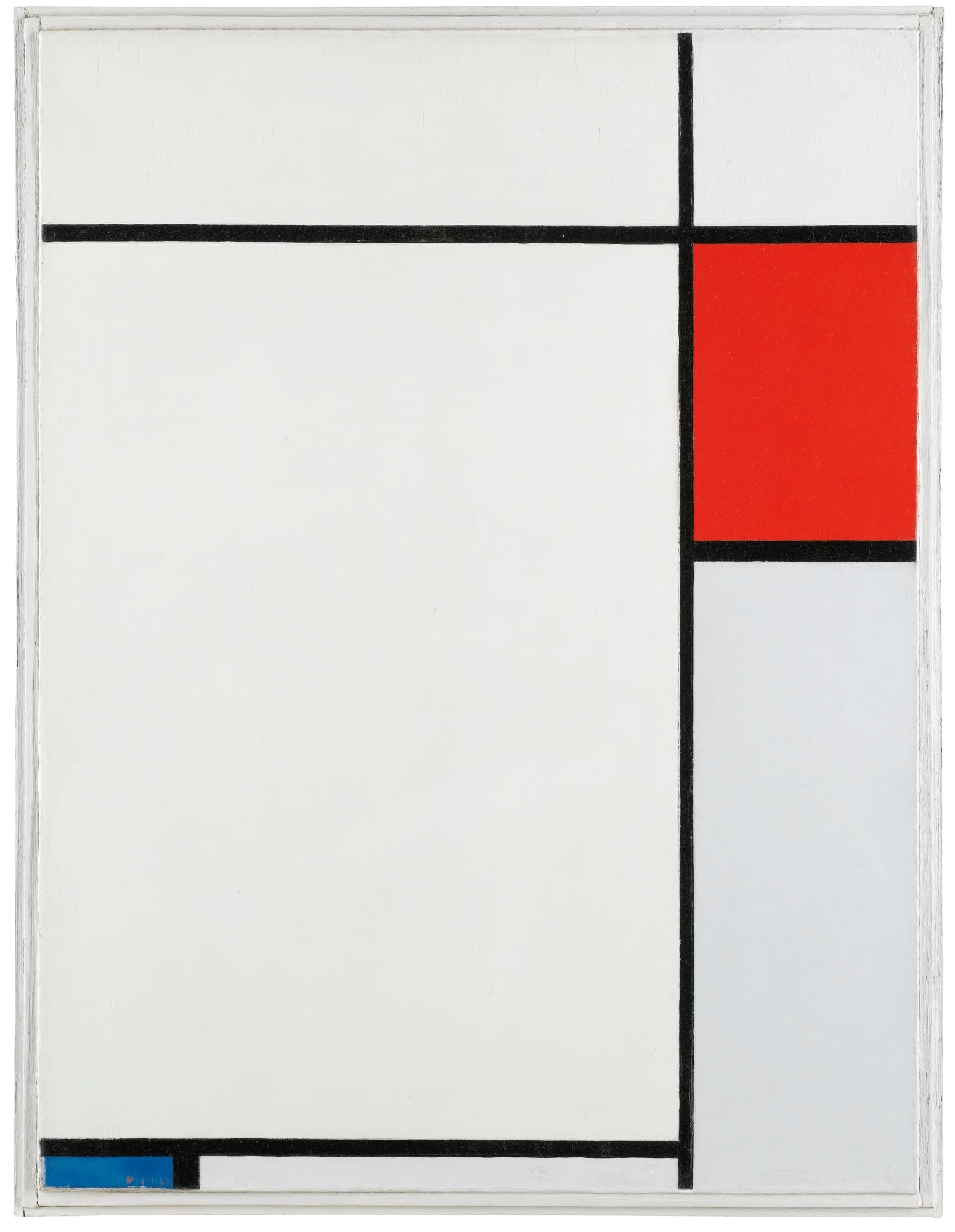
$30-50 million
Anchored to Sotheby’s 23 June 2014 sale (£15,202,500 ≈ $25.9M), a comparable 1927 Neoplastic canvas is currently estimated at $30–50M.
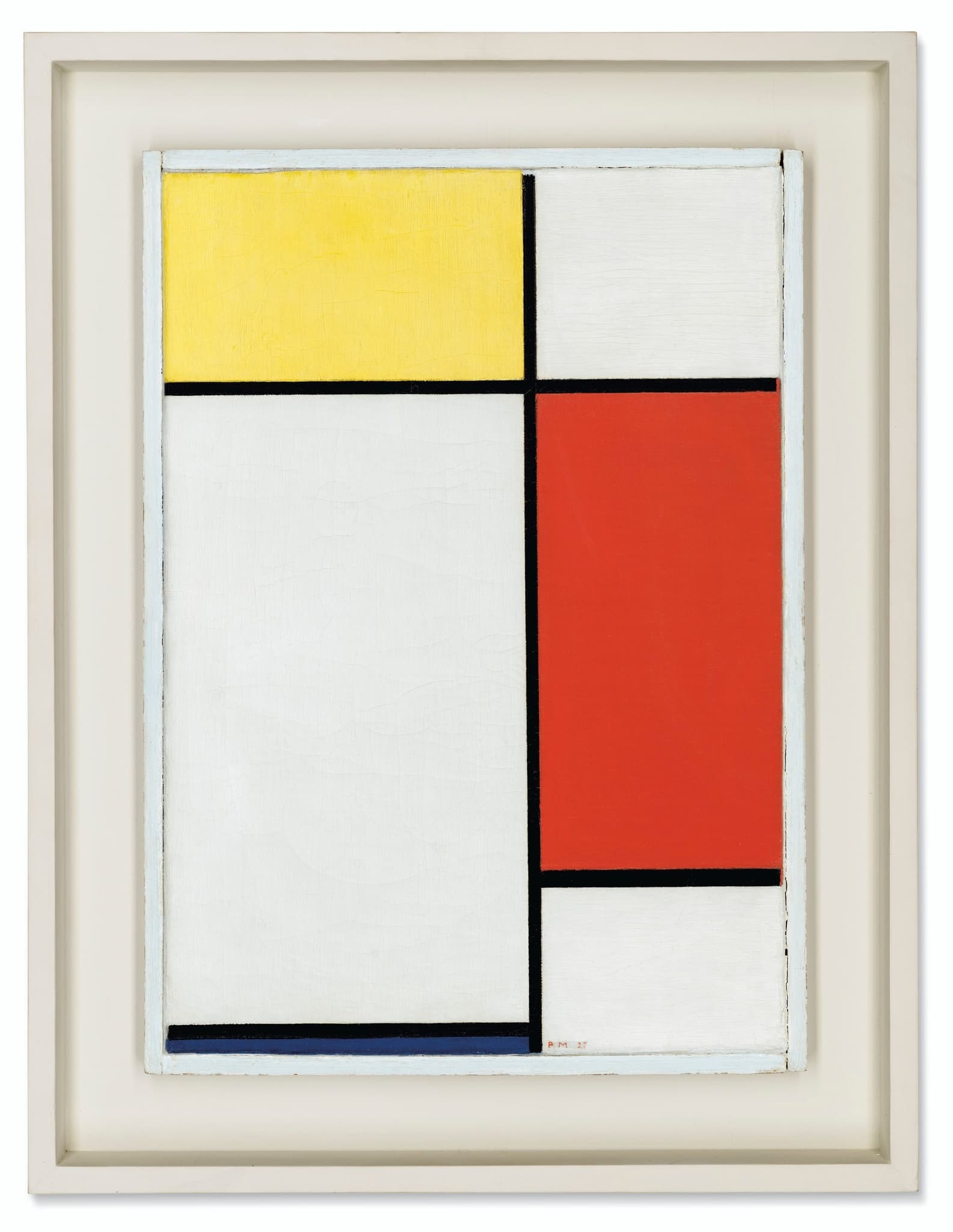
$20-35 million
Documented Christie’s New York sale of $26,122,500 (13 May 2021) anchors a present market range of $20–35M for this small, catalogue‑listed composition.
$8-25 million
This small 1932 Mondrian, purchased from the artist by A. E. Gallatin and bequeathed to the Philadelphia Museum of Art, is estimated at $8–25M.
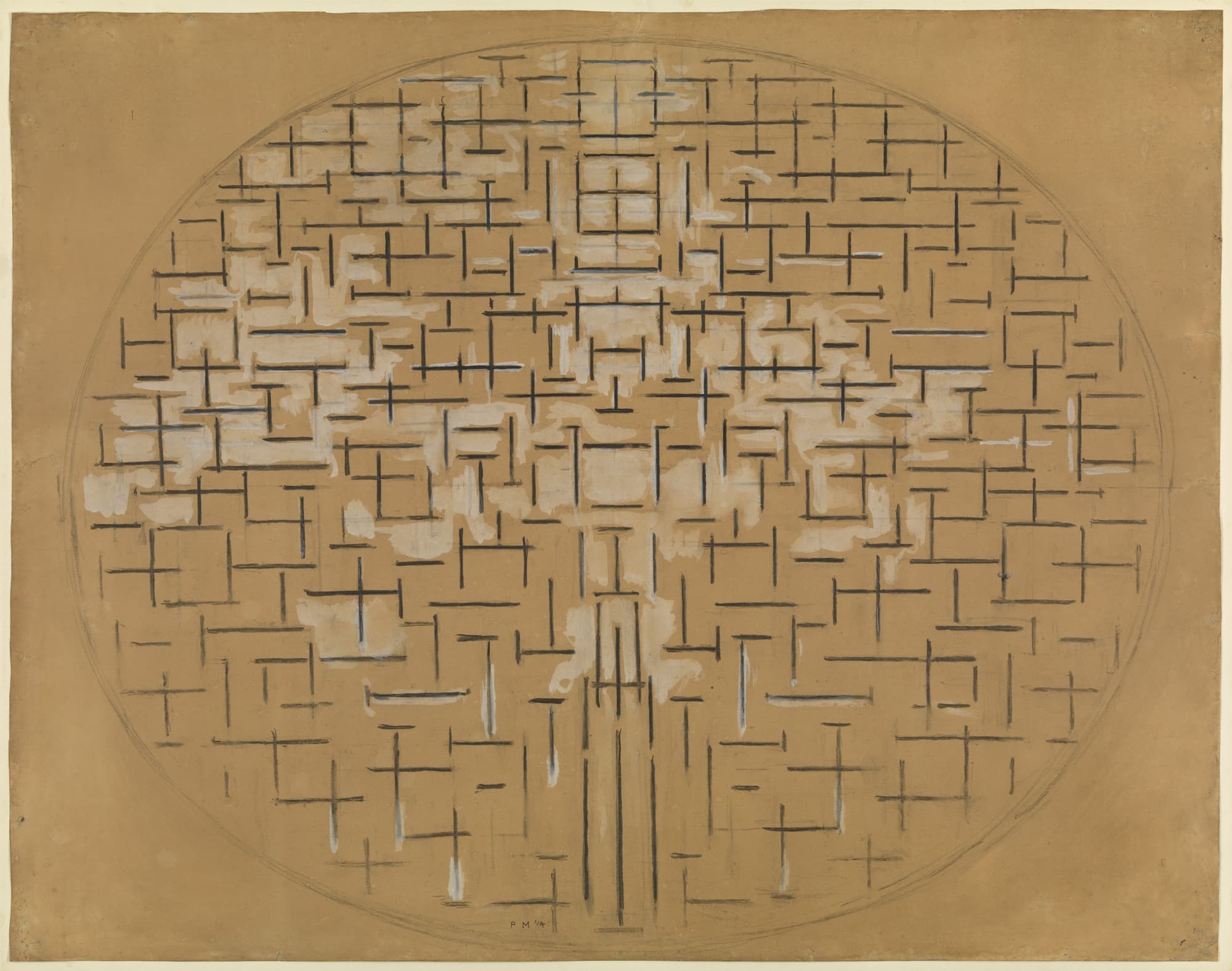
$5-7.5 million
Based on directly comparable results for top-tier Mondrian drawings from the 1914–15 ‘sea/plus-minus’ period, a credible current auction value for a work equivalent to Pier and Ocean 5 is $5–7.
What Drives Value in Piet Mondrian's Work
Canonical period & dating (late‑1929–1932 Neoplastic grids)
Mondrian’s market is highly period‑specific: prime late‑1929–1932 Neoplastic grids are the most prized category. Works like the 1930 Composition with Red, Blue and Yellow (Kunsthaus Zürich) or the 1929 Composition No. III type consistently anchor headline prices (public comparables include the c.$51M Sotheby’s 2022 result and the $50.565M Christie’s 2015 sale). A confirmed 1929–1932 date materially elevates demand relative to earlier/later or transitional pieces.
Boogie Woogie / late New York ‘terminal’ works carry an icon premium
Mondrian’s New York late works — Broadway Boogie Woogie and Victory Boogie Woogie — behave differently from his European grids: they are culturally iconic and attract trophy buyers beyond traditional collectors. Broadway’s MoMA status and Victory’s ‘last masterpiece’ status produce supra‑comparables pricing dynamics, where institutional visibility and cultural resonance can push theoretical valuations well above standard auction ceilings despite limited public sale history.
Format & scale: large square canons vs small studio works; lozenge premium
Within Mondrian’s oeuvre, size and format drive steep price differentials. Large, museum‑scale square grids achieve top market ceilings; small studio canvases (e.g., Composition No. IV at ~52×51 cm) trade materially lower even when period‑correct. Uncommon formats — notably lozenge/diamond works (Picture No. III) — often command a measurable premium above same‑period small rectilinear studies because format rarity and visual impact intensify institutional and collector demand.
Provenance, RA entry and museum ownership — supply and liquidity effects
Mondrian prices are acutely sensitive to provenance specifics: catalogue‑raisonné entries, artist dedications (Kunsthaus Zürich’s Roth dedication) and long museum ownership (MoMA, PMA, Stedelijk, Kunstmuseum Den Haag) both raise confidence and tighten available supply. Strong institutional provenance boosts bids; conversely, national ownership or state‑held masterpieces (Victory Boogie Woogie) constrains liquidity and can make theoretical values unrealizable, altering achievable pricing dynamics.
Market Context
Piet Mondrian is a blue‑chip Modern master whose scarce, museum‑quality De Stijl canvases command persistent top‑end demand: the auction record stands at roughly US$51M (Sotheby’s, 2022) and a major early‑1920s Composition realized $47.56M in 2025, underlining sustained depth for A‑grade works. Mature late‑1920s/1930s grids with strong palette and provenance regularly trade in the mid‑ to high‑eight figures, while late “Boogie Woogie” works remain effectively off‑market—Victory Boogie Woogie was acquired by the Dutch State in the late 1990s. Institutions and trophy collectors drive competition, often mediated by guarantees, private sale channels and underwriting, so outcomes depend heavily on timing, provenance and sale mechanics. Overall trajectory: selective resilience at the apex, with marquee masterpieces continuing to attract global, risk‑managed bidding.