How Much Is Composition with Red, Blue and Grey Worth?
Last updated: April 18, 2026
Quick Facts
- Last Sale
- $25.9M (2014, Sotheby's London)
- Methodology
- comparable analysis
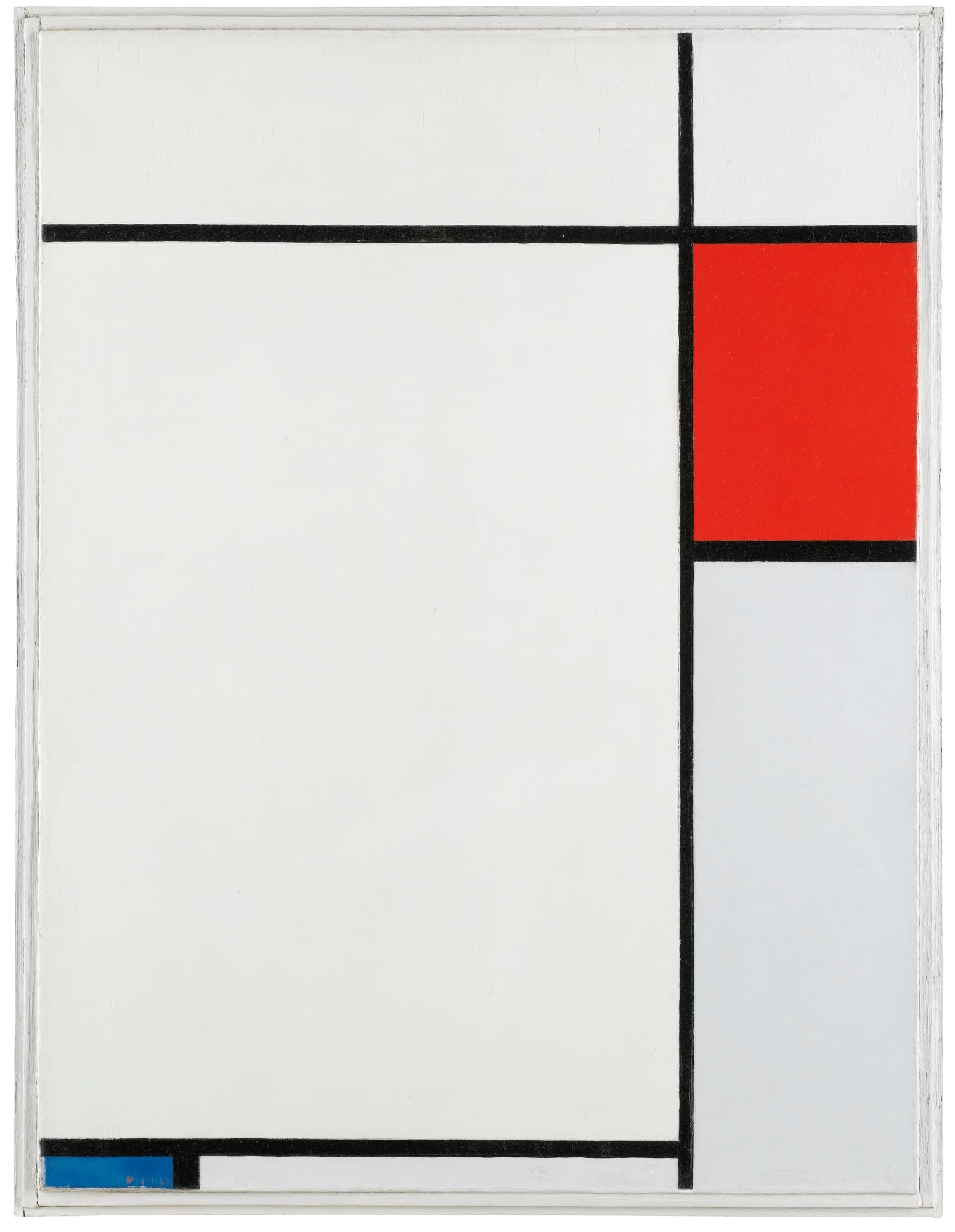
Anchored to the confirmed Sotheby’s sale of Composition with Red, Blue and Grey (23 June 2014) — realized £15,202,500 (≈ USD $25.9M) — and set against later high‑end Mondrian results, the realistic market range today for this authenticated, well‑provenanced 1927 Neoplastic canvas of comparable scale and condition is approximately $30–$50M. Final price will pivot on condition, precise dimensions/format, catalogue‑raisonné status and sale route (evening sale or single‑owner offering).
Valuation Analysis
Valuation conclusion: Using published auction comparables and the confirmed 2014 Sotheby’s result as the primary market datum, I estimate a market range of $30,000,000–$50,000,000 for Piet Mondrian’s Composition with Red, Blue and Grey (1927) when the work is authenticated, in good condition, and accompanied by the provenance and exhibition history published with the Sotheby’s lot [1].
Anchor and comparables: The anchor is the Sotheby’s London evening‑sale result (23 June 2014) for the exact painting (price realized £15,202,500 ≈ USD $25.9M), which the house catalogued with catalogue‑raisonné and exhibition references; that sale is the single best direct market datum for this object and establishes a firm baseline [1]. Top‑end market evidence from closely related, canonical late‑1920s/1930 Mondrians — notably the Christie’s May 2015 Composition No. III (realized ≈ USD $50.565M) and Sotheby’s record 2022 sale (≈ USD $51M) — demonstrates that museum‑quality, larger or more historically pivotal canvases can trade substantially higher [2][3]. More recent single‑owner offerings (e.g., Christie’s Riggio sale, May 2025) continue to show demand in the mid‑to‑high tens of millions for prime Neoplastic canvases [4].
How the range was derived: I begin with the 2014 realized price as the primary datum and account for two effects: (A) time‑value adjustments and general positive repricing for premium Mondrians since 2014, and (B) the observed dispersion between smaller/mid‑scale studio canvases and larger, canonical museum pieces. Inflation‑ and market‑adjusting the 2014 result produces an approximate mid‑30s million USD reference point; the low end of my range ($30M) reflects a conservative market re‑pricing for a small/medium 1927 composition in the current market, while the high end ($50M) represents an outcome where the work (1) benefits from superior condition, (2) is offered in a prime evening sale or single‑owner context that generates institutional interest, and (3) faces active competition from trophy buyers [1][2][3].
Key sensitivities & next steps: The single greatest determinants that would push the estimate up or down are condition and any restoration history, confirmed catalogue‑raisonné/authentication status, depth and clarity of provenance and exhibition history, and the chosen sales route (evening sale with guarantees vs. timed or private sale). Recommended next steps to firm value: obtain a formal condition report and technical imaging (X‑ray, IRR, pigment analysis); confirm catalogue‑raisonné entry and loan/exhibition records; request provenance documentation and ownership/title checks; and solicit formal pre‑sale estimates or guarantees from major houses. With those items verified, this preliminary range can be narrowed to a firm pre‑sale estimate or a guaranteed offer.
Confidence statement: This is a reasoned market estimate based on published auction outcomes and observable market movement through 2025. It is not a replacement for a physical inspection, authentication report, and formal auction house underwriting, all of which materially affect realized price.
Key Valuation Factors
Art Historical Significance
High ImpactThis work dates to Mondrian's mature Neoplastic period (1927), a phase that produced his most sought‑after grid paintings. Its inclusion in authoritative scholarship (catalogue raisonné entry in Joop M. Joosten & Robert P. Welsh, vol. II, no. B195 per the Sotheby’s lot) elevates its academic and curatorial importance. Works from this period that are also linked to landmark exhibitions and scholarship command premiums because museums compete for representative examples of the artist’s canonical vocabulary. Scarcity of comparable museum‑quality canvases further magnifies the significance of any authenticated, well‑provenanced 1920s Mondrian.
Provenance & Exhibition History
High ImpactThe painting’s provenance as published with the Sotheby’s lot (artist's estate → Harry Holtzman → Sidney Janis Gallery → Galerie Beyeler → private family) and documented loans to major retrospectives (Guggenheim 1971; Centre Pompidou 2010–11) materially increase buyer confidence and marketability. Strong, continuous provenance and exhibition citations reduce ownership risk and appeal to institutional buyers, often converting a competent estimate into a competitive mid‑to‑high‑millions sale. Lack of such documentation would materially depress value.
Condition & Physical Characteristics
Medium ImpactScale and condition materially affect pricing for Mondrian: the painting is a small/medium canvas (c. 66 × 50 cm as catalogued), which typically sells below the largest canonical canvases. Sotheby’s condition notes (lining, restretching or conservation history) must be reviewed; visible retouching, unstable ground layers, or intrusive restorations will reduce buyer competition and price. Conversely, excellent surface integrity, minimal intervention, and recent conservation documentation will preserve or enhance value.
Authenticity & Catalogue Raisonné Status
High ImpactAn entry in the standard catalogue raisonné and acceptance by recognized Mondrian specialists is critical to convert theoretical market value into actual sale realizations. Technical authentication (pigment analysis, canvas weave matching, IR/X‑ray) and specialist sign‑off reduce attribution risk and are often prerequisites for evening‑sale consignments and museum purchases. Any unresolved attribution questions or missing RA documentation will materially lower achievable prices.
Market Liquidity & Comparables
Medium ImpactMondrian is a blue‑chip artist but market outcomes vary by route and freshness. Recent high results (2015, 2022, 2025) show that top canvases still clear very high prices, while the >$10M segment has seen selective cooling and increased emphasis on guarantees and single‑owner sales. For a mid‑scale 1927 work with the Sotheby’s provenance and RA citation, liquidity is strong among institutions and major private collectors, but the final price depends on auction setup, competitive interest and macro market appetite at time of sale.
Sale History
Sotheby's London, Impressionist & Modern Evening Sale, Lot 14
Christie's New York (Evening Sale)
Sotheby's New York
Christie's New York (Leonard & Louise Riggio collection)
Piet Mondrian's Market
Piet Mondrian occupies blue‑chip status in the Modern market. His mature Neoplastic canvases are held in major international museums, making fresh market appearances relatively rare and highly contested. Top results (mid‑tens to low‑50s of millions USD) have been established in the last decade for canonical works; smaller studies and less documented pieces sell at lower, but still substantial, levels. Institutional demand, scarcity of museum‑quality examples in private hands, and high collector recognition underpin persistent high valuations for quality Mondrians.
Comparable Sales
Composition with Red, Blue and Grey
Piet Mondrian
Exact same painting — primary market datum with published provenance, catalogue‑raisonné reference and exhibition history (Sotheby's lot 23‑Jun‑2014).
$25.9M
2014, Sotheby's London
~$35.9M adjusted
Composition No. III, with Red, Blue, Yellow and Black
Piet Mondrian
Large, mature‑period grid (1929) that realized a top result in 2015 — useful to size the premium for museum‑quality, iconic late‑1920s works versus smaller examples.
$50.6M
2015, Christie's New York
~$68.0M adjusted
Composition No. II
Piet Mondrian
1930 mature grid that set a recent auction record (Nov 2022) — demonstrates the contemporary top of market for canonical Mondrians and the impact of rarity/quality.
$51.0M
2022, Sotheby's New York
~$55.7M adjusted
Composition with Large Red Plane, Bluish Gray, Yellow, Black and Blue
Piet Mondrian
Recent single‑owner sale (Riggio collection) achieving a top‑tier 2025 price — shows ongoing demand at the high end and the premium attached to prominent single‑owner offerings.
$47.6M
2025, Christie's New York (Leonard & Louise Riggio sale)
Composition avec bleu, rouge, jaune et noir
Piet Mondrian
High‑profile 2009 sale from the YSL/Bergé collection — useful for understanding the effect of marquee single‑owner/charity sales and demand for early‑1920s works.
$27.6M
2009, Christie's Paris (Yves Saint Laurent / Pierre Bergé sale)
~$44.3M adjusted
Current Market Trends
Since the 2022 auction record, the very top end of the market has shown selective cooling (2024–2025), but premier examples and marquee single‑owner offerings continue to produce strong results. Buyers are more route‑sensitive and prize clear provenance, catalogue‑raisonné status, and conservative condition. Guarantees and targeted private placements have become common tools to manage sale risk and secure top prices.
Sources
- Sotheby's — Impressionist & Modern Evening Sale: Composition with Red, Blue and Grey (lot 14), 23 June 2014 (catalogue lot page)
- Christie's press release / sale report — Composition No. III (1929), New York, 14 May 2015 (price realized USD $50,565,000)
- Observer — A Piet Mondrian Painting Sold for a Record‑Breaking $51 Million at Auction (Sotheby's New York, 14 Nov 2022)
- Christie's press — Leonard & Louise Riggio: Collected Works and 20th Century Evening Sale (May 2025) — Mondrian result (USD $47,560,000)