How Much Is Temptations of Christ (Sistine Chapel) Worth?
Last updated: July 3, 2026
Quick Facts
- Methodology
- extrapolation
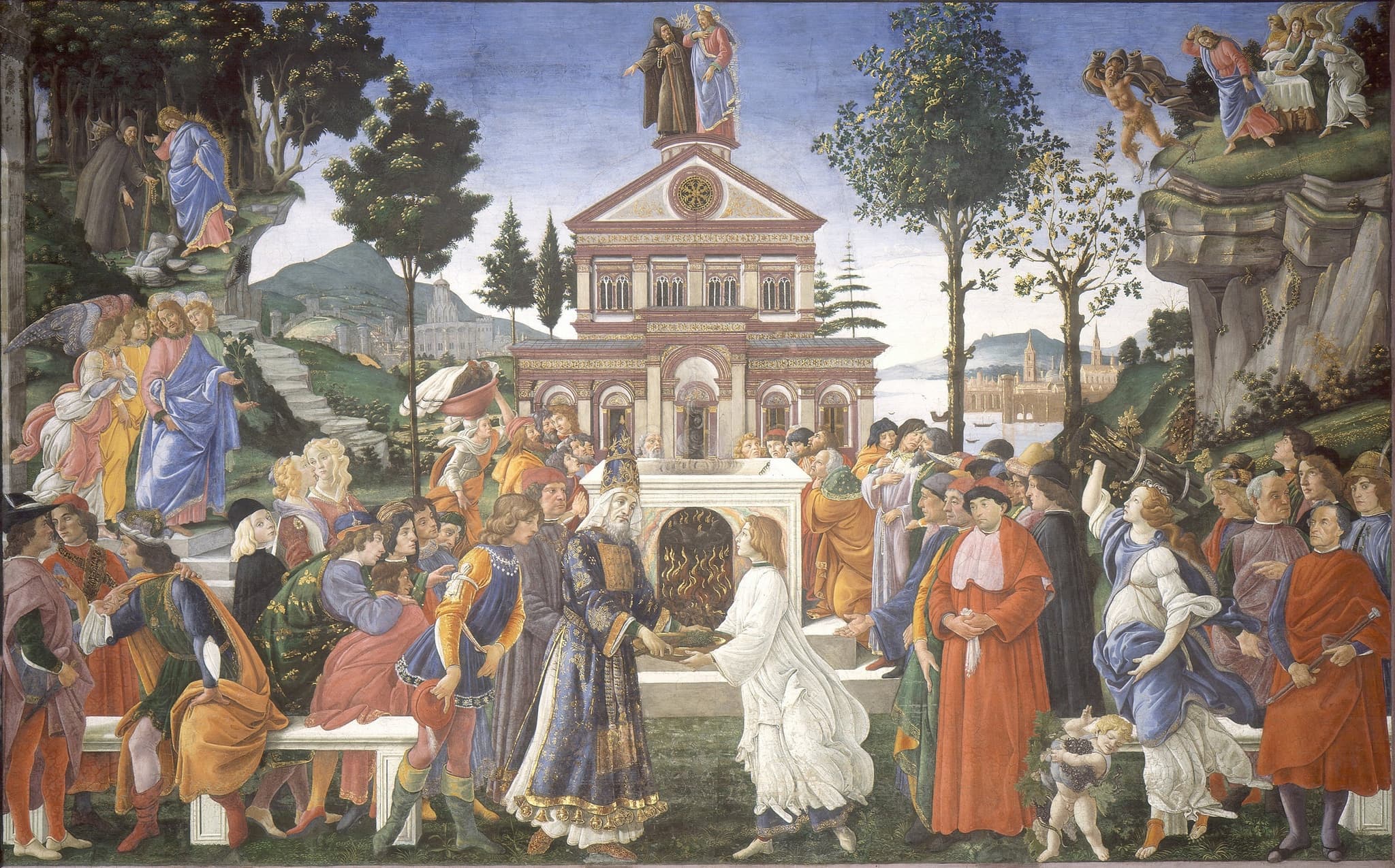
Botticelli’s Temptations of Christ is an in-situ Vatican fresco that has never been on the market; any price is necessarily hypothetical. Anchoring to Botticelli’s modern auction ceiling ($92.2m for the Roundel portrait) and applying a premium for the fresco’s papal commission and Sistine Chapel context—tempered by workshop participation and the fresco medium—we estimate a hypothetical fair-market range of $150–300 million. This reflects a sale scenario assuming the work were freely transferable.
Valuation Analysis
What is being valued and why it matters. Sandro Botticelli’s Temptations of Christ (c. 1481–82) forms part of the original wall cycle on the north side of the Sistine Chapel, executed for Pope Sixtus IV alongside works by Perugino and Ghirlandaio. It is a monumental, site-specific fresco owned by the Vatican Museums and has never been offered for sale; the object is legally and physically immovable in ordinary circumstances [1].
Method and market anchors. With no direct sale history for Botticelli frescoes, valuation must extrapolate from the artist’s panel-painting market. The modern benchmark is Botticelli’s Portrait of a Young Man Holding a Roundel, which realized $92.2 million at Sotheby’s New York in 2021, setting the artist’s record and one of the highest Old Master prices of the era [2]. His The Man of Sorrows made $45.4 million in 2022, confirming depth for sacred subjects at the top end [3]. More recently, a high-quality devotional panel, The Virgin and Child enthroned, sold for £9.96 million (c. $12.7m) in London (2024), illustrating current pricing for significant but less rarefied material [5].
Adjustments and resulting range. Relative to these comparables, the Sistine Chapel fresco commands a substantial qualitative premium for its royal-papal commission, scale, and centrality to Renaissance Rome. Countervailing forces include likely workshop participation and the fresco medium’s extremely low portability and liquidity. Balancing these factors, and assuming a hypothetical scenario in which the composition were freely transferable (e.g., if it existed as a museum-quality movable work), a fair-market estimate clusters around a 1.5x–3.0x multiple of the 2021 record, yielding $150–300 million. This captures both trophy scarcity and the Sistine Chapel prestige premium while recognizing market friction that would arise from authorship sharing and the complexities associated with frescoes.
Positioning in today’s market. The Old Masters sector rebounded after a lean 2024, with 2025 showing renewed growth and continued preference for canonical names and fresh, museum-caliber works. Within this two-speed environment, blue-chip Renaissance masterpieces continue to attract global bidders, and scarcity is acute for Botticelli at the top tier [4]. Our estimate situates the fresco at a rational premium to the artist’s panel record, consistent with its cultural weight and irreplaceability in art-historical terms, yet disciplined by practical considerations that seasoned buyers apply to attribution and medium.
Key Valuation Factors
Art Historical Significance
High ImpactCommissioned for Pope Sixtus IV and executed for the Sistine Chapel’s original wall program, the fresco sits at the intersection of Florentine mastery and Roman papal iconography. It narrates key Gospel episodes and is integral to one of the most important sacred interiors in Western art. While Botticelli’s Florentine panels (e.g., Primavera, Birth of Venus) are more publicly iconic, this fresco is a cornerstone of his Roman period and a primary document of quattrocento fresco practice. That institutional stature, rarity, and the work’s contribution to a unified narrative cycle all create a strong value premium in any hypothetical market setting, placing it among the artist’s most historically resonant achievements.
Authorship and Workshop Participation
Medium ImpactScholars generally accept that Botticelli led the design and execution with the aid of his workshop. In valuation, the presence of assistants typically moderates price relative to fully autograph panels of equivalent quality. Here, however, the net effect is nuanced: Botticelli’s authorship of design, compositional invention, and key passages remains critical. For a site-defining commission of this magnitude, workshop assistance was standard practice and does not materially diminish the fresco’s cultural gravity. We therefore apply a measured discount relative to wholly autograph masterworks, while preserving a substantial premium for Botticelli’s creative leadership and the fresco’s prestige context.
Medium and Transferability
High ImpactAs a fresco embedded in the Sistine Chapel’s masonry, the work is effectively immovable and non-marketable. Even in a hypothetical scenario allowing transfer, fresco detachment (stacco/strappo) introduces major conservation risk, display constraints, and market friction compared with portable panels. Collectors and institutions price liquidity and condition risk, which compresses valuations for wall paintings relative to equally important movable works. Our range reflects this reality: the fresco’s unique stature commands an exceptional premium, but the medium’s low liquidity, technical fragility, and display limitations necessitate a conservative tempering of price expectations in any theoretical sale framework.
Market Comparables and Demand
Medium ImpactBotticelli’s modern market is thin but demonstrably deep at the top end. The $92.2m Roundel portrait (2021) set a durable ceiling; The Man of Sorrows at $45.4m (2022) confirmed appetite for devotional subjects; and a strong 2024 London panel at c. $12.7m indicates continued engagement across quality tiers. Applying a reasoned premium for a papal-Sistine subject, while discounting for workshop input and fresco illiquidity, yields a disciplined $150–300m band above the panel record. This aligns with today’s “masterpiece economy,” where scarcity, condition, and canonical authorship are paramount, and where the rarest Renaissance trophies still command global competition.
Sale History
Temptations of Christ (Sistine Chapel) has never been sold at public auction.
Sandro Botticelli's Market
Sandro Botticelli’s market is exceptionally strong yet chronically supply-constrained. The artist’s auction record stands at $92.2 million for Portrait of a Young Man Holding a Roundel (Sotheby’s New York, 2021), one of the highest Old Master prices achieved in the modern era. A year later, The Man of Sorrows realized $45.4 million, underscoring robust demand for autograph sacred subjects. Recent sales in London have confirmed steady interest for high-quality devotional panels in the low-to-mid eight figures, while studio and circle works trade materially lower. Collectors prize early, autograph works with rigorous provenance and scholarship, and fresh-to-market material can catalyze intense international bidding.
Comparable Sales
Portrait of a Young Man Holding a Roundel
Sandro Botticelli
Same artist; fully autograph, museum‑caliber panel from Botticelli’s prime; sets the modern market ceiling for the artist and anchors nine‑figure potential for top‑tier Botticelli. Medium differs (panel vs. fresco), but quality and autograph status make it the key market benchmark.
$92.2M
2021, Sotheby’s New York
~$108.8M adjusted
The Man of Sorrows
Sandro Botticelli
Same artist; autograph and iconic Christ subject with strong devotional appeal, indicating depth of demand for sacred imagery by Botticelli. Useful subject‑matter proxy for a biblical narrative, though a small panel rather than a monumental fresco.
$45.4M
2022, Sotheby’s New York
~$50.0M adjusted
The Virgin and Child enthroned
Sandro Botticelli
Same artist; religious panel painting with recent, well‑publicized sale (and UK export bar context). Demonstrates current pricing for high‑quality devotional works. Smaller scale and portability make it less directly comparable to a site‑specific fresco, but still a relevant market datapoint.
$12.7M
2024, Sotheby’s London
~$13.0M adjusted
The Virgin and Child, with a landscape beyond (Botticelli and Studio)
Sandro Botticelli
Same artist circle; demonstrates pricing for Botticelli and Studio religious imagery in today’s market. Useful for bracketing values by authorship/quality tier under the autograph masterpieces.
$4.3M
2024, Sotheby’s London
~$4.5M adjusted
Mystic Marriage of Saint Catherine of Alexandria
Workshop of Sandro Botticelli
Same artist’s workshop; religious subject. Serves as a lower‑bound indicator for workshop material and underscores how strongly the market differentiates autograph masterworks from studio production.
$660K
2025, Sotheby’s New York
Current Market Trends
Old Masters experienced a soft 2024 but rebounded in 2025, with buyers concentrating capital on museum-caliber works by canonical names. The sector remains supply-led and event-driven: record results surface when truly rare, well-preserved masterpieces appear. Within this framework, Italian Renaissance highlights—particularly those with ironclad provenance and institutional visibility—continue to attract deep demand across geographies. Pricing discipline has increased, but the trophy segment remains resilient, supported by global collectors and institutions seeking historically anchored value. Against this backdrop, a Sistine Chapel Botticelli—if transferable—would command a premium over panel-based comparables, reflecting its singular cultural importance and extreme rarity.
Sources
- Vatican Museums: Temptations of Christ (Sistine Chapel, North Wall)
- Sotheby’s Press: Botticelli Portrait achieves $92.2 million (2021)
- The Art Newspaper: Botticelli’s Man of Sorrows sells for $45.4m (2022)
- Art Basel & UBS Global Art Market Report 2026 – sector trends
- Sotheby’s: Old Masters London 2024 results (incl. Botticelli, Virgin and Child enthroned)