How Much Is Nymphs and Satyr (Les Nymphes et le Satyre) Worth?
Last updated: April 20, 2026
Quick Facts
- Methodology
- comparable analysis
Assuming the work is the canonical 1873 Salon canvas (the Sterling and Francine Clark Art Institute picture), a realistic market estimate if offered today is approximately $3,000,000–$8,000,000. If the object is a later variant, studio replica, study, or a smaller reduction, expect materially lower values (commonly $500,000–$3,000,000).
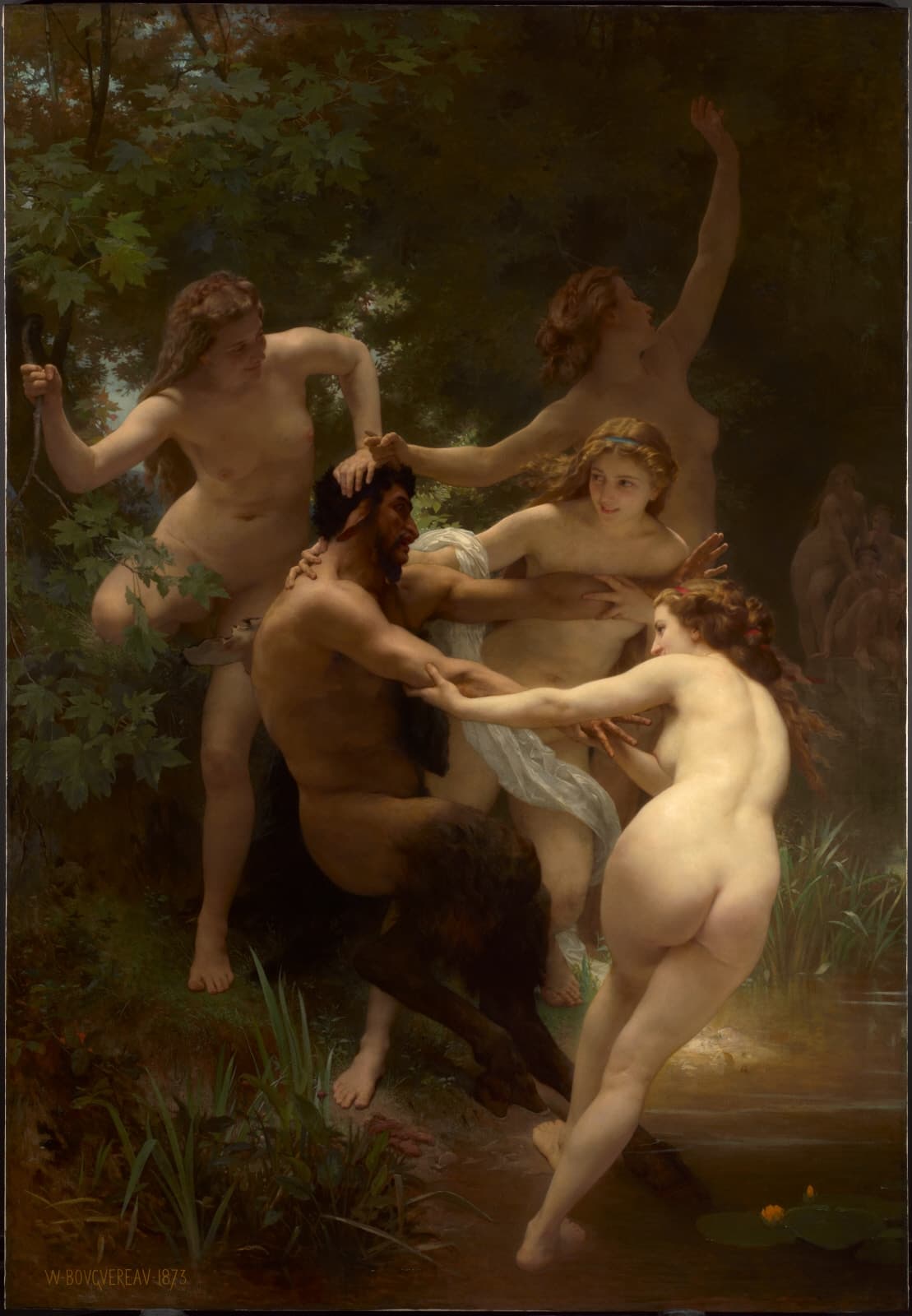
Nymphs and Satyr (Les Nymphes et le Satyre)
William-Adolphe Bouguereau, 1873 • Oil on canvas
View more by William-Adolphe Bouguereau →Valuation Analysis
Scope and headline: This valuation assumes the work under review is the canonical 1873 Salon canvas Les Nymphes et le Satyre, now in the Sterling and Francine Clark Art Institute. Because the Clark painting is in a museum collection and has not appeared on the modern public market, the figures below are hypothetical market values should that specific picture ever be offered for sale. The Clark catalogue entry and provenance support attribution and the painting’s status as a major Bouguereau composition [1].
Comparable benchmark and market context: The clearest public benchmark for museum‑quality Bouguereau canvases is Christie’s 2019 sale of Chansons de printemps, which realized $3,615,000; that lot represents the artist’s modern auction high and hence anchors the public ceiling for comparable, Salon‑scale mythological works [2]. Recent Sotheby’s and house results (2023–2026) have typically seen strong examples realize in the mid‑six to low‑seven‑figure range, highlighting a two‑tier market: a small trophy tier and a broader mid‑market [3]. In the absence of a direct public sale for the Clark picture, these comparables guide a prudent marketed range.
Valuation rationale: Given its scale, finished surface quality, and documented provenance, the Clark canvas would be competitively positioned within the trophy segment if offered. However, museum ownership both elevates scholarly and collector interest and complicates liquidity—deaccessions or private sales often involve legal, ethical, and administrative constraints that can reduce buyer depth or introduce sale conditions. Condition and technical authentication are decisive: an excellent, unrestored surface and unambiguous autograph attribution will push results toward the high side of the band; significant restoration or structural issues will erode value. Sale vehicle matters: a top‑house New York/Paris offering with marketing and a guarantee will achieve materially higher outcomes than a constrained deaccession or regional sale.
Final synthesized estimate and caveats: For the canonical 1873 Les Nymphes et le Satyre (Clark canvas) I set a realistic offered‑for‑sale range of approximately $3,000,000–$8,000,000 (USD). The low end reflects the strongest public comparables and market conservatism; the high end assumes optimal market conditions, a major auction venue or competitive private treaty and intact condition. Private treaty sales can occasionally exceed public records if multiple institutions or deep‑pocketed private buyers compete, but such outcomes are exceptional. If the object you are valuing is a later variant, studio replica, study, or smaller reduction, expect materially lower valuations (commonly $500,000–$3,000,000). To refine this opinion I recommend high‑resolution imagery, a full condition report, and documentary provenance/exhibition citations before any marketing or insurance appraisal [1][2][3].
Key Valuation Factors
Art Historical Significance
High ImpactLes Nymphes et le Satyre (1873) is a major Salon composition by Bouguereau: large scale, multi-figure, and executed at the height of his academic career. Such canonical mythological works appear routinely in monographs and exhibition histories and are treated as anchor pieces within the artist’s oeuvre. That intellectual prominence translates directly into institutional demand and collector prestige: canonical works attract museums for exhibition and scholarship, and trophy collectors prize them for completeness and display. The painting’s centrality to Bouguereau’s output therefore exerts a strong upward pressure on market value, provided attribution and condition are secure.
Provenance & Exhibition History
High ImpactThis painting benefits from a clear, well-documented provenance chain (sold by the artist to John Wolfe in 1873; through Edward S. Stokes and the Leary family; acquired by Robert Sterling Clark and placed in the Clark Art Institute) which materially reduces authenticity and attribution risk. Museum provenance and inclusion in a major institutional collection are powerful value-enhancers because they provide documentary validation and scholarly visibility. At the same time, institutional ownership constrains liquidity, as deaccession processes and export limitations can complicate or delay a market offering; that mixture both raises implied value and reduces the practical likelihood of an open-market sale.
Market Comparables & Auction Record
High ImpactPublic auction comparables set the practical price ceiling in the absence of private-treaty disclosures. Christie’s 2019 Chansons de printemps ($3,615,000) is the artist’s modern auction high and thus a key anchor for museum-quality Bouguereau canvases. Recent Sotheby’s and major-house sales (2023–2026) show top Bouguereau works commonly realizing in the mid-six to low-seven-figure range, demonstrating a two-tier market. Because the Clark picture has not been publicly sold in the modern era, these comparables inform a conservative marketed band rather than a precise realized price.
Condition & Technical State
Medium ImpactCondition is a decisive financial variable for Bouguereau: conservation interventions (relining, inpainting, varnish discoloration, structural repairs) can materially reduce buyer confidence and value. Conversely, an original, well-preserved surface with stable craquelure and minimal heavy restoration supports premium pricing. Technical analysis (infrared reflectography, X‑radiography, pigment and ground analysis) can bolster autograph claims and provenance and thereby increase marketability. A detailed condition report and technical dossier are necessary to finalize valuation; absent them, buyers will price conservatively to allow for potential conservation costs and attribution uncertainty.
Marketability, Sale Venue & Liquidity
Medium ImpactHow the work is offered (major-house auction, private treaty, or institutional deaccession) will materially affect outcome. A New York or Paris evening sale with a guarantee and strong marketing attracts institutions and wealthy private buyers and tends to maximize price; by contrast, a constrained deaccession or regional sale may yield lower results because of buyer limitations and sale conditions. Market timing, global demand, guarantees, and buyer concentration (including interest from museums) will therefore determine whether the painting lands at the low or high end of the estimated band.
Sale History
William-Adolphe Bouguereau's Market
William‑Adolphe Bouguereau (1825–1905) occupies a secure place in the market for 19th‑century French academic painting: best examples still command seven‑figure prices, but the market is selective. The artist experienced a late 20th/early 21st century revival and institutional exhibitions have reinforced demand for top works. Public auction activity concentrates in two tiers—trophy Salon‑scale canvases and a broader mid‑market of single‑figure or cabinet pictures—so prospective sellers should expect strong results only for works with exceptional provenance, scale and condition.
Comparable Sales
Chansons de printemps (Songs of Spring)
William-Adolphe Bouguereau
Artist's modern public auction record; large, salon-scale mythological/figure composition sold at a top house — best single-market benchmark for a museum-quality Bouguereau.
$3.6M
2019, Christie's New York
~$4.3M adjusted
La petite écolière (The Little Schoolgirl)
William-Adolphe Bouguereau
Recent major-house sale of a well-executed, single-figure Bouguereau; indicates mid-market demand for high-quality works (mid-six-figure to low-seven-figure band).
$882K
2023, Sotheby's New York
~$936K adjusted
La Fleur Préférée (L'Odorat)
William-Adolphe Bouguereau
Representative Sotheby's sale of a Bouguereau genre/figure work — useful as a lower-bound comparable for non–salon-scale or later-date works.
$597K
2024, Sotheby's New York (19th-century sale)
~$615K adjusted
La Palme (The Palm Fronde)
William-Adolphe Bouguereau
Recent 2025 sale illustrating realized prices for smaller or less monumental Bouguereau works in current market conditions.
$381K
2025, Sotheby's New York
Current Market Trends
Current market conditions are selective: top‑tier, museum‑quality academic works remain collectible and can achieve strong prices, but most Bouguereau lots now trade in the mid‑to‑high six‑figure range. Demand is concentrated, and sell‑throughs at 19th‑century sales have been uneven; timing, venue and provenance drive outcomes more than broad market momentum.
Sources
- Sterling and Francine Clark Art Institute — Object: Nymphs and Satyr (William‑Adolphe Bouguereau, 1873)
- Christie’s — Lot: Chansons de printemps (William‑Adolphe Bouguereau), 28 October 2019 (sale record reference)
- Sotheby’s — Recent Bouguereau sale listings and comparables (e.g., La petite écolière, Jan 26, 2023)
- HENI / Market reporting — 19th‑century sale roundups and contextual market data (2024–2026)