How Much Is The Great Red Dragon and the Woman Clothed with the Sun Worth?
Last updated: April 21, 2026
Quick Facts
- Last Sale
- $10K (1941, Parke-Bernet Galleries, New York)
- Methodology
- extrapolation
We estimate William Blake’s The Great Red Dragon and the Woman Clothed with the Sun (NGA, Washington) at $18–30 million in a fully global, marquee sale. This range extrapolates above all published Blake auction records to reflect the work’s iconic status, institutional-grade provenance, and near-zero supply of finished Revelation watercolors.
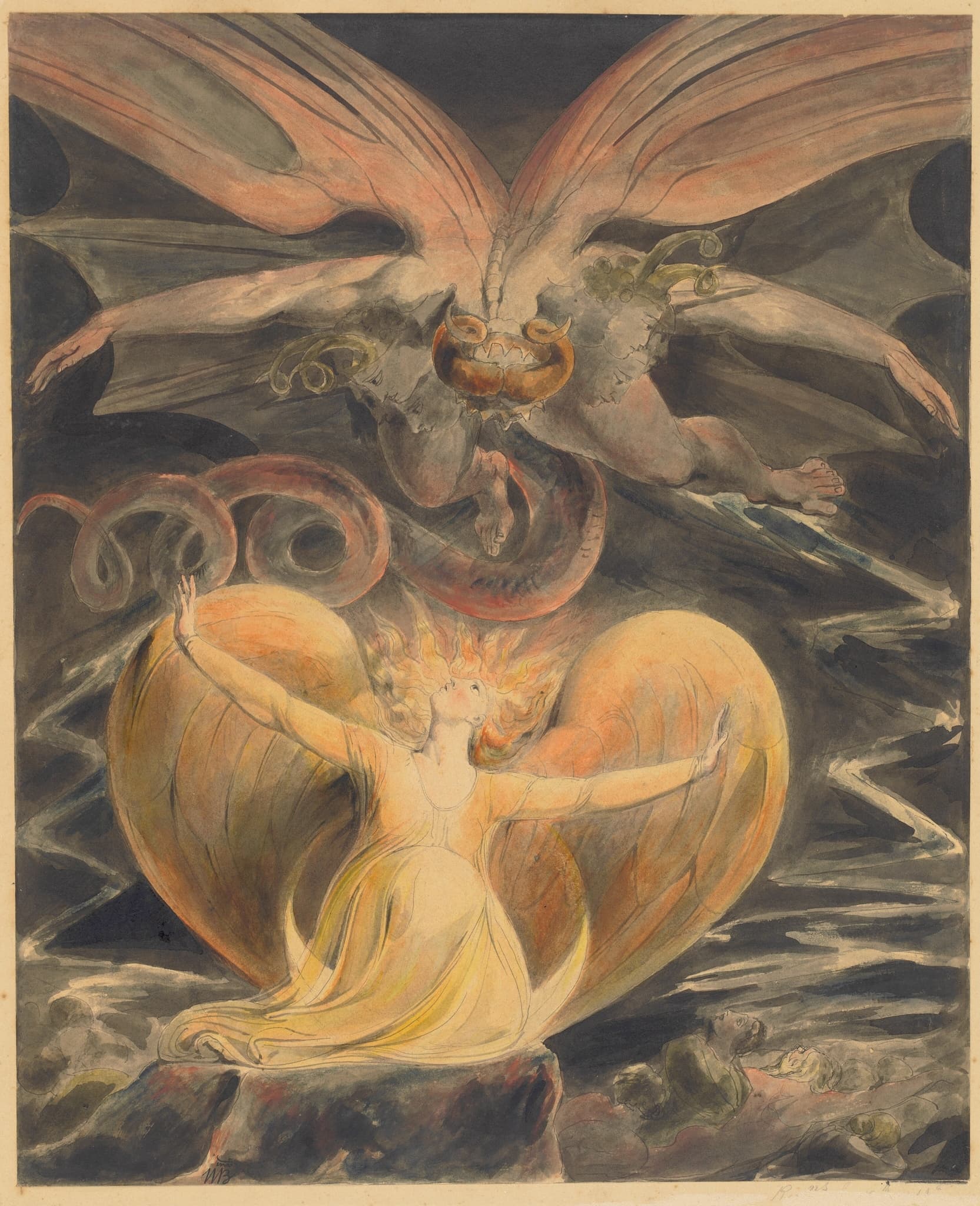
The Great Red Dragon and the Woman Clothed with the Sun
William Blake, c. 1805 • Pen and gray ink with watercolor over graphite on paper
Read full analysis of The Great Red Dragon and the Woman Clothed with the Sun →Valuation Analysis
Conclusion. We estimate $18–30 million for William Blake’s The Great Red Dragon and the Woman Clothed with the Sun (c. 1805; pen and gray ink with watercolor over graphite, 40.8 × 33.7 cm), assuming free-and-clear title, excellent condition, and presentation in a marquee evening sale with full global marketing. This is a canonical image from Blake’s Revelation series for Thomas Butts, with an unimpeachable provenance culminating in the National Gallery of Art, Washington, DC (Rosenwald Collection) [1].
How the estimate was derived. Public benchmarks for Blake are thin yet instructive. The artist’s overall auction record is $4.32 million for a masterpiece copy of Songs of Innocence and of Experience (Sotheby’s, 2024) [4]. The closest large-scale pictorial proxy is The Good and Evil Angels Struggling for Possession of a Child at $3.928 million (Sotheby’s, 2004) [3]. The Great Red Dragon, however, is a far more widely recognized, once-in-a-generation emblem of Blake’s visionary art, and finished Revelation watercolors of this caliber are effectively unavailable. In categories like Old Masters and British Romantic works, truly iconic, museum-grade appearances often leap well beyond historical artist records when trophy-level competition materializes [7].
Provenance and rarity. This sheet originates in the Butts commissions, passed through Robson & Co. and the celebrated A. Edward Newton collection, sold at Parke-Bernet in 1941 for $10,100 to the Rosenbach firm for Lessing J. Rosenwald, and entered the NGA by gift in 1943 [1][2]. Large, finished Blake Revelation watercolors are largely sequestered in public collections; the subject’s profile across scholarship and culture amplifies demand far beyond the core Blake market. Taken together, this creates a perfect scarcity-and-status equation: a singular subject, blue-chip pedigree, and virtually no direct substitutes.
Medium and market positioning. While works on paper typically trail oils in price, Blake is an outlier: his most coveted objects are unique watercolors and illuminated books. The 2004 Good and Evil Angels result proves that highly finished visionary compositions on paper can achieve seven-figure prices; the $4.32 million Songs record (2024) confirms depth of demand for best-in-class Blake material [3][4]. Recent momentum—two further seven-figure Songs results in 2025 and a record for a single Blake print (The Tyger) at ~$305,000—signals sustained appetite across formats when rarity, condition, and provenance align [5][6].
Positioning the $18–30 million range. The low end of the range anchors to Blake’s top public results uplifted for iconography, rarity, and institutional provenance; the high end captures realistic upside if two or more major bidders—cross-category collectors, foundations, or museums—compete for a museum-grade, universally recognized image. Strengthened Old Masters sell-through and trophy chasing in 2025–26 support this step-change outcome for a once-in-a-generation Blake [7]. On balance, $18–30 million is an assertive but defensible synthesis of market evidence and the work’s singular stature.
Key Valuation Factors
Art Historical Significance
High ImpactAmong the most celebrated images Blake ever created, The Great Red Dragon and the Woman Clothed with the Sun sits at the pinnacle of his Revelation series for Thomas Butts. It distills Blake’s visionary theology, draughtsmanship, and dramatic design into a single, unforgettable composition. The work’s scholarly centrality, ubiquity in survey texts, and crossover resonance beyond Blake specialists elevate it above most of the artist’s output. Within Blake’s oeuvre, it occupies the same echelon as the finest illuminated-book plates and the most ambitious standalone watercolors. This degree of cultural recognition meaningfully expands the potential bidder pool and supports a valuation that exceeds historical Blake pricing norms.
Rarity and Supply
High ImpactFinished, large-format Revelation watercolors by Blake almost never surface on the market; most are long held by major museums. The NGA sheet is one of a handful of fully realized Red Dragon compositions and is virtually irreplaceable for a collector or institution seeking a definitive Blake image. With no near substitutes in private hands, price elasticity increases sharply when an icon of this stature becomes hypothetically available. Scarcity-driven bidding has repeatedly propelled Old Master and British Romantic masterworks beyond prior artist records, and the supply constraints around the Butts watercolors are even tighter. This extreme rarity is a primary driver of the $18–30 million range.
Provenance and Institutional Status
High ImpactThe chain from the Butts commission to Robson & Co., A. Edward Newton, Lessing J. Rosenwald, and the National Gallery of Art confers exemplary provenance. The 1941 Parke-Bernet result anchors its 20th‑century market history; Rosenwald’s 1943 gift to the NGA secures its scholarly stature. Such a pedigree reduces transactional risk, enhances lender appeal, and increases bidder confidence—especially critical at the trophy level. Works with museum-grade provenance often achieve premiums because due diligence is simplified, narratives are compelling, and institutional references are unimpeachable. For a canonical Blake, this provenance context supports aggressive bidding without the uncertainties that can cap prices for lesser-documented works.
Medium, Scale, and Condition
Medium ImpactAs a pen-and-ink and watercolor sheet of substantial size (40.8 × 33.7 cm), this work occupies the top end of Blake’s works-on-paper spectrum. Although watercolors can be light-sensitive and historically trade below oils, Blake’s market reverses some of that hierarchy: his most coveted objects are precisely unique watercolors and illuminated books. The $3.928m price for Good and Evil Angels (2004) demonstrates buyer willingness for ambitious pictorial works on paper, while recent records for Blake’s illuminated material affirm depth at the top. Assuming excellent condition and sensitive presentation, the medium should not inhibit a trophy-level result for so iconic an image.
Market Momentum and Timing
Medium ImpactOld Masters and British Romantic categories improved in 2025 after a softer 2024, with stronger sell-throughs and active cross-category bidding. Record Blake results since 2024 across books and prints indicate renewed and diversified demand when quality, rarity, and provenance align. In such conditions, museum-grade, instantly legible trophies tend to outperform, drawing interest from contemporary and cross-category collectors seeking cultural landmarks. Against this backdrop, the Red Dragon’s fame and scarcity argue for a step-change result relative to historical Blake prices. Proper sale timing and global positioning would likely maximize competition and support the upper half of the proposed range.
Sale History
Parke-Bernet Galleries, New York
A. Edward Newton sale, Lot 118; purchased by Rosenbach for Lessing J. Rosenwald.
William Blake's Market
William Blake’s market is thin at the masterpiece level due to scarcity, but depth is proven when core works appear. The overall auction record stands at $4.32 million for a prime copy of Songs of Innocence and of Experience (Sotheby’s, 2024). For large pictorial works on paper, the benchmark is $3.928 million for The Good and Evil Angels Struggling for Possession of a Child (Sotheby’s, 2004). Momentum has broadened: in 2025, two further seven-figure Songs results were achieved at Christie’s, and a single-leaf first-issue impression of The Tyger set a print record around $305,000. These results underscore that top-tier, early, and uniquely colored works attract intense competition—despite a limited auction history—and support extrapolating materially higher for an iconic subject like the Red Dragon.
Comparable Sales
The Good and Evil Angels Struggling for Possession of a Child
William Blake
Same artist; visionary Biblical subject; late-18th/early-19th-century major picture; very close dimensions (~16 x 13 in) and pictorial ambition. Longstanding record for a Blake painting/large work on paper, making it the closest market proxy for a finished Butts-series watercolor.
$3.9M
2004, Sotheby's New York
~$6.6M adjusted
Songs of Innocence and of Experience (Copy J, the 'Tulk–Rothschild' copy)
William Blake
Same artist; apex illuminated book by Blake with unique hand-coloring; establishes current top-of-market willingness to pay for masterpiece-status Blake material. Different medium, but critical to framing ceiling demand for the artist.
$4.3M
2024, Sotheby's New York
~$4.4M adjusted
Songs of Experience (first printing, 1794)
William Blake
Same artist; top-tier illuminated book from the core period; recent result showing deep competition for exceptional Blake works. Cross-medium indicator of current demand for best-in-class Blake material.
$1.9M
2025, Christie's New York
The First Book of Urizen (hand-colored, illuminated book)
William Blake
Same artist; landmark illuminated book with unique hand-coloring from the same creative arc; historically a headline price. Not the same medium, but a strong benchmark for rarity-driven Blake valuations.
$2.5M
1999, Sotheby's New York
~$4.8M adjusted
The Great Red Dragon and the Woman Clothed with the Sun (same NGA sheet; Butlin 520)
William Blake
Identical work; earliest modern public sale reference (Newton collection). Serves as a historical anchor for long-run appreciation of a pinnacle image from the Butts Revelation series.
$10K
1941, Parke-Bernet Galleries, New York
~$212K adjusted
Current Market Trends
Old Masters and British Romantic works saw softer demand in 2024, then rebounded in 2025 with improved sell-through and more cross-category bidding at the top end. Buyers continue to prioritize rarity, condition, and narrative-rich provenance. Within this climate, “best-in-class” works—especially those with institutional pedigrees and strong name recognition—command premiums and can reset artists’ records. Parallel strength in prints and rare books indicates broader engagement with historical material, drawing in newer buyers. These dynamics favor a canonical Blake watercolor with unimpeachable provenance, supporting a valuation that meaningfully exceeds prior artist benchmarks when staged in a marquee sale with global marketing.
Study print
Study this painting as a print
Pair the full artwork with a museum-style study sheet focused on one meaningful detail.
Sources
- National Gallery of Art (NGA) object page: The Great Red Dragon and the Woman Clothed with the Sun
- Bentley, G.E., Sale Catalogues 1900–1999 (Robson 1904; Parke-Bernet 1941)
- Sotheby’s NY (2004): The Good and Evil Angels Struggling for Possession of a Child
- Sotheby’s NY (2024): Songs of Innocence and of Experience (Copy J) — record for Blake
- Fine Books & Collections: Blake works top Maurice Sendak sale (Christie’s, 2025)
- Christie’s press release (Dec 2025): Record for a Blake print — The Tyger
- Observer: Old Masters market analysis and rebound (2025)