The Great Red Dragon and the Woman Clothed with the Sun
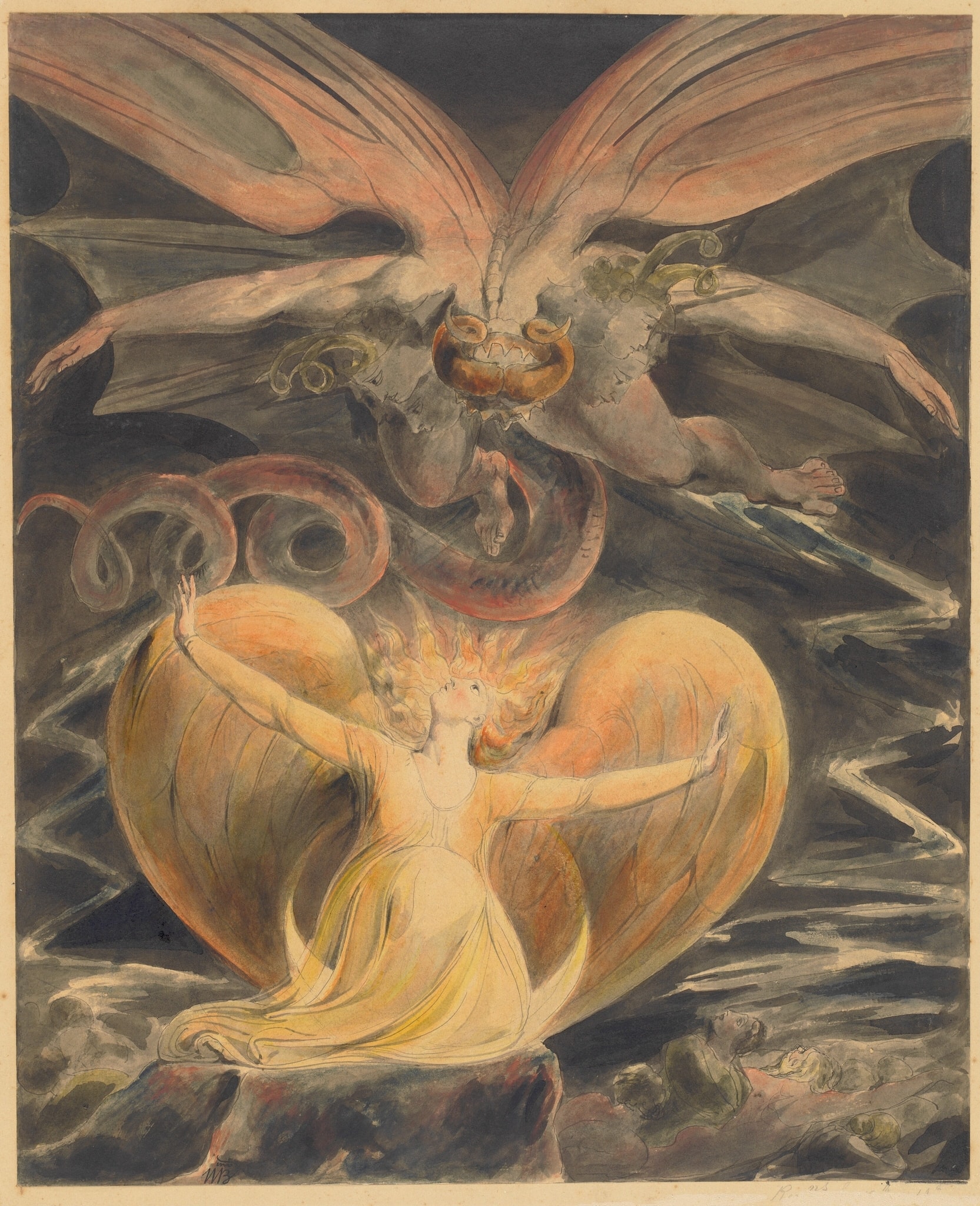
In The Great Red Dragon and the Woman Clothed with the Sun, William Blake pits radiant innocence against predatory tyranny. A bat‑winged dragon with ramlike horns plunges from a stormed sky as the woman, haloed in light with great golden, heart‑shaped wings, lifts open palms to meet the assault. Blake’s high‑contrast watercolor turns the tableau into a visionary contest of light versus darkness [1].
💰
Market Value
$18-30 million
How much is The Great Red Dragon and the Woman Clothed with the Sun worth?Study Print Studio
Create a personal study print
Build a companion study sheet around the part of this painting that speaks to you most. Choose a detail, shape an interpretation, and walk away with something personal and display-worthy.
Fast Facts
- Year
- c. 1805
- Medium
- Pen and gray ink with watercolor over graphite on paper
- Dimensions
- Image 40.8 × 33.7 cm; support 55.2 × 44.2 cm
- Location
- National Gallery of Art, Washington, DC
Click on any numbered symbol to learn more about its meaning
Meaning & Symbolism
Blake uses composition to legislate meaning. The dragon’s wings span nearly the whole sheet, their membranes arcing like a dark vault that attempts to seal the woman inside its dominion. The horned, crowned head thrusts down the central axis, and along the neck Blake compresses additional profiles—his visionary shorthand for Revelation’s many‑headed adversary—so that multiplicity becomes a single, psychological pressure bearing down upon her 1. Below, the woman kneels on rock with arms flung wide, palms open as if both shielding and invoking, while her hair erupts into rays that clothe her in light. Her great, heart‑shaped golden wings echo the dragon’s arc but reverse its intention: where the monster’s curve encloses, hers opens. Lightning‑like strokes cut the gloom; a serpentine tail coils to the left; at lower right, stunned figures and flickering faces imply a world endangered by this celestial siege. Every mark insists that domination strides from above, yet the ground of the picture glows from the woman’s aureole, insisting on a counter‑order of radiance 1.
Color and material intensify the drama’s ethics. Blake tempers the “red” of the dragon into steel‑gray flesh flushed with rose and sulfur, so the creature reads as red‑tinged darkness more than literal scarlet; this makes evil feel like a pall rather than a hue, a saturation of atmosphere rather than an isolated body 1. Against it, the woman’s yellows and creams behave like a small sun, diffusing outward through her wings and hair. The opposition is not merely moral; it is ontological: heaviness versus lightness, enclosure versus emanation, appetite versus grace. In Revelation 12 the dragon seeks to devour the woman’s child; Blake translates that threat into a choreography of diagonals and coils, a physics of menace that bears down yet fails to extinguish the visionary core. Situated within Blake’s Butts Bible series, the sheet converses with his companion designs of beasts and numbers, a suite that Romantic critics read as the apocalyptic sublime—terror married to the promise of deliverance 123. The late‑eighteenth‑century upheavals that sent artists back to Revelation further charge the image: Blake’s dragon can be read as a figure for tyrannies political and psychic, his woman as the Church, Israel, Mary, or—most Blakean of all—the imaginative faculty itself resisting the empire of appetite 23.
Thus the picture refuses mere illustration. By making the woman’s wings mirror the dragon’s canopy, Blake shows that illumination counters domination not by brute contest but by refiguring space—turning enclosure into embrace, fear into vision. The viewer is placed at the fulcrum of that choice: to be governed by the weight of the descending beast or to inhabit the field of light issuing from the upturned face. In this way, the sheet operates as prophecy and pedagogy, staging a crisis that asks whether perception will be tyrannized or transfigured. That is why The Great Red Dragon and the Woman Clothed with the Sun endures—as an image where form, color, and scripture fuse into a single act of spiritual resistance 13.
Explore Deeper with AI
Ask questions about The Great Red Dragon and the Woman Clothed with the Sun
Popular questions:
Powered by AI • Get instant insights about this artwork
💬 Ask questions about this artwork!
Interpretations
Aesthetics of Dread: The Apocalyptic Sublime
Morton D. Paley’s account of the Romantic apocalyptic sublime clarifies Blake’s fusion of terror and deliverance. The dragon supplies the dread spectacle—monumental wings, plunging descent—while the woman’s aureole installs a counter‑telos of hope. Rather than cancel terror, Blake frames it as the necessary condition of visionary transport: fear becomes the threshold through which illumination arrives. The viewer, stationed beneath the descending mass, is taught to convert intimidation into insight, a pedagogy of feeling that is as much experiential as doctrinal. In this register, the sheet is not illustration but initiation into the sublime’s paradox—stupefaction that ripens into revelation 41.
Source: Morton D. Paley; National Gallery of Art
Formal Analysis: Two Compositions, Two Ethics of Space
Across the Butts series, Blake varies point of view to recalibrate meaning. In the Brooklyn sheet the dragon’s monumental back engulfs the scene, making evil feel like an impersonal force-field that dwarfs human measure; in the NGA sheet, the frontal descent meets the woman’s aureole in a tense equilibrium, allowing her radiance to contend with mass rather than be annihilated. These shifts in silhouette, wing-span, and viewer vantage convert iconography into ethics: enclosure versus emanation, weight versus lightness. The compositions are not variants but arguments—demonstrations of how pictorial structure legislates experience. Blake’s arcs, diagonals, and voids choreograph menace as physics while preserving a counter‑geometry of grace that opens the image from within 12.
Source: National Gallery of Art; Brooklyn Museum
Iconography Recast: From Marian Emblem to Visionary Sign
Blake honors Revelation 12 while disobeying its literalism. The crescent moon and the kneeling pose locate the figure within traditional Woman‑of‑the‑Apocalypse imagery, yet the “sun” becomes a fountain of hair‑light and the seven heads compress into spectral profiles along the neck—his visionary shorthand for multiplicity. By exchanging catalogued attributes (e.g., the twelve‑star crown) for atmospheric emanation, he moves from inventory to epiphany: scripture made present as state of being rather than checklist of signs. This selective fidelity aligns with Blake’s conviction that the Bible is the supreme poem, to be realized imaginatively rather than mimetically, merging text and sight into one continuous revelation 13.
Source: National Gallery of Art; The Met Museum (Heilbrunn Timeline)
Historical-Political Lens: Apocalypse after Revolution
Curators note that the French Revolution primed artists to mine Revelation; Blake’s dragon thus reads as a figure for modern tyrannies—political, ecclesial, and psychic—while the woman models steadfast conscience. The Brooklyn sheet’s overpowering back renders domination as scale itself, an image of systems rather than villains; the NGA version, by contrast, stages direct confrontation where appeal and defense are visible. Within this climate, Blake’s theology becomes critique: apocalypse as a grammar for reading contemporary power. The result is a double time—biblical past and revolutionary present—where prophetic picture-making indicts the age’s "empire of appetite" and offers imagination as a form of resistance 23.
Source: Brooklyn Museum; The Met Museum (Heilbrunn Timeline)
Medium and Atmosphere: Watercolor as Moral Weather
Executed in pen and ink with watercolor over graphite, the NGA sheet inflects the “red” dragon toward steel‑gray flesh flushed with rose and sulfur, producing a pall rather than a hue—a climate of red‑tinged darkness. Washes and transparent glazes let evil spread as atmosphere, while the woman’s creams and yellows travel outward through wing and hair, a concentrated source diffusing through paper. The medium’s liquidity turns doctrine into meteorology: sin as saturation, grace as irradiance. Blake’s technique thus literalizes ontology—heaviness vs. lightness—as material behavior on the sheet, binding ethics to the flow and stain of watercolor itself 1.
Source: National Gallery of Art
Related Themes
About William Blake
William Blake (1757–1827) was an English poet, engraver, and painter whose visionary Romantic art rejected Classicist norms to pursue prophetic, scriptural, and personal mythologies. Around 1800–1806 he created a large cycle of biblical watercolors for his patron Thomas Butts, within which the Red Dragon sheets are central statements of his apocalyptic imagination [3][4].
View all works by William Blake →