Painting Meanings Essay
Degas’s Vanished Paris: The Painting That Went to War and Came Back With a Secret
Start in 1875: a man strides, girls in gray keep pace, a dog scouts the pavement. No one looks at each other.
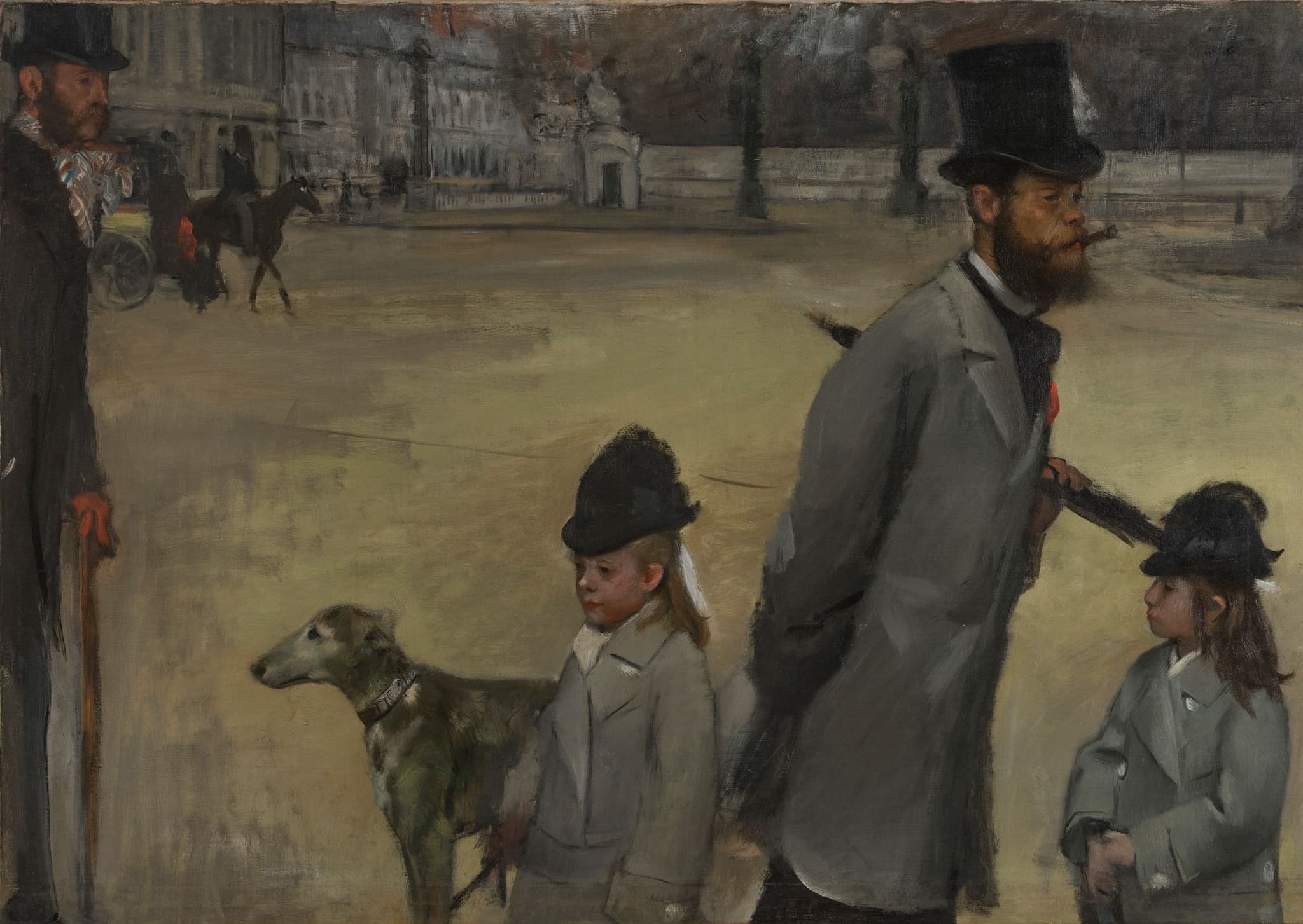
Start in 1875: a man strides, girls in gray keep pace, a dog scouts the pavement. No one looks at each other. A city square yawns like a stage. Edgar Degas freezes it all with brutal cuts at the frame, the visual grammar of a world too fast for eye contact. Today the canvas lives at the State Hermitage Museum in St. Petersburg, a long way from the Paris square it depicts—and even farther from where it was last seen before the war State Hermitage Museum1.
Here’s the part collectors hate to remember: Place de la Concorde once hung in Berlin, in the collection of insurance magnate Otto Gerstenberg. When Berlin fell, so did his walls. The Degas went missing in the chaos of 1945. Paper trails go dim. Rumors do the rest. Was it burned? Bargained? Buried?
For fifty years, silence. Then—spotlights. In 1995, the Hermitage staged a shocker of a show, a coming‑out party for art the Soviets had seized from Germany and kept hidden for decades. The New York Times didn’t mince words:
"In its manner, the museum displays its looted art." — The New York Times on the Hermitage’s “Hidden Treasures Revealed,” 1995 (link)[2]
There it was: Degas’s Place de la Concorde, also known as Viscount Lepic and His Daughters, behind glass in Russia, no longer a rumor but a fact with borders and guards. The wall text called it a masterpiece; the backstory called it trophy art. Wikipedia—cross‑checked against the Hermitage record—traces the path from Gerstenberg’s Berlin rooms to postwar seizure to its present home in St. Petersburg (Wikipedia))[3].
What was on the line? Reputation, first. Museums insist on stewardship; nations insist on justice; collectors’ heirs insist on memory. Every time the picture travels—even across a web page—someone asks who owns it, morally if not legally. Meanwhile, Degas himself gets drafted into arguments he never asked to fight.
Because the composition, all hard edges and abrupt exits, looks like a manifesto for modern alienation. Scholars have read it that way for years—instant vision, an almost photographic slice of Paris life André Dombrowski, The Art Bulletin[5]. We nod, we say: yes, that’s the point, the city makes you invisible. But the painting’s afterlife hands the feeling back to us with a twist.
Reversal: the isolation isn’t just on the canvas. For half a century the painting itself lived in isolation—unexhibited, unmentionable, a cultural hostage whose label couldn’t be printed. Its wide, empty plaza starts to read like a prophecy for its own fate. A public scene built to go private.
And here’s the kicker, from Degas himself, the control freak of Impressionism.
"No art was ever less spontaneous than mine." — Degas, quoted by the National Gallery of Art (link)[4]
He fussed over angles, cropped like a surgeon, and waged war on accident. Yet history made the biggest crop of all: it cut his painting out of Western sight.
Look again at the figures. Viscount Lepic moves forward but never meets our eye. His daughters travel with him but not with each other. A dog leads, indifferent. That chill isn’t just modern life; it’s the emotional weather of property displaced—lives and objects moving quickly, purposefully, without contact.
Why does this matter now? Because meaning is a custody battle. Museums write labels, governments write laws, markets write checks—but images write to us. When the Hermitage finally let this picture surface, it didn’t just display a painting; it displayed a decision. The canvas became evidence, and the square became a courtroom. If you want the clean version—just the art, none of the baggage—click the tidy museum page. If you want the real story, you have to read the route the painting took to get there.
So the next time you see those abrupt edges and think “snapshot modernity,” add the quieter truth: the most modern thing about Place de la Concorde may be what happened to it—displacement, opacity, the long bureaucratic hallway where culture waits for permission to be seen. That’s not a metaphor. It’s the frame.
Further reading and sources:
1 https://hermitagemuseum.org/digital-collection/29681?lng=en
[2] https://www.nytimes.com/1995/03/30/arts/hermitage-in-its-manner-displays-its-looted-art.html
[3] https://en.wikipedia.org/wiki/Place_de_la_Concorde_(Degas)
[4] https://www.nga.gov/artists/1219-edgar-degas
[5] https://www.jstor.org/stable/23046593
See the Painting Meanings page for the work itself and context: /artworks/edgar-degas/place-de-la-concorde.
Sources & Further Reading
Place de la Concorde — Edgar Degas
Continue Exploring
What else has your favorite picture survived? Follow the trail on our artwork page.