Painting Meanings Essay
The Blue Armchair Rebellion
Paris, 1878. An American woman is fighting for entry into the most controversial circle in art.
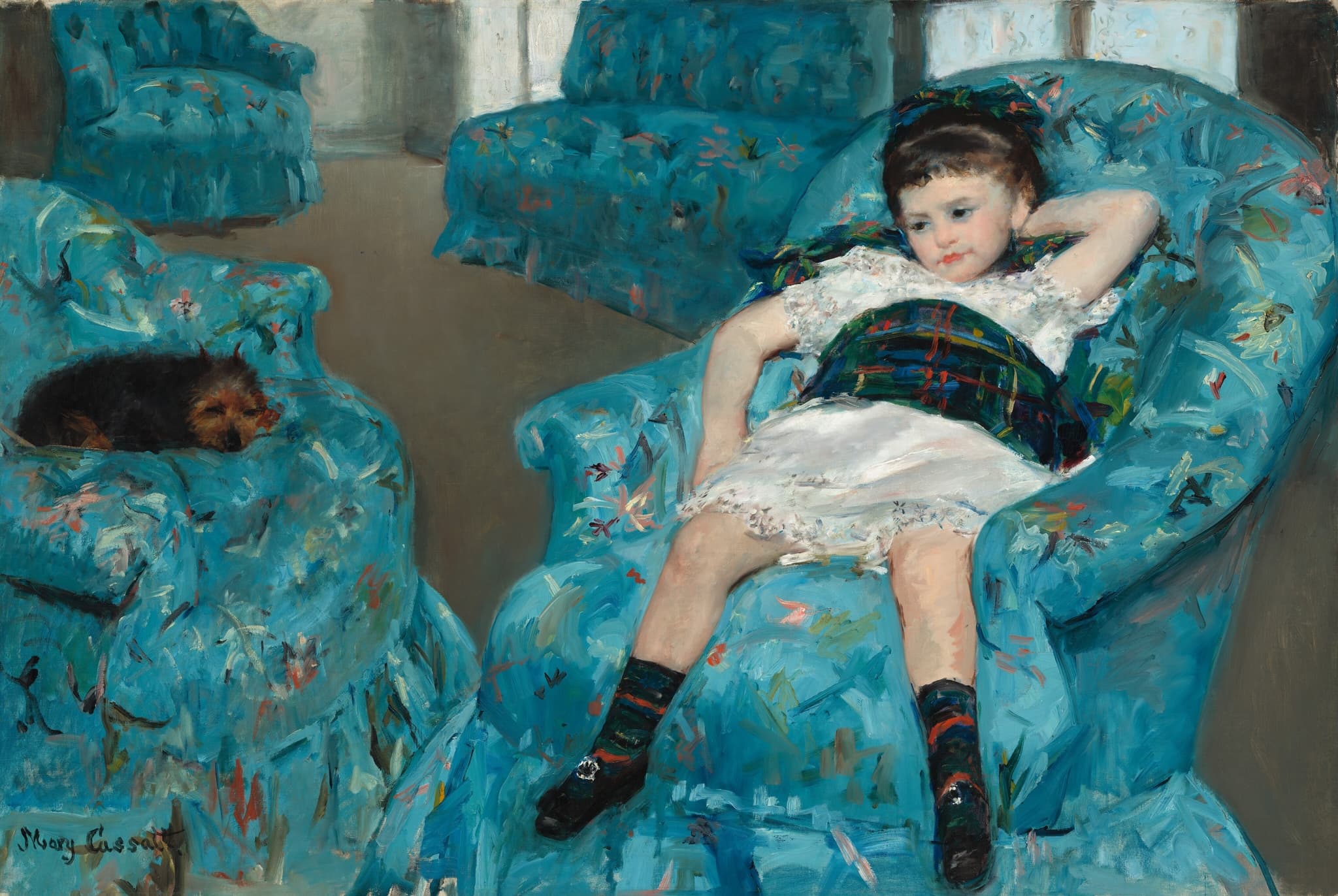
Paris, 1878. An American woman is fighting for entry into the most controversial circle in art. Reputation on the line, money scarce, critics circling. Her next move must land. She paints… a kid who won’t behave.
A small girl slumps diagonally across a vast sea of turquoise upholstery, socks rumpled, gaze elsewhere, a terrier comatose on a neighboring chair. It looks unbothered, even rude. And that’s the point. In a market that rewarded sugarcoated childhood, Mary Cassatt risked everything on a portrait that shrugs at adult decorum 1.
Cassatt had just thrown in with the outsiders—at Degas’s urging—and was preparing for her first Impressionist exhibition the following year. It wasn’t a club you entered softly. “I accepted with joy,” she later said of the invitation, because the Salon “crushed all originality” [3]. If this picture failed, the doubters would say she didn’t belong.
Collectors expected cherubs and manners; Cassatt delivered autonomy and boredom. The chairs swallow the child; the room tilts, refusing tidy perspective. That tilt reads like a dare: are you here for reality or for flattery?
Critics had already typecast her: woman painter, therefore domestic, therefore decorative. Pick up the brush and they’ll hand you a lace bonnet. Cassatt answers with a posture: diagonal, splayed, uncompromising. Smarthistory nails it:
“A modern, unsentimental view of childhood—bored, autonomous, out of step with adult decorum.” [4]
There’s money at stake too. Portrait commissions could keep an artist afloat. Cassatt paints a child who won’t even look at the buyer.
Now the twist. Decades later, conservators x-ray the canvas and find an extra hand in the room. Degas—friend, champion, sometimes sparring partner—likely reworked parts of the background, pushing the floor’s diagonal and the room’s sweep. The finding, published by the National Gallery of Art, doesn’t take authorship away; it intensifies the tension: a woman staking a claim in modern painting, with a man’s brush sharpening the stage around her [2].
This is not the cliché of the male master finishing the woman’s work. It’s the opposite: the composition’s thrust serves her unsentimental drama. The diagonal he emphasized turns the girl’s slouch into a current, pulling your eye while she refuses to perform.
Degas knew what he was seeing. He once looked at Cassatt’s art and reportedly said, “There is someone who feels as I do.” [3] He wasn’t spotting a pupil; he was spotting a partner in risk. In Little Girl in a Blue Armchair, the risk is social. Victorian childhood in paintings was supposed to be a moral lesson in miniature. Cassatt made it a modern fact.
And look where she stages modernity—not on the boulevard, but in a living room of relentless blue. The Financial Times calls Cassatt’s interiors a quiet but radical arena for modern life; the shock isn’t the city’s rush, it’s the domestic sphere tipped off its axis [7]. The room becomes a theater where the child opts out of pleasing you. That refusal is the true subject.
So what do we do with the discovery that Degas touched the background? We stop confusing collaboration with authorship. Technical analysis shows his hand on the set; Cassatt directs the scene [2]. The stubborn body language, the choice to paint boredom, the refusal to sweeten—those are hers. That’s why this single canvas has a gravitational pull in her story, as the National Gallery’s dossier and our own page make clear 1 (see also our artwork entry here: /artworks/mary-cassatt/little-girl-in-a-blue-armchair).
“I accepted with joy,” Cassatt said of joining the Impressionists. The blue armchair is what joy looked like for a modernist: a chance to tell the truth, even when the truth slumps and looks away [3].
Authorship isn’t a signature; it’s the risk you’re willing to take. Cassatt risked the sale, the critics, the typecast—and let a child take the seat.
Notes
1 National Gallery of Art, object page for Little Girl in a Blue Armchair: https://www.nga.gov/collection/art-object-page.61368.html
[2] National Gallery of Art, Degas/Cassatt technical findings: https://www.nga.gov/exhibitions/exhibition-degascassatt.html
[3] Encyclopaedia Britannica, Mary Cassatt biography: https://www.britannica.com/biography/Mary-Cassatt
[4] Smarthistory, analysis of Little Girl in a Blue Armchair: https://smarthistory.org/sidebar-menu-group/europe-1800-1900/
[7] Financial Times review on Cassatt’s interior modernity: https://www.ft.com/content/d07cbd98-b6c5-41b7-9c38-fa9d4fc0ff78
Sources & Further Reading
Little Girl in a Blue Armchair — Mary Cassatt
Continue Exploring
See what else the blue chair unlocks on our artwork page: /artworks/mary-cassatt/little-girl-in-a-blue-armchair