Painting Meanings Essay
The Bureaucrat Who Bought the Apocalypse
Start at the worst moment. In 1803, William Blake was hauled into court, accused of shouting treason after throwing a soldier out of his garden.
Start at the worst moment. In 1803, William Blake was hauled into court, accused of shouting treason after throwing a soldier out of his garden. Witnesses swore he’d cried, “Damn the King.” A guilty verdict could have wrecked him. He was acquitted a year later, but the message was clear: the Crown was listening.2
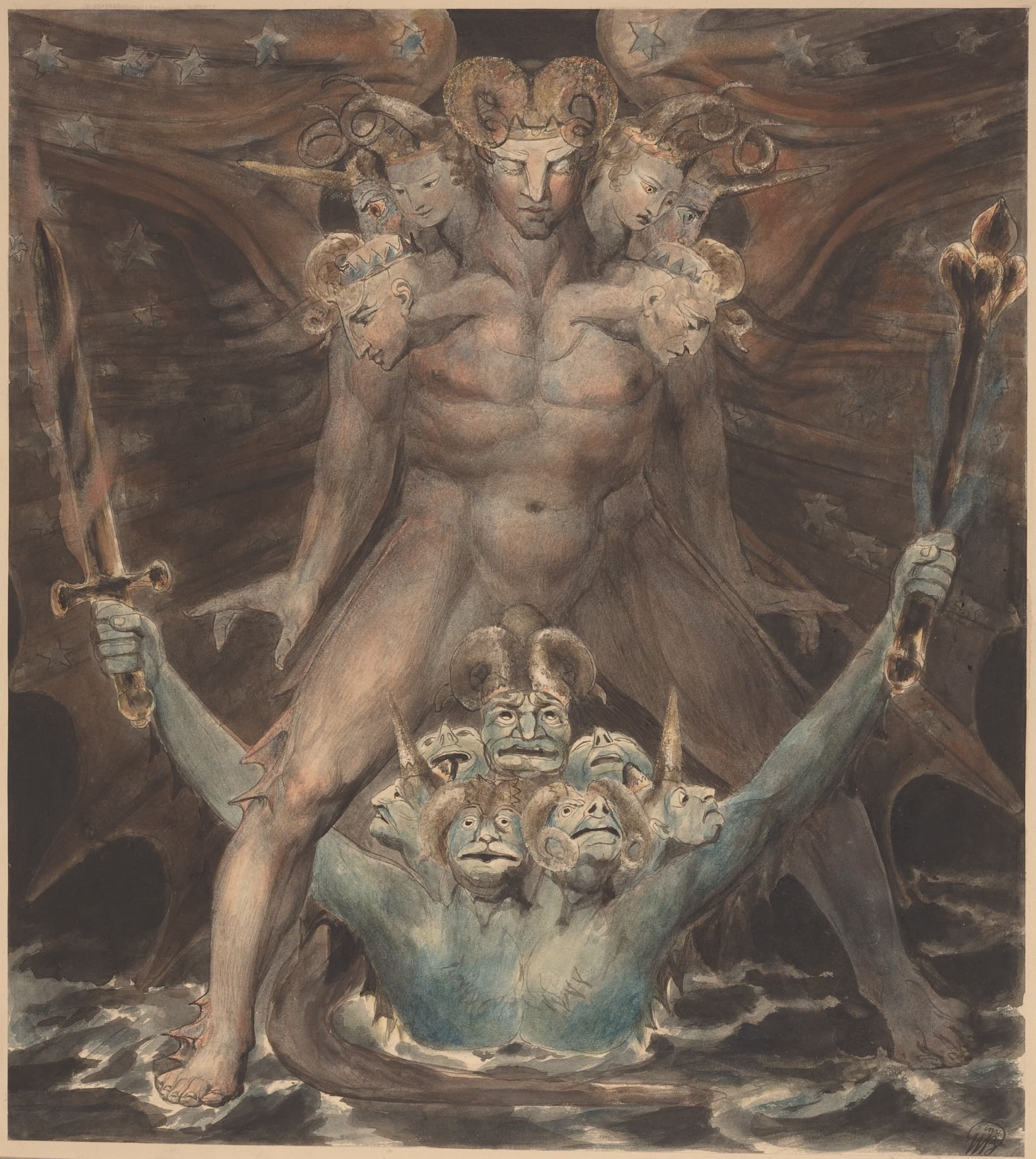
Now imagine going back to a small room and deciding to paint the end of the world. That’s what Blake did—turning to Revelation, drafting a bestiary of power with a monster that still jolts the eye: The Great Red Dragon and the Beast from the Sea. Today you can see it in Washington; then, it was another sheet on a table, ink and fire for rent money.3
Because critics weren’t buying. When Blake tried a splashy solo show in 1809, the lone review torched him. The Examiner sneered: "The wild effusions of a distempered brain... an unfortunate lunatic."4 One line, and a reputation goes cold. What collector risks their name on a man branded mad?
Enter the bureaucrat no one expected to be a hero: Thomas Butts, a steady civil servant with a steady salary. While the art world laughed, Butts commissioned Blake to illustrate Scripture—dozens upon dozens, including a run through Revelation. That’s the pipeline that birthed this dragon: a quiet paycheck underwriting a loud vision.31
So look again at the image. A crowned, many-horned power straddles a churning, seven-headed state; swords flash; the sky is a field of stars. It reads like pure occult spectacle—until you remember the man painting it had just stared down a judge, accused of sedition in a nation at war. The dragon isn’t cosplay. It’s a portrait of power from the inside of fear.23
And Blake wasn’t pretending it was all technique. He told his patron straight: "I am under the direction of Messengers from Heaven, daily & nightly."5 He wasn’t selling special effects. He was reporting, with watercolor and graphite, from a world he believed was realer than Parliament.
Here’s the twist: the image that later thrilled pop culture started as survival art—work-for-hire turned weapon. The Great Red Dragon and the Beast from the Sea belongs to a Butts-funded Revelation series, grounded in scripture but aimed squarely at tyranny. In Blake’s cosmology, empire is a beast that rises from the deep to demand worship. Painting it is how you refuse to bow.3
The stakes weren’t soft. Blake needed cash, needed dignity, needed to prove he wasn’t a mad blasphemer but a seer with purpose. Technique followed pressure: transparent washes over graphite to make the flesh gleam, a limited palette that reads like scorched metal—fast, precise, economical. You can feel the speed of a man outrunning ridicule while banking on faith.31
The payoff two centuries later? That single sheet reads like a user’s manual for power: how it looks, how it moves, how it asks you to kneel. Critics cooled; museums warmed; the dragon endured. Not because it’s spooky—but because it taught us what tyranny feels like when it breathes down your neck, and how a working artist with one faithful patron can stare it down and paint it anyway.
Read more on the Painting Meanings page for this work: /artworks/william-blake/the-great-red-dragon-and-the-beast-from-the-sea.1
1 Painting Meanings: The Great Red Dragon and the Beast from the Sea — /artworks/william-blake/the-great-red-dragon-and-the-beast-from-the-sea
2 British Library on Blake’s sedition trial and context — https://www.bl.uk/romantics-and-victorians/articles/william-blake-radicalism
3 Overview and provenance (Revelation series; Butts commission; current location) — https://en.wikipedia.org/wiki/The_Great_Red_Dragon_and_the_Beast_from_the_Sea
4 Tate on Blake’s 1809 exhibition and its savage review — https://www.tate.org.uk/art/artists/william-blake-39/blakes-1809-exhibition
5 British Library: Blake’s letter to Thomas Butts (25 April 1803) — https://www.bl.uk/collection-items/william-blakes-letter-to-thomas-butts-25-april-1803
Sources & Further Reading
The Great Red Dragon and the Beast from the Sea — William Blake
The Great Red Dragon and the Beast from the Sea — William Blake
The Great Red Dragon and the Beast from the Sea — William Blake
The Great Red Dragon and the Beast from the Sea — William Blake
The Great Red Dragon and the Beast from the Sea — William Blake
Continue Exploring
What monster was your era paid to paint? Share the one image you’d put on trial.