Painting Meanings Essay
The Day Manet Took a Knife to His Own Painting
Paris, 1864. The Salon is the arena.
Paris, 1864. The Salon is the arena. A painting can knight you or end you. Manet, already bruised by scandal the year before, bets big on spectacle: a sweeping bullfight scene, Spanish costume, blood and bravado.
He hangs it for the crowd. The critics circle. The verdict is icy. He can’t afford another public drubbing; every jeer dents his chances of becoming more than a punchline. The stakes are career, pride, and Paris itself.
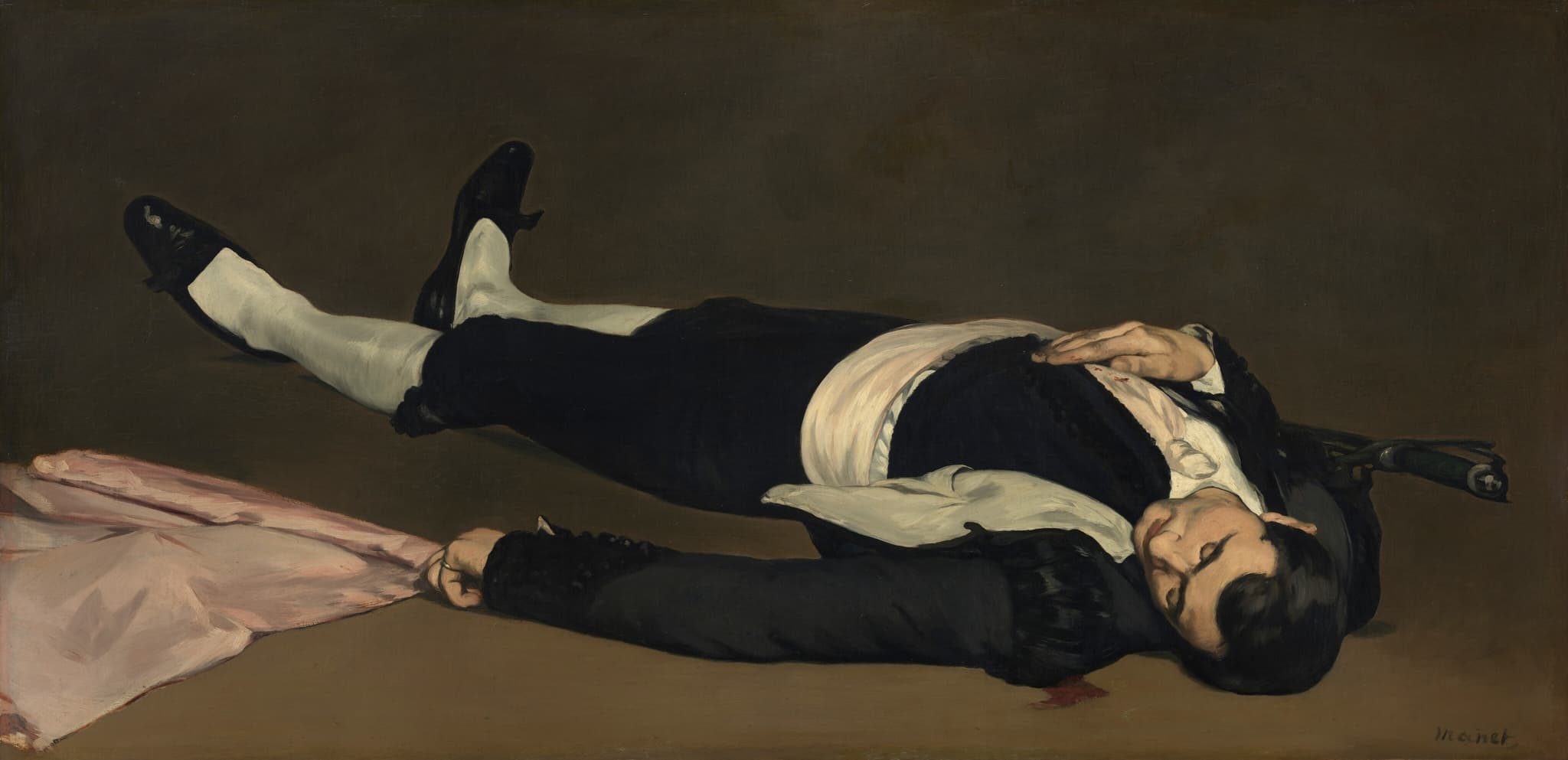
Here’s the twist sitting in plain sight: the famous close‑up of the fallen matador you know as The Dead Toreador — you can see it here link1 — started life as just one corner of that doomed panorama.
Manet doesn’t argue with reviewers. He goes home and reaches for a blade.
He slices the canvas apart, amputates the chaos, and keeps the body. Then he repaints edges, cools the colors, and lets silence rush in. The corpse becomes the whole world — no bull, no crowd, no heroics.
How do we know? The paper trail arrives like a forensic report. The National Gallery of Art explains that The Dead Toreador began as a fragment from a larger bullfight painting, later “cut down and reworked” after its poor reception.2
The clincher came in 1999, when curators reunited the two pieces — the quiet dead man in Washington and the action scene in New York — and showed how seams and paint layers match. The Frick didn’t bury the lede. It titled the show:
"Fragments of a Lost Salon Painting Reunited."3
Suddenly, the painting’s austerity reads differently. It isn’t just modern minimalism. It’s triage.
And look at the timing. Manet painted this Spanish drama before he ever set foot in Spain; his famed trip wouldn’t come until 1865.5 He was obsessed with Spanish art — Velázquez, Goya — and with the swagger that Paris craved. But after the Salon landing went thud, swagger had to go. He edited it out.
Critic Sebastian Smee has written about how the picture drains the bullring of noise, leaving a body, a pink cape, and a small pool of blood — an image that feels eerily contemporary in its calm.4 That calm was an emergency invention.
Manet, the supposed provocateur, does something more radical than scandal: he removes drama to find truth.
Not everyone hated him. One voice rose above the boos. Émile Zola, watching the pile‑on, staked his own reputation on backing Manet:
"Manet est un très grand peintre, bien plus grand qu’on ne croit."5
Translation: Manet is a very great painter, greater than people think. Zola wasn’t praising a bullfight. He was praising the nerve to make pictures that look like decisions.
The Dead Toreador is that decision, made visible. A horizontal body, white stockings, black jacket, the tiniest red wound. No crowd to explain it. No narrative to soften it. When he cut away the spectacle, he left the cost.
That’s why the painting hits like a headline photo — why it feels closer to a film still than to history painting. Manet literally invented a new kind of close‑up by destroying his old one. The market would catch up later; the modern eye did first.
He didn’t just edit a composition. He edited his fate. And, with one ruthless crop, he taught generations of artists and image‑makers the most modern lesson of all: when the noise is killing you, cut it.
The dead toreador lives because Manet killed the rest.
Sources
1 Painting Meanings – The Dead Toreador: /artworks/edouard-manet/the-dead-toreador
2 National Gallery of Art – Object page: https://www.nga.gov/artworks/1179-dead-toreador
3 The Frick Collection – Exhibition (1999): https://www.frick.org/exhibitions/past/1999/manets-dead-toreador-and-bullfight-fragments-lost-salon-painting-reunited
4 Washington Post – Sebastian Smee on The Dead Toreador: https://www.washingtonpost.com/graphics/2020/entertainment/edouard-manet-the-dead-toreador/
5 National Gallery of Art – Manet biography (Zola’s defense; 1860s context): https://www.nga.gov/artists/1506-edouard-manet
Sources & Further Reading
The Dead Toreador — Édouard Manet
The Dead Toreador — Édouard Manet
The Dead Toreador — Édouard Manet
The Dead Toreador — Édouard Manet
The Dead Toreador — Édouard Manet