Painting Meanings Essay
The Iron and the Eye: Degas Against the Glare
By the mid‑1870s, collectors wanted Degas for ballet: satin shoes, mirrored studios, the sellable dream. Instead, he kept showing up in steam and starch.
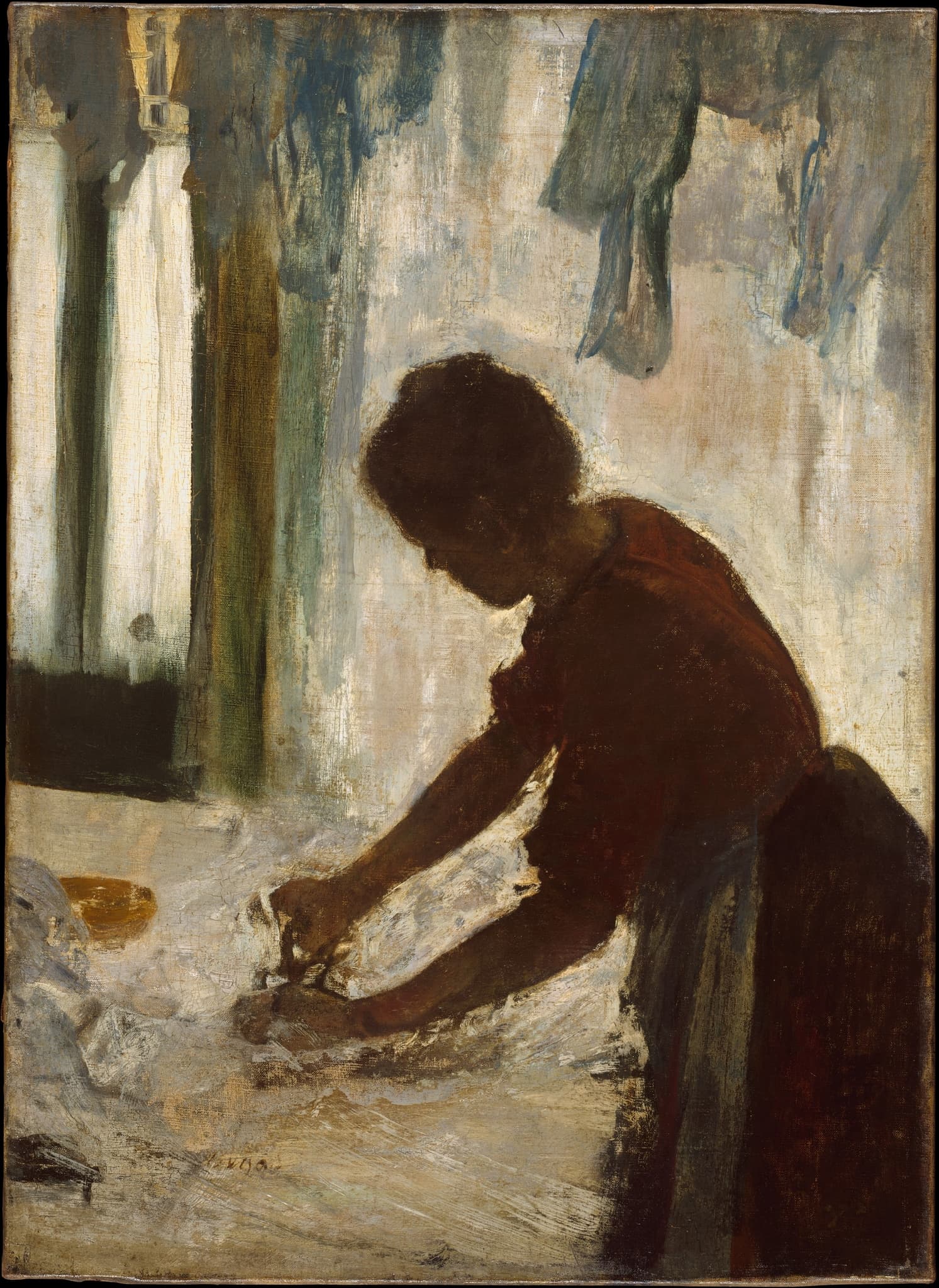
By the mid‑1870s, collectors wanted Degas for ballet: satin shoes, mirrored studios, the sellable dream. Instead, he kept showing up in steam and starch. Over and over, he painted laundresses—women who boiled, beat, and pressed other people’s clothes for pennies in rooms as hot as kilns. The choice wasn’t neutral; it could stall sales and annoy patrons who preferred dancers to drudgery. But Degas wouldn’t look away. The Musée d’Orsay calls this an obsession, tracing versions of ironers across the decade, including the famous yawning pair in Repasseuses 1.
Now look at the National Gallery’s Woman Ironing: a silhouette bent into the light, arms braced, iron driving diagonally through fabric like a blade. The scene is not cozy; it’s backlit—contre‑jour—so bright the figure goes almost black against the window, the whites of the linen turning to glare [2]. This was a compositional dare and a physical one. The man who made it was beginning to lose his sight. Scholars at the Met note Degas’s progressive eye trouble from the 1870s onward; he avoided plein air, stayed indoors, leaned on artificial and raking light, and altered how he shaped masses and edges [4]. He paints the glare that hurt him.
Stakes, then, for everyone in the room: the worker, paid by the piece; the artist, fighting his own eyes; the market, judging whether labor could be beautiful. And the work was dangerous. Curators surveying nineteenth‑century Parisian laundries detail caustic soaps, scalding steam, chemical burns, and the grind of hours bent at the board—sweat economy before HR manuals [3].
"The heat was stifling, the steam so thick they choked."
Zola didn’t write those lines about Degas specifically, but his novel of working‑class Paris, L’Assommoir, captured the same atmosphere—the hot breath of the city’s hidden rooms. Recent research on Degas’s laundresses places the paintings squarely in that world, where labor and modernity met, and where laundresses were both necessary and stigmatized [3].
Here’s the twist: the softness many people read as “Impressionist haze” is not softness at all. It’s vapor. The light that seems to bathe the scene actually obliterates detail, compressing the woman into a single, dark shape—anonymous because that’s how the city treated her, confrontational because Degas won’t let us prettify the strain. He shows the cloth mid‑transformation—wrinkled chaos driven into order—a ritual of modern life, not a domestic daydream [2], and exactly what our own page on the painting calls “ritualized transformation” [5].
"How horrible it is to see so badly,"
Degas lamented late in life, in letters that track a steady dimming [4]. He might have been writing about his own eyes, but the line doubles as a verdict on viewers who miss the point. Woman Ironing isn’t an interlude between ballets; it’s the underbelly of the same city, seen with a nerve that borders on cruel. The backlight isn’t a halo; it’s a furnace.
That reversal matters because it reassigns the hero. Not the artist as genius observer, not the collector who can afford the canvas, but a worker whose body is the fulcrum of the composition. The force line from shoulder to iron—the very design—makes her effort the engine of modern beauty. Degas risks market comfort, and he risks his own endurance, to make a picture where labor is form, not backdrop. That’s why the image still sticks to the retina.
Zoom out, briefly: Paris wanted surfaces ironed flat—costumes, tablecloths, reputations. Degas hands us the wrinkle and the person making it vanish. It’s his most honest stage. We think Impressionism equals leisure; Woman Ironing corrects the record. He made light hurt.
Sources: 1 Musée d’Orsay, Repasseuses (Women Ironing) — https://www.musee-orsay.fr/en/artworks/repasseuses-1142; also object record 1. [2] National Gallery of Art, Woman Ironing — https://www.nga.gov/artworks/53532-woman-ironing. [3] Cleveland Museum of Art, Degas and the Laundress: Women, Work, and Impressionism — https://www.clevelandart.org/exhibitions/degas-and-laundress-women-work-and-impressionism. [4] The Metropolitan Museum of Art, Degas (1834–1917) — https://www.metmuseum.org/de/met-publications/degas-1834-1917. [5] Painting Meanings, Woman Ironing — /artworks/edgar-degas/woman-ironing.
Sources & Further Reading
Woman Ironing — Edgar Degas