Painting Meanings Essay
The Mirror That Said No: Berthe Morisot’s Quiet Rebellion
Look at the setup: a woman in satin, arm lifted, powders and jars within reach. Paris, late 1870s.
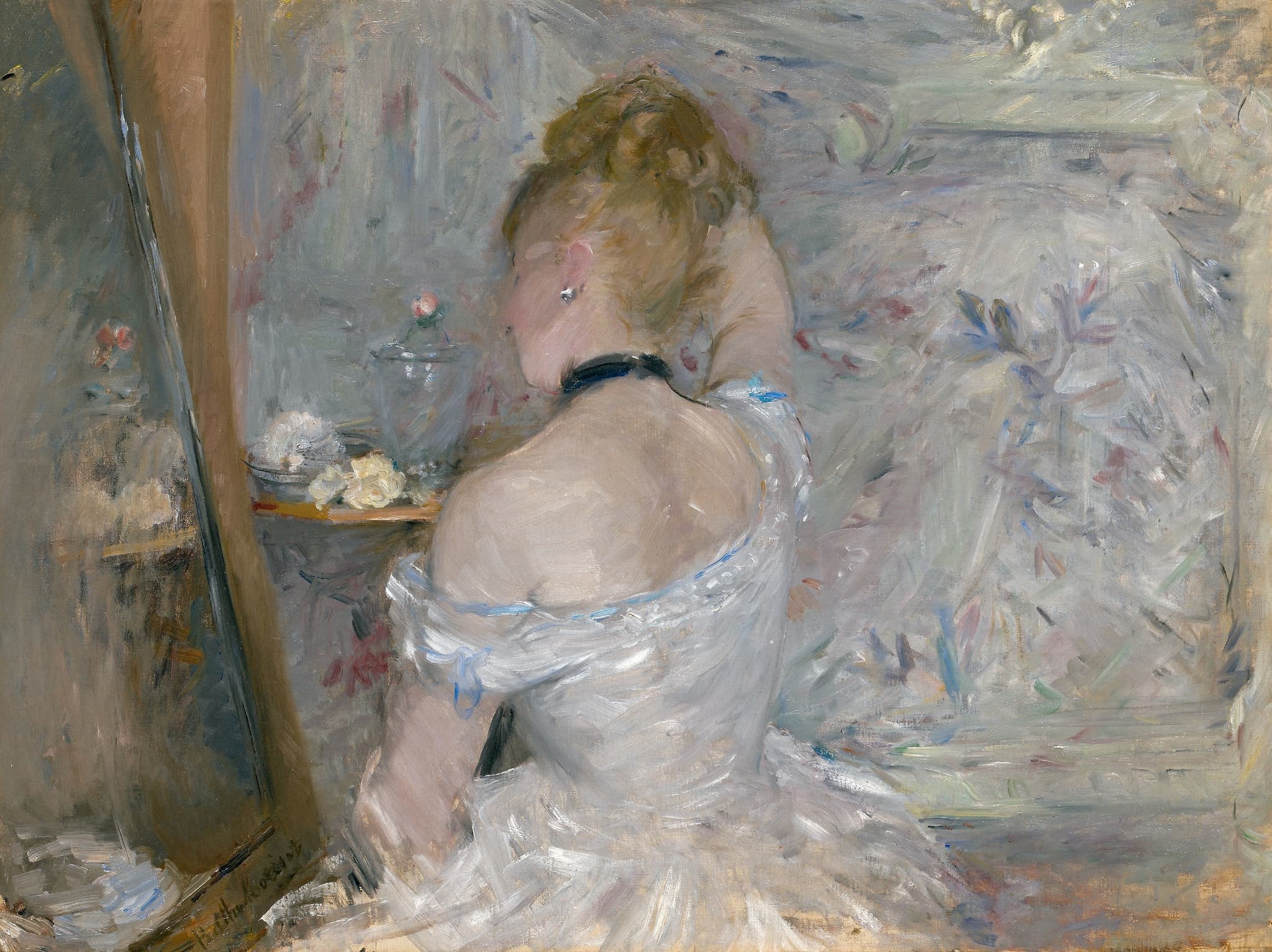
Look at the setup: a woman in satin, arm lifted, powders and jars within reach. Paris, late 1870s. It reads like flirtation. But the reflection is a smear, the face withheld. Morisot built a trap for the viewer and sprung it with a brush.
Stakes? Reputation and independence. In 1874, Berthe Morisot married Eugène Manet—yes, the brother of Édouard Manet, the star who could eclipse anyone in the room. Every time she painted a woman, critics reached for a lazy line: feminine, domestic, derivative. A career could vanish behind a famous surname.
So when she paints Woman at Her Toilette (1875–1880), she paints risk. She’s a founding Impressionist showing women’s lives from the inside, just as she navigates marriage and, by 1878, new motherhood. The tightrope: stay visible as an artist without being turned into someone’s muse. Britannica says it plainly—Morisot helped invent Impressionism while insisting on female interiors as serious ground for modern art 1.
The painting refuses to cooperate with voyeurism. The mirror blurs; powders and a white flower hover like clues; a black velvet choker cuts a bold line through the silvery atmosphere. The Art Institute of Chicago notes that Morisot makes identity deliberately indistinct, turning a toilette into a study of presence without spectacle 2.
“Woman at Her Toilette stages a private ritual of self‑fashioning, not a spectacle of vanity… the mirror’s blurred reflection refuses a clear face.” 3
But here’s the twist: the old story says Édouard Manet taught her how to see. Recent scholarship flips it. The Yale exhibition on Manet & Morisot positions their exchange as reciprocal—two artists cross‑pollinating, not a master and a disciple. Morisot’s audacity and speed challenged Manet, and he changed in response 4.
“Morisot wasn’t orbiting Manet—she was exerting gravity.” 5
Once you hear that click, the painting reads differently. The figure’s back is not coyness; it’s control. The choker is not a costume; it’s punctuation. The scumbled reflection is a boundary line: you don’t get her face, because the moment isn’t for you.
And Morisot knew the cost of setting that line. Impressionism was mocked for being unfinished; women painters were mocked for being women. She doubles down on both: feathery facture, flashes of lilac and gray, a body solid enough to hold its own and a mind that declines to pose. The Art Institute dates the work to a five‑year span; you feel the time—the lived days of a painter who kept working through marriage, through a child’s nap, through the noise of famous men 2.
The market would one day reward this steeliness, but the payoff that matters is cultural: Morisot keys a modern paradox—visibility without surrender. The canvas lets a woman fashion herself, in private, while the public strains to see. That tension is the art. If you want the face, you have to admit why.
Start with the image, then read the room. The museum label will tell you about brushwork; the newer scholarship will tell you about power. Put them together and the myth evaporates. This isn’t vanity. It’s agency—in paint.
Key sources that shift the story: the Art Institute’s record confirms Morisot’s deliberate blur and the 1875–80 dating 2; Britannica establishes her founding role and focus on intimate interiors 1; the Yale study reframes her relationship with Manet as mutual 4; and recent coverage underscores how institutions are finally centering Morisot rather than treating her as a footnote 5. For a fast, vivid walkthrough of the image’s cues, see the Painting Meanings page 3.
Takeaway: the mirror isn’t there to reflect her to us—it’s there to reflect us back.
1 Britannica: https://www.britannica.com/topic/Woman-at-Her-Toilette
2 Art Institute of Chicago object record: https://www.artic.edu/artworks/11723/woman-at-her-toilette
3 Painting Meanings artwork page: /artworks/berthe-morisot/woman-at-her-toilette
4 Yale University Press exhibition excerpt (Manet & Morisot): https://yalebooks.yale.edu/2025/11/07/an-excerpt-from-manet-and-morisot/
5 The Washington Post on the 2025 Manet & Morisot exhibition: https://www.washingtonpost.com/entertainment/art/2025/10/17/manet-morisot-san-francisco/
Sources & Further Reading
Woman at Her Toilette — Berthe Morisot
Woman at Her Toilette — Berthe Morisot
Woman at Her Toilette — Berthe Morisot
Woman at Her Toilette — Berthe Morisot
Woman at Her Toilette — Berthe Morisot
Continue Exploring
See more details and the full image: /artworks/berthe-morisot/woman-at-her-toilette