Painting Meanings Essay
Two Guilders and a Global Brand: How “Girl with a Pearl Earring” Won the Market Without Ever Being for Sale
The room smelled of dust and old frames. A minor Hague auction.
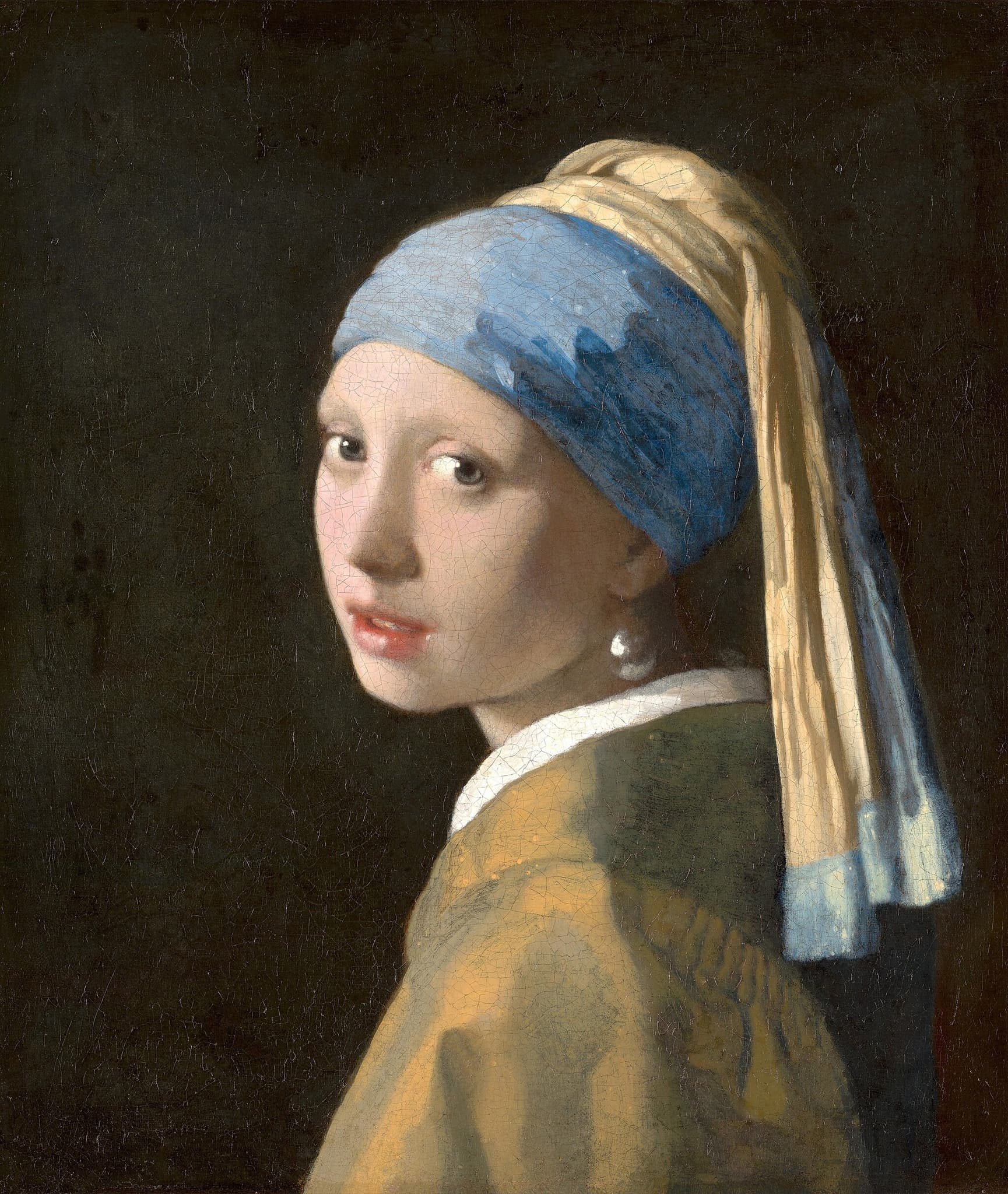
The room smelled of dust and old frames. A minor Hague auction. Little competition. A civil servant named A.A. des Tombe raised a hand, nudged by art crusader Victor de Stuers. They weren’t chasing a trophy; they were rescuing something no one else wanted. Reputation was on the line—De Stuers had warned for years that Dutch heritage was slipping away. Des Tombe took the gamble and the girl came home wrapped in brown paper.
“Two guilders and thirty cents.”1
That number would become the market’s favorite ghost story.
Des Tombe never sold. When he died in 1902, he left the painting to the Mauritshuis. No auction theatre. No dealer drumroll. The museum inherited not just a picture but a question: how do you build a brand on an unknown? Vermeer, then, wasn’t Vermeer. He was a whisper restored to a name, a handful of canvases amid attribution fights and shrugging audiences.
The Mauritshuis answered with patience and light. A 1994 restoration stripped yellowed varnish, snapping the headscarf back to ultramarine, the jacket to honey, the background to clean night.1 The girl’s gaze, freshly oxygenated, met ours. Visitors slowed. Photographers copied the pose. Posters began to sell. The museum had a star—and a responsibility. Protect it. Share it. Monetize it without cheapening it.
Then pop culture detonated. Tracy Chevalier wrote a novel, pictured a housemaid, a workshop, a gaze that could upend a life. The bestseller brought the girl into bedrooms and book clubs; the 2003 film beamed her to multiplexes. The painting wasn’t a portrait after all—it’s a tronie, an imagined face—but the myth had momentum, and the museum had lines down the block.14
Here’s the twist that would make auction houses sweat: the world’s most bankable image wasn’t even in the marketplace. Instead, the Mauritshuis loaned selectively, toured judiciously, and watched the meter spin in ticket sales, city tourism, and global attention. At every stop, the price was measured in hours waited, not hammers dropped.
By 2023, the frenzy crystallized. The Rijksmuseum announced a once-in-a-lifetime Vermeer show. Tickets vanished. People begged online for returns; scalpers prowled forums. The museum’s statement read like an earnings call for wonder:
“Never before have so many Vermeer paintings been brought together… The show is completely sold out.”3
For a few weeks, the girl traveled across town, anchoring a blockbuster and then snapping back to the Mauritshuis, where empty walls mean lost pilgrims and missed revenue. In the modern art economy, scarcity is strategy. Presence—here, now, only briefly—is pricing power.
What, exactly, did that 1881 bet buy? Not a commodity. A perpetual motion machine. Every school report, every cell-phone selfie, every tote bag is a micro-transaction in cultural capital. The Mauritshuis doesn’t quote a number; it doesn’t have to. The painting mints attention that underwrites conservation labs, education programs, and entire museum calendars. When your headliner’s eyes meet a visitor’s and they feel seen, the museum has already closed the deal.
Critics will say this is marketing wrapped as miracle. They’re not wrong. But marketing needs a product, and the product is an encounter. Vermeer engineered it with ruthless economy—few strokes, big contrasts, a black stage where a single earring flashes like a bell. That simplicity travels. It’s easy to print. Easy to parody. Easy to love. And every copy only sells the original harder.2
The raw material? A misunderstanding the museum has leaned into with tact. It’s not a portrait of Vermeer’s daughter. It’s a fantasy face, a studio invention, a study in light. But fantasies are famously scalable. The less specific the sitter, the more space for projection—and the more people will pay to stand in that space, even if no money changes hands.12
So the price keeps rising without a sale. The girl rescues the museum that rescued her. Des Tombe and De Stuers look like geniuses in the rearview. And the market learns a quiet new rule: the most valuable art may be the piece you can never buy, only borrow, only visit, only remember.
That 1881 slip of paper still haunts the ledger. Two guilders and thirty cents. The cheapest bid that rewrote what expensive looks like.