Marc Chagall Paintings in Paris — Where to See Them

Paris remains essential for experiencing Marc Chagall because the city houses his work across three major institutions — with approximately one painting on permanent display — anchoring his presence in the specific historical and cultural contexts of Paris. The Musée d'Art et d'Histoire du Judaïsme (mahJ) is the site of that permanent Chagall painting, while the Petit Palais and the Musée Carnavalet frame his connection to the city and Jewish heritage through exhibitions and archives even though they do not hold paintings on permanent display.

At a Glance

Museums
Musée d'Art et d'Histoire du Judaïsme (mahJ), Petit Palais (Musée des Beaux-Arts de la Ville de Paris), Musée Carnavalet - Histoire de Paris
Highlight
See Chagall's painting at mahJ and explore Jewish art context.
Best For
Art and history lovers interested in Jewish heritage and Parisian museums.

Musée d'Art et d'Histoire du Judaïsme (mahJ)

The mahJ holds important early works by Marc Chagall that speak directly to his Jewish roots and his formative years in Paris — for example the museum’s holdings include Chagall’s 1911 picture (often shown in the mahJ’s modern/20th‑century displays), which is used in the museum’s narratives about Jewish artists of the École de Paris. The mahJ frames Chagall not simply as a modernist painter but as part of a Jewish cultural history in France, so seeing his work there places it in dialogue with religious objects, archives and the stories of the Parisian Jewish community. ([mahj.org](https://www.mahj.org/en/permanent-collection?utm_source=openai))
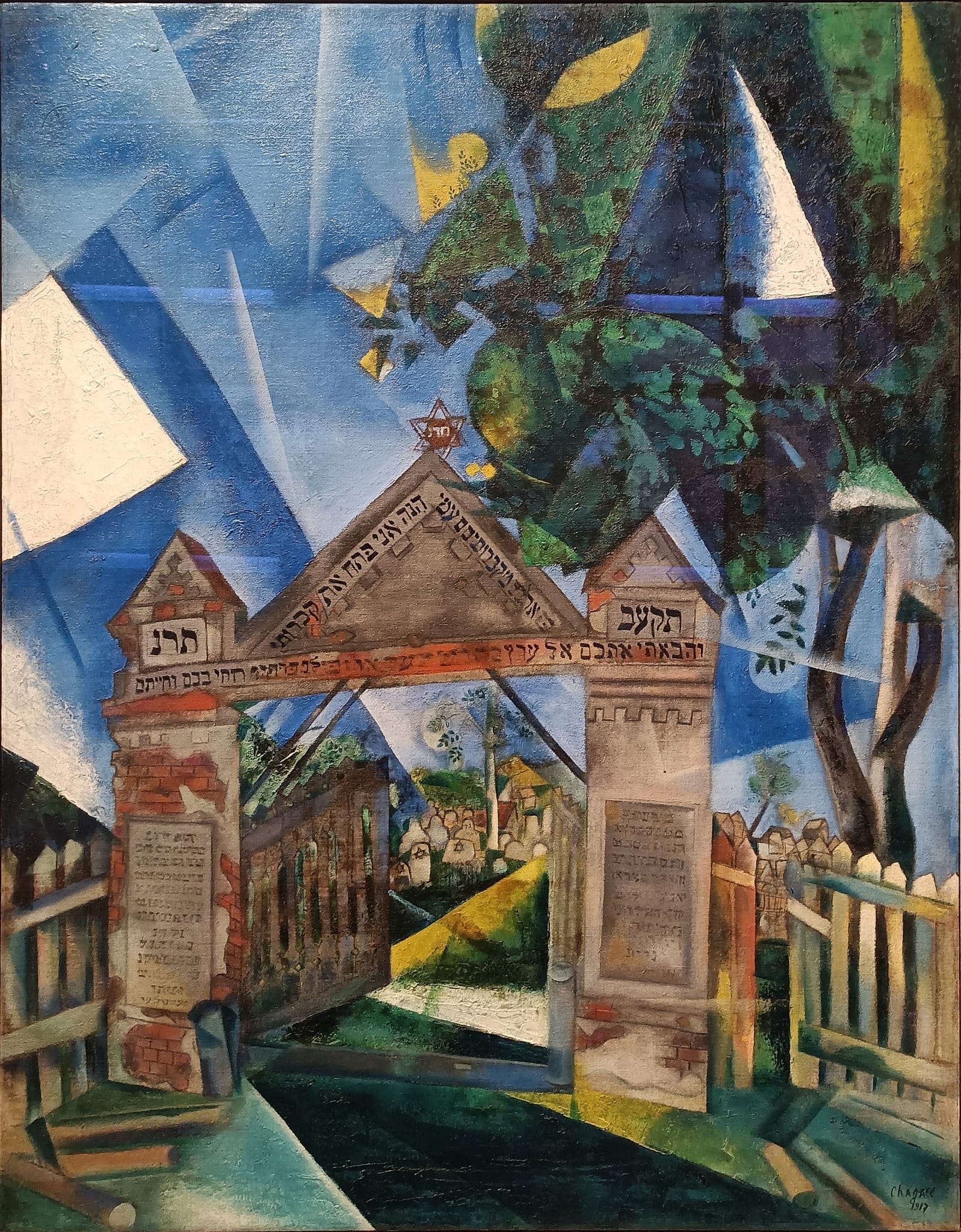
Les Portes du cimetière

Les Portes du cimetière

1917

Depicts the entrance gates of a Jewish cemetery seen from outside, with Chagall’s characteristic floating, angular forms and a compacted, dreamlike composition that blends figuration and abstraction. Painted in 1917, it is significant for linking personal Jewish memory and religious themes (cemetery/resurrection) with the artistic innovations of its moment — showing Chagall’s engagement with contemporary currents such as Suprematism while expressing the hopes and anxieties around the 1917 revolutionary period. Viewers should look for the gate’s triangular and geometric motifs, the juxtaposition of somber and luminous colors, and small, suspended figures that give the scene its lyric, otherworldly quality.

Must-see
Address: 71 Rue du Temple, 75003 Paris
Hours: Tue–Fri 11:00–18:00; Sat–Sun 10:00–18:00; closed Monday. (Nocturnes sometimes extend hours; check mahJ for exceptions.)
Admission: Full price €13 (reduced rates available); permanent collection free first Saturday of the month Oct–Jun. Check mahJ for up-to-date tariffs and concessions.
Tip: Head first to the mahJ’s 20th‑century/École de Paris rooms (where Chagall is grouped with Modigliani and others) early in the day when lighting is calm; visitors often miss the archival labels explaining provenance (useful for understanding why that particular Chagall is in the mahJ). ([mahj.org](https://www.mahj.org/en/permanent-collection?utm_source=openai))

Petit Palais (Musée des Beaux-Arts de la Ville de Paris)

Address: Avenue Winston Churchill, 75008 Paris
Hours: Tuesday–Sunday 10:00–18:00 (last entry to permanent collections ~17:15). Closed Monday. Late openings (exhibitions) Friday & Saturday until 20:00.
Admission: Access to the permanent collections is free; temporary exhibitions have separate paid admission.

Musée Carnavalet - Histoire de Paris

Address: 23 Rue de Sévigné, 75003 Paris
Hours: Tuesday–Sunday 10:00–18:00 (last ticket sales / last entry 17:15). Closed Monday and on January 1, May 1, and December 25.
Admission: Permanent collections: free and open access. Temporary exhibitions: paid (ticketed).

Marc Chagall and Paris

Marc Chagall’s relationship with Paris was foundational to his career. He arrived in the French capital in May 1911, settling first in Montparnasse and soon moving into the artists’ colony La Ruche, where he lived and worked from 1911–1914 and absorbed Cubist and Fauvist developments alongside peers such as Modigliani and Léger. 12 In Paris he showed at the annual Salons (Salon des Indépendants and Salon d’Automne) and made important contacts—most notably with the critic-poet Guillaume Apollinaire and dealer Herwarth Walden—that led to his first one-person exhibition at Der Sturm in Berlin in June–July 1914, just before he returned to Vitebsk for World War I. 3 After the war Chagall returned to Paris in the 1920s, worked with dealer Ambroise Vollard on major illustrated projects (Gogol’s Dead Souls, La Fontaine’s Fables, the Bible) and exhibited widely, consolidating his reputation in the city’s interwar avant-garde. 4 Key Parisian addresses and institutions—La Ruche (Passage Dantzig), the Salons, and galleries connected to Der Sturm and Vollard—mark the decisive moments when Chagall’s poetic, color-driven style coalesced and entered the international art world. 134

Also See Marc Chagall Paintings In