Marc Chagall Paintings in New York — Where to See Them
New York matters for experiencing Marc Chagall because, while only approximately two of his paintings are on permanent display across five major museums, those works sit in institutions that frame his art within both modernist innovation and monumental architecture. Specifically, The Museum of Modern Art and the Solomon R. Guggenheim each maintain one Chagall painting on view, whereas The Metropolitan Museum of Art, the Brooklyn Museum, and The Jewish Museum currently have no paintings on permanent display—so your best bet in the city is to see how Chagall’s canvases operate within MoMA’s modern narrative and the Guggenheim’s spiraling presentation.
At a Glance
- Museums
- The Metropolitan Museum of Art, The Museum of Modern Art (MoMA), Solomon R. Guggenheim Museum, Brooklyn Museum, The Jewish Museum
- Highlight
- See Chagall's works at MoMA and the Guggenheim.
- Best For
- Fans of modern art and Chagall's poetic, Jewish-inflected imagery.
The Metropolitan Museum of Art
Although the Met holds no paintings by Marc Chagall, it matters for experiencing his work because its drawings, prints, and thematic installations place Chagall within the long history of European and Jewish art that the museum surveys. Seeing Chagall in the Met’s broader decorative-arts and Old Master contexts helps you trace the sources he drew on—folk motifs, religious imagery, and color traditions—rather than viewing him only as an isolated modernist. The museum’s catalogues and occasional loans also help reconstruct how Chagall’s work was received by major collectors and institutions in the U.S.
The Museum of Modern Art (MoMA)
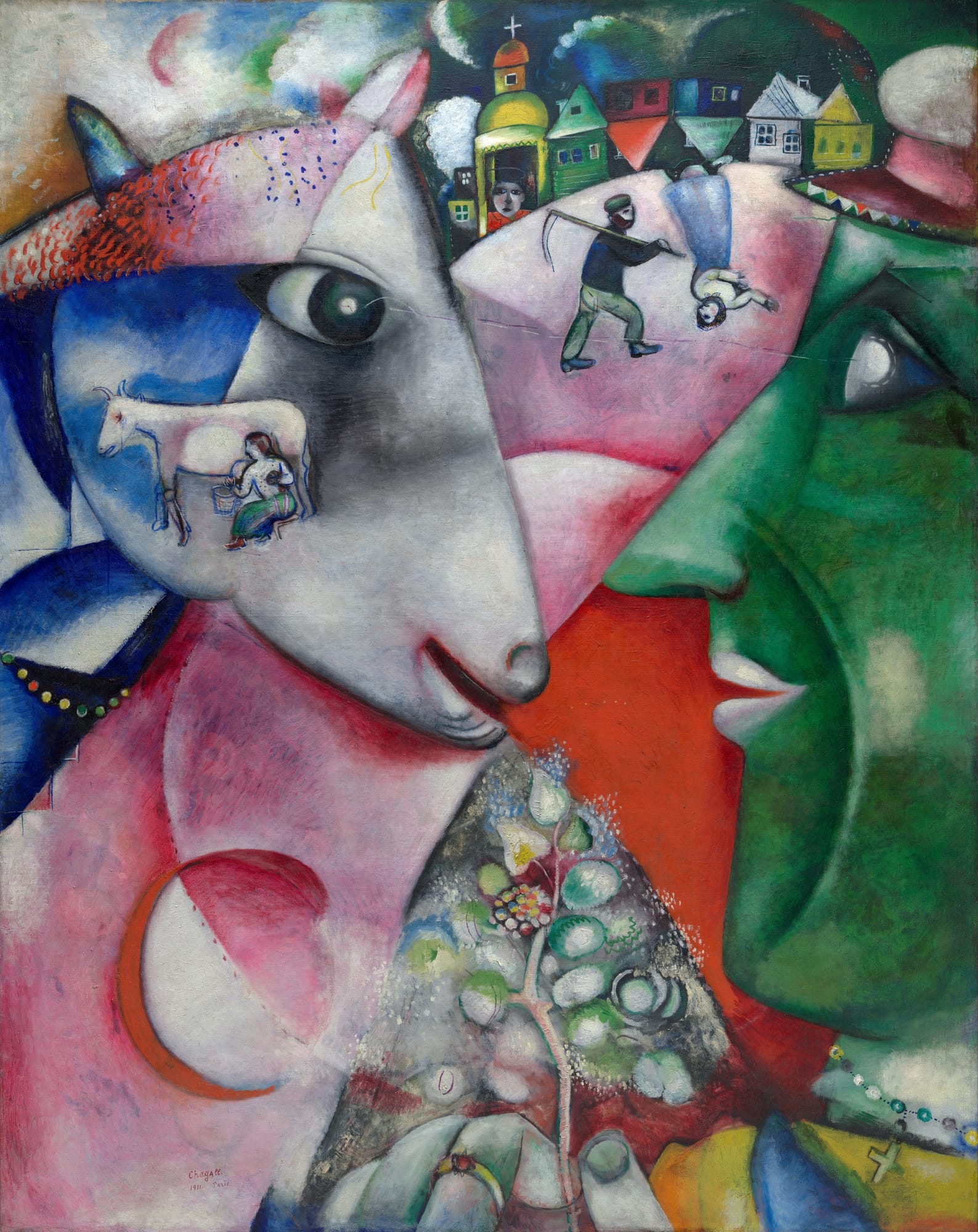
MoMA’s single painting by Chagall matters because it situates him directly within the story of twentieth‑century modernism that MoMA tells: placed alongside Cubist, Surrealist, and Abstract works, that painting highlights how Chagall blended avant‑garde formal innovation with deeply personal, narrative symbolism. MoMA also frequently uses that presence to frame loans, exhibitions, and comparisons that clarify Chagall’s relationship to movements like Surrealism and lyrical modernism, making the museum a key place to see how curators interpret his influence on modern art.
Solomon R. Guggenheim Museum
The Guggenheim’s single Chagall painting matters because the museum’s commitment to modernist narrative makes it a place where Chagall’s coloristic and spatial innovations can be read alongside contemporaries who pushed pictorial boundaries. The building’s spiral galleries encourage a continuous, centrifugal viewing experience that emphasizes movement and dreamlike progression—qualities resonant with Chagall’s floating figures and poetic compositions—so his work gains a particular dynamism within the Guggenheim’s presentation strategy.
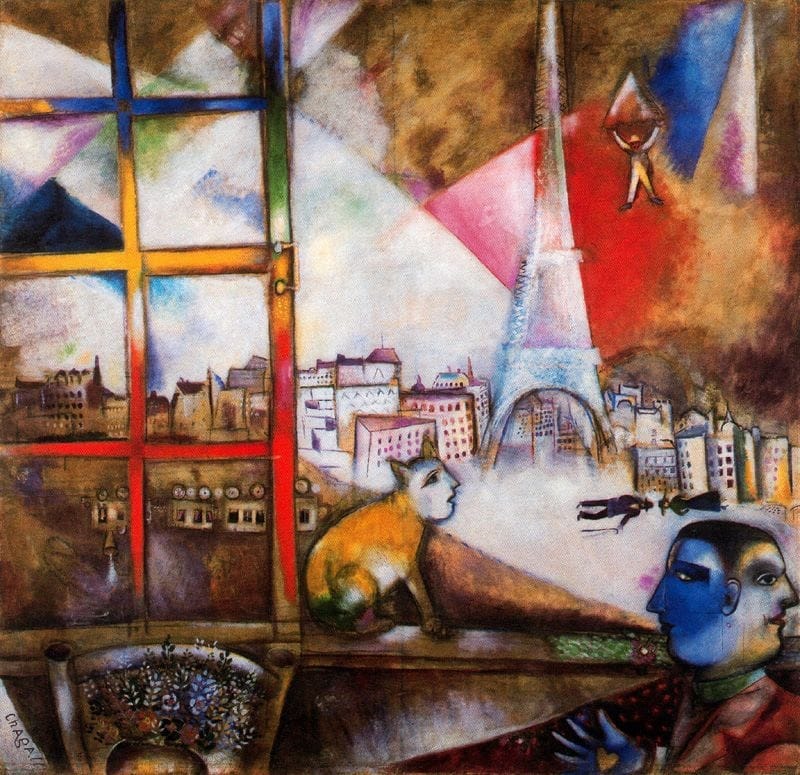
Paris Through the Window
1913
A dreamlike, bird’s-eye view of Paris seen through a window: rooftops, a tiny Eiffel Tower-like spire and a cluster of floating, often-animal or human figures overlap fragmented planes. The work is significant as an early achievement in which Chagall fuses his Russian-Jewish folkloric imagery with the formal experiments of Parisian modernism, creating a personal, poetic take on Cubist-inspired space. Look for the framing device of the window, the playful scale shifts (figures and objects floating above the city), and the bold jewel-like colors and outline gestures that make the scene feel both intimate and fantastical.
Must-seeBrooklyn Museum
Even though the Brooklyn Museum lists no paintings by Chagall, it matters because its collecting and exhibition programs often highlight the cultural and social milieus that shaped Chagall—Jewish life in Eastern Europe, immigrant narratives in America, and cross‑cultural modernisms—so encountering related objects there enriches an understanding of his themes. The museum’s regional and thematic shows, plus its educational resources, make it a useful place to study the communities and visual traditions that informed Chagall’s iconography.
The Jewish Museum
The Jewish Museum’s significance for Chagall lies less in holdings of paintings and more in interpreting the Jewish themes that pervade his oeuvre—biblical subjects, shtetl memory, and ritual imagery—within a focused cultural and historical framework. Exhibitions and programs there typically place Chagall in conversations about Jewish visual culture, memory, and identity, helping visitors understand the religious and communal contexts that shaped many of his most persistent motifs.