I and the Village
by Marc Chagall
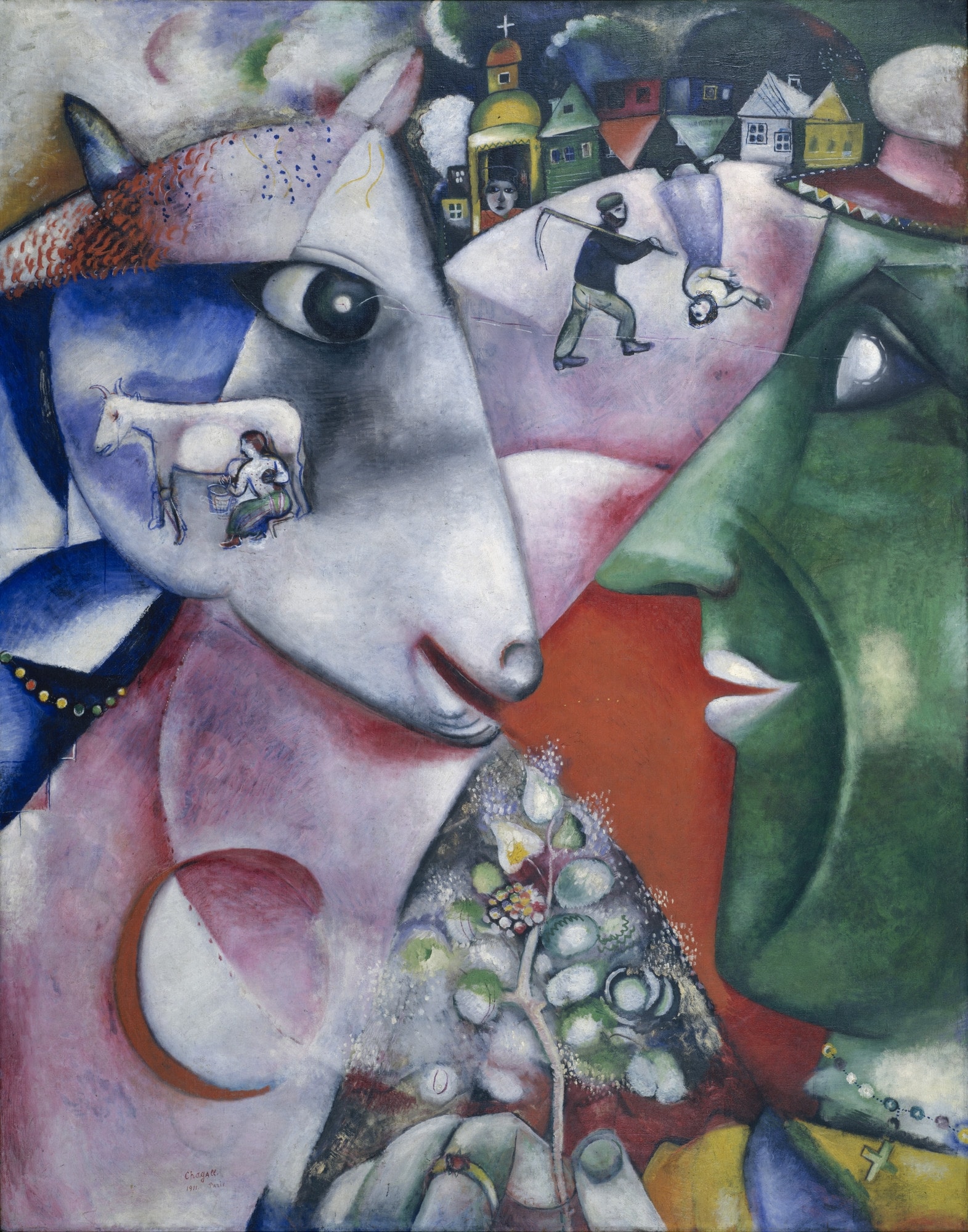
In I and the Village, Marc Chagall fuses memory, myth, and rural ritual into a dream‑logic tableau where a green‑faced villager and a pale bovine meet eye‑to‑eye. Concentric forms, prismatic color, and floating figures turn Vitebsk’s everyday life into a cosmic community where work, faith, and imagination coexist [1][3].
Study Print Studio
Create a personal study print
Build a companion study sheet around the part of this painting that speaks to you most. Choose a detail, shape an interpretation, and walk away with something personal and display-worthy.
Fast Facts
- Year
- 1911
- Medium
- Oil on canvas
- Dimensions
- 192.1 × 151.4 cm
Click on any numbered symbol to learn more about its meaning
Meaning & Symbolism
Chagall builds the painting around a reciprocal gaze: a large pale animal and a green‑cheeked villager confront each other across a sliver of red, their eyes bridged by a faint directional line. This is less portrait than pact—a claim that human life, barnyard life, and the land are mutually legible. Inside the animal’s muzzle, a miniature scene of a woman milking a goat or cow functions as a memory‑within‑memory, locating nourishment and labor at the heart of the bond 3. Around this bond, the village unfurls in broken planes: an onion‑domed church glows above stacked, tilting houses; a peasant strides with a scythe; another figure flips upside‑down, as if gravity yields to recollection. Circular forms bind these fragments into a rhythmic continuum—the beaded rosary at the man’s neck, a bright crescent moon, fruiting orbs on the sprig he holds—suggesting cycles of day and season, devotion and return. The chromatic scheme—acid greens, chalk whites, blues and reds sliced into angled facets—echoes Cubism’s structure and the Delaunays’ chromatic orbs, yet Chagall bends these devices toward folk‑poetry rather than toward abstraction for its own sake 125.
The painting’s spatial logic is declarative: simultaneity replaces sequence. Houses invert, a fiddler‑like figure floats, faces interpenetrate field and sky; Chagall asserts that memory does not proceed in straight lines. He also refuses confessional exclusivity. The villager’s necklace bears a simple cross while the onion dome crowns the skyline; these Christian emblems sit unopposed within an Eastern European shtetl world, staging an inclusive, lived religiosity rather than a doctrinal statement 123. The hand holding a luminous sprig—clustered with round fruits or blossoms—reads as a modest tree‑of‑life sign, a counter‑scythe that marks renewal against harvest and mortality. Through these juxtapositions, Chagall converts Paris‑era modernism into a grammar of continuity: Cubist fracture becomes a way to layer past and present; Orphic circles become time’s wheels; color becomes emotional topography. In this light, the green face is not exoticism but inner weather—a chromatic mask for the self who carries the village within him. For Britannica, the canvas is a “cubist narrative self‑portrait”; for museum scholarship, it resists labels precisely because it treats style as a servant of remembrance 21. What endures is the work’s ethical proposition: the village is a living commons of human, animal, and celestial bodies—a cosmic community whose pact is sealed eye‑to‑eye 3. By binding modern form to ancestral memory, I and the Village shows how art can keep a place alive even after one has left it, and why this painting remains a touchstone for artists seeking to reconcile experimentation with home 123.
Explore Deeper with AI
Ask questions about I and the Village
Popular questions:
Powered by AI • Get instant insights about this artwork
💬 Ask questions about this artwork!
Interpretations
Eco‑Phenomenology: A More‑Than‑Human Village
Read through environmental humanities, the painting frames a reciprocal ecology: human, animal, and celestial bodies form a single lifeworld. The eye‑to‑eye tether, embedded milking scene, and sprig establish an ethics of co-presence where sustenance and care circulate across species. Polyxeni Potter calls this a “cosmic community,” collapsing barnyard, church, sun, and moon into a shared continuum; Chagall’s lyric Cubism thus becomes a One‑Health poetics rather than mere style 3. By integrating fauna (the ungulate), flora (fruiting sprig), and village labor, the canvas resists the modern city’s extractive distance, proposing intimacy as environmental knowledge. The result is not pastoral escape but a phenomenology of kinship, where looking is a form of tending.
Source: CDC, Emerging Infectious Diseases (Polyxeni Potter)
Syncretic Iconography: Lived Religion, Not Doctrine
The cross at the villager’s neck and the onion‑domed church signal Christian iconography nested within a shtetl setting. Rather than a confessional manifesto, Chagall stages everyday coexistence—a visual anthropology of belief as habit and place. Britannica identifies the work as a “cubist narrative self‑portrait,” yet stresses Chagall’s dreamlike synthesis of memory and symbol; the Christian signs read as local fixtures within a plural village cosmos, not theological claims 2. Museum scholarship further notes Chagall’s resistance to strict labels, absorbing forms from multiple traditions into a personal metaphoric system 6. The painting thus models plural devotion, where sacred markers anchor communal rhythm while yielding to the higher law of memory and care.
Source: Encyclopaedia Britannica; Guggenheim (Dossier Chagall)
Temporal Montage: Cubist Structure as Memory Engine
“Simultaneity replaces sequence” describes a temporal montage: inverted houses, floating figures, and picture‑within‑picture fold past and present into one pictorial instant. UCL research highlights how concentric circles and Cubist geometry collaborate with the church motif to stage layered time—Orphist rhythms rewired as mnemonic cycles 4. In Chagall’s hands, fracture is not analytic dissection but a continuity device, letting heterogeneous moments co‑inhabit the surface. This temporal cubism differs from Parisian rigor; it is folk‑poetic, calibrated to recollection’s leaps rather than to optics. As modernist vocabulary, circles and facets become timekeepers, making the canvas function like memory’s palimpsest rather than a window onto sequential narrative.
Source: UCL Discovery (academic study on I and the Village)
Labor, Gender, and Embedded Memory
Inside the animal’s muzzle, the milking vignette operates as an embedded archive of village labor—quiet, gendered, sustaining. Instead of heroic toil, Chagall preserves care work: milking as ritual that binds human bodies to animal rhythms and the local economy. The Met’s contextual materials on Vitebsk imagery underscore how folk life and “naïve” accents shape Chagall’s Paris‑era language, allowing domestic labor to occupy central symbolic space 5. Potter’s reading of a “cosmic community” clarifies why this insertion matters: nourishment is structural, not anecdotal 3. By installing work inside the animal, Chagall literalizes interdependence—labor is not beside life; it is life’s interior scene, remembered and sanctified.
Source: The Metropolitan Museum of Art; CDC, Emerging Infectious Diseases
Doppelgänger Self‑Portrait: The Human–Animal Pact
Britannica’s phrase “cubist narrative self‑portrait” invites a doppelgänger reading: the green‑cheeked villager and pale animal mirror and complete each other, joined by a directional eye‑line 2. The title—“I and the Village”—has been glossed as Chagall and Vitebsk, suggesting that identity is relational, composed of place and its creatures 7. The animal is not mere motif but an alter‑ego that stores memory (the milking scene) and returns the viewer’s gaze, as if acknowledging shared personhood. In this psycho‑poetic structure, color functions as a mask of interiority (the green face as inner weather), while Cubist interpenetration stages a compact between selves. Portraiture here becomes pact‑making, an ethics of recognition across species.
Source: Encyclopaedia Britannica; JAMA (Humanities essay)
Seen in Comparisons
Related Themes
About Marc Chagall
Marc Chagall (1887–1985) left Vitebsk for Paris in 1910, absorbing Cubism and the color experiments of the Delaunays while forging a personal language rooted in memory and folklore. Painted in 1911 during his first Paris stay, I and the Village crystalizes this synthesis before his 1914 return to Vitebsk and later cosmopolitan career [1][6].
View all works by Marc Chagall →