The Green Violinist

by Marc Chagall

The Green Violinist magnifies a village fiddler into a sky‑bridging guardian, his green face and purple coat turning him into a spiritual emissary rather than a mere entertainer. Striding across crooked rooftops without crushing them, he binds the shtetl’s houses, tree, clouds, and wandering figures into one continuous chord. Chagall fuses folkloric memory with modernist facets to assert music as the community’s sustaining force.

Fast Facts

Year
1923–1924
Medium
Oil on canvas
Dimensions
197.5 × 108.6 cm
Location
Solomon R. Guggenheim Museum, New York
The Green Violinist by Marc Chagall (1923–1924) featuring Green face, Violin and bow, Patchwork garments (purple coat and checked trousers), Rooftops and houses of the shtetl

Click on any numbered symbol to learn more about its meaning

Meaning & Symbolism

Chagall casts the fiddler as a colossal, otherworldly patron whose music literally orders the world beneath him. The figure’s green visage, tilted under a plum hat, and his angular, patchwork trousers are not mere eccentricities; they mark a shift from portrait to spiritual agency, aligning the violinist with Hasidic practices in which sound and movement become prayer 2. The musician’s bow draws a horizon through the canvas, while houses splay into Cubist planes that seem to vibrate with the melody. He plants one foot on a pitched roof and hovers the other above a second, refusing the physics that would crush the village—an assertion that culture survives not by weight but by rhythm. The bare winter tree, the drifting clouds, and the small passerby with a stick echo the seasons and errands of shtetl life, yet the village yields to the fiddler’s scale, declaring that communal time keeps tempo with his song. The color logic intensifies this metaphysics. Green, clashing with the purple coat and orange‑red violin, reads as an aura rather than flesh, projecting renewal, strangeness, and sanctity. Scholars have noted how Chagall’s chromatic oppositions reach beyond decoration to tap deeper psychic currents; here green refuses naturalism to signal a mediator between earthbound roofs and a clouded, hovering realm 26. The fractured coat and faceted background absorb lessons from Parisian avant‑garde idioms, but Chagall bends those geometries toward lyricism, letting forms drift and overlap as if the bow’s vibrations were re‑composing space. This is not Cubism’s analytic dissection; it is a devotional montage in which memory, belief, and place are superimposed. The image’s authority also comes from its self‑citation. Painted in 1923–24, after Chagall left Russia and resettled in Paris, The Green Violinist revisits the violinist motif he developed for the Moscow State Jewish Theater—especially the panel Music—yet enlarges it into a stand‑alone icon 34. That doubling of time—past theater, present canvas—lets the fiddler figure as a custodian of heritage at a moment of displacement. Even the precarious footing across rooftops admits vulnerability: a culture must balance, improvise, and keep playing. This helps explain why The Green Violinist has become shorthand for the “fiddler on the roof” archetype in popular discourse, even as scholars caution against tying the later musical’s title to any single Chagall canvas 5. In Chagall’s hands, however, the archetype is not nostalgia but continuity: the violin converts private grief into communal grace. The painting thus articulates why The Green Violinist is important: it forges a modern sacred image where avant‑garde form, shtetl memory, and musical devotion cohere into one sustaining, green‑glowing presence 23.

Explore Deeper with AI

Ask questions about The Green Violinist

Popular questions:

Powered by AI • Get instant insights about this artwork

💬 Ask questions about this artwork!

Interpretations

Historical Context

Painted just after Chagall’s return to Paris (1923), The Green Violinist reactivates imagery first forged in Moscow for the State Jewish Theater, but now scaled into a solitary, iconic presence. This interlude—Russia (1914–22), the GOSET commission (1920–21), transit via Berlin, and resettlement in Paris—matters because it recasts the fiddler from decorative ensemble to diasporic emblem. In leaving the revolutionary yet tightening cultural climate of Russia, Chagall transforms stage “Music” into a portable shrine of memory that could travel with him, aesthetically and biographically. The painting’s monumental format and self‑quotation register as a negotiation between avant‑garde Paris and the artist’s rooted Yiddishkeit, making the canvas a hinge between institutions (theater/museum) and between geographies (Vitebsk/Paris) 236.

Source: Guggenheim/Art Institute of Chicago (1992); Musée National Marc Chagall; French Ministry of Culture

Symbolic Reading (Hasidic Devotion and Color)

Chagall’s fiddler performs as a Hasidic tzadik of sound: music and dance operate as prayer, elevating the everyday into devekut (cleaving to the divine). The chromatic choices intensify this sanctity—green face against purple coat and orange‑red violin read not as naturalism but as numinous aura, a sign of mediated presence rather than portrait likeness. The bow aligns a horizon, literally tuning the village to a sacred tempo. Color here functions theologically: the anti‑natural green codes estrangement and renewal, marking the violinist as an intermediary between earthbound roofs and hovering cloud‑forms. In this frame, chroma is not décor but a vector of spiritual agency, translating sound into light and ritual into sight 17.

Source: Solomon R. Guggenheim Museum (Jennifer Blessing); Christie’s catalogue essay

Formal Analysis (Lyric Cubism and Spatial Music)

Formally, the canvas conducts a shift from Cubist analysis to lyric montage. Faceting remains, but edges soften into overlapped planes that seem scored by the bow’s vibrations; architecture splays into rhythmic intervals rather than Euclidean solids. The violinist’s asymmetric footing—one boot planted, the other hovering—introduces a kinetic “off‑beat” that denies gravity and installs meter as the work’s structuring principle. The effect is a pictorial synesthesia: color harmonies (complements and dissonances), planar counterpoint, and a drawn “staff‑line” horizon bind village and sky into a single tonal field. This isn’t abstraction severed from referent; it’s a recalibrated mimesis where memory and melody re-compose space 12.

Source: Solomon R. Guggenheim Museum; Guggenheim/Art Institute of Chicago (1992)

Intermedial Lens (From Stage Mural to Modern Icon)

Green Violinist converts theatrical language into a museum‑scale icon. The 1920 GOSET panel Music staged communal ritual within a performative environment; the 1923–24 canvas isolates and canonizes that performer, stripping narrative sequence for emblematic force. This translation across media reframes spectatorship: from time‑bound stage action to contemplative, vertical address. The figure’s enlargement and centralized pose adopt the rhetoric of devotional imagery, yet the painterly facture and Cubist‑inflected planes anchor it in modernism. The result is an intermedial palimpsest—stage memory metabolized into a portable, auratic object that could circulate within Parisian modernist networks while still bearing the theater’s collective ethos 2.

Source: Guggenheim/Art Institute of Chicago (1992)

Reception & Cultural Afterlife

While popular shorthand links Chagall’s rooftop fiddlers to Fiddler on the Roof, historians caution against assigning the musical’s title to a single painting. Designers and directors drew broadly on Chagall’s violinist corpus; Green Violinist functions as a powerful emblem rather than a sole source. In pedagogy, the image often exemplifies Ashkenazi musical lifeworlds, helping audiences visualize how klezmer practice sutures rites, seasons, and memory. This dual reception—scholarly restraint alongside popular iconization—reveals the canvas’s durability as a cultural shorthand for continuity under displacement, even as academic accounts preserve the plural, intertextual routes from Chagall to Broadway 45.

Source: Washington Post (Solomon/Robbins scholarship synthesis); LACMA educator materials

Related Themes

About Marc Chagall

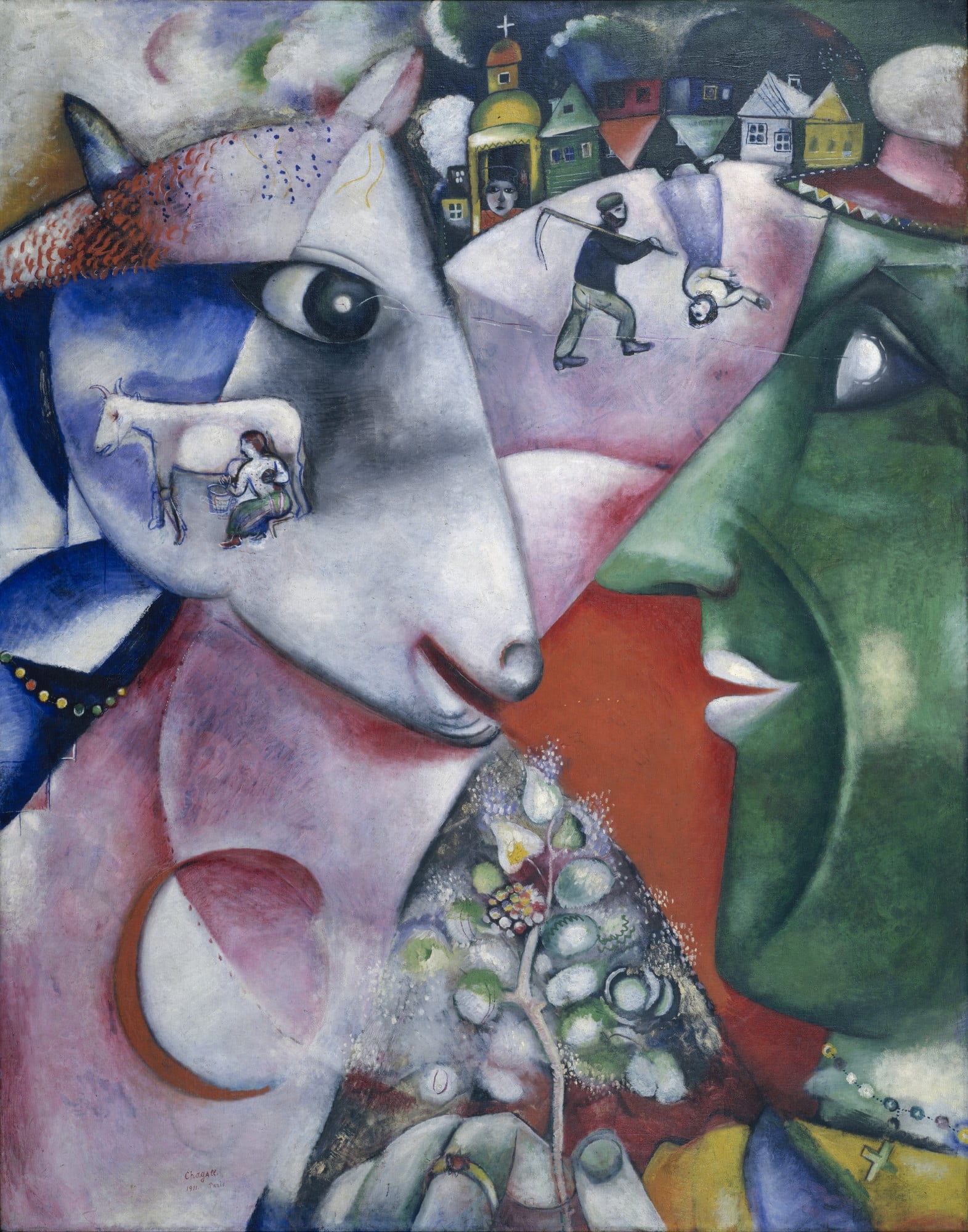
Marc Chagall (1887–1985) left Vitebsk for Paris in 1910, absorbing Cubism and the color experiments of the Delaunays while forging a personal language rooted in memory and folklore. Painted in 1911 during his first Paris stay, I and the Village crystalizes this synthesis before his 1914 return to Vitebsk and later cosmopolitan career [1][6].
View all works by Marc Chagall

More by Marc Chagall