Christina's Crawling Pose in Christina's World
A closer look at this element in Andrew Wyeth's 1948 masterpiece
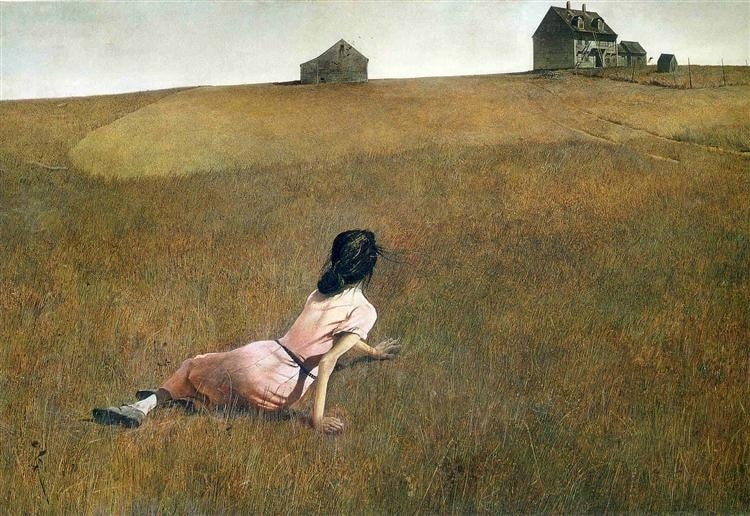
Wyeth fixes Christina low in the grass, arms braced and torso torqued, so that a single act of crawling becomes a state of mind. Observed from life yet composed with care, her pose turns the Maine field into a psychological landscape of resolve measured against distance.
Historical Context
Andrew Wyeth first met Anna Christina Olson in 1939 through Betsy James (later Betsy Wyeth) and worked for years at the Olson House in Cushing, Maine. In the summer of 1948 he conceived Christina’s World after watching Olson cross the fields by pulling herself with her arms, a routine born of a progressive neuromuscular condition and her refusal to use a wheelchair 12. Wyeth aimed, as MoMA records, to “do justice” to her daily conquest; Betsy titled the finished work, signaling that it was less a portrait than a psychological landscape 1.
The setting is real and historically specific: the farmhouse and surrounding acreage where Wyeth made hundreds of works, now preserved by the Farnsworth Art Museum. This grounded, place‑based practice—returning to the same fields, the same hill, the same house—made Christina’s ground‑level mode of travel central rather than incidental to his vision of coastal Maine life in the postwar United States 31.
Symbolic Meaning
Christina’s crawling pose condenses grit, vulnerability, and yearning into a single, legible gesture. Her clenched hand, taut arm, and twisted spine embody determination within isolation, a postwar American realism that MoMA and critics frame as shading into magic realism: precise description haunted by quiet unreality 15. Placed low in the picture plane and far from the buildings, she is anchored to earth while her gaze reaches homeward, making distance itself the subject—the visible measure between desire and attainment 14.
Because Wyeth presents the scene as a psychological landscape, the crawl reads as inner motion as much as locomotion: an emblem of will directed toward belonging 1. Disability‑studies and medical‑humanities scholars focus on the pose’s anatomical cues, arguing that Olson likely had Charcot‑Marie‑Tooth disease rather than polio, which intensifies the image’s documentary power 7. At the same time, Wyeth built the figure from multiple models—Betsy’s younger torso and other details—raising ethical questions about idealization when representing disability; the result is both observational and imaginative, a hybrid body performing a real, observed crawl 56.
Artistic Technique
Wyeth painted the figure in egg tempera on panel, whose matte surface and quick‑drying precision let him render hair wisps, fabric torque, and the strained hands with extraordinary clarity. At roughly 32 × 48 inches, the scale invites close scrutiny of the anatomy that carries the pose’s meaning 1. Conservation imaging shows deliberately descriptive strokes in Christina’s body contrasted with drier, textural handling in the field, heightening tension between a taut figure and a vast terrain 8. Compositionally, a ground‑level viewpoint, a pitched slope, and foreshortened arms pull the viewer into the grass beside her; Wyeth refined rooflines and horizon during painting to optimize the dynamic between body and distant architecture 48.
Connection to the Whole
The crawl is the painting’s narrative engine. It transforms topography into biography: the field becomes “Christina’s world” precisely because her mode of movement inscribes purpose across distance 1. The low vantage and long interval to the house turn a quiet hill into an ordeal measured in inches, binding viewer empathy to her forward intent 4. Critics have long located the work at the hinge of meticulous realism and uncanny stillness; the crawling posture is that hinge, translating psychological reach into visible strain 10. Because the Olson House is real and preserved, the gesture remains tethered to place, fusing memory, site, and human effort into a single compositional thrust 3.
Explore More from This Painting
This detail is one part of Christina's World. Use the links below to return to the full interpretation, browse the full set of details, or view the painting's valuation if available.
Sources
- The Museum of Modern Art, collection record and Highlights text for Christina’s World
- Brandywine Museum of Art, studies and context for Anna Christina Olson
- Farnsworth Art Museum, Olson House history
- MoMA Magazine, One on One essay (Laura Hoptman) on vantage and psychological reading
- Smithsonian Magazine, “Wyeth’s World” (magic realism; composite modeling)
- MoMA Magazine, disability‑focused perspectives on Christina’s World
- Patterson et al., Journal of Child Neurology: clinical analysis of Christina Olson’s condition
- MoMA conservation/imaging overview of Wyeth’s techniques in Christina’s World
- Encyclopaedia Britannica, overview of Christina’s World
- MoMA catalogue essay (PDF) on American realism and magic realism