Christina's World

by Andrew Wyeth

Andrew Wyeth’s Christina’s World distills vast rural space and human resolve into a single, charged image: a woman in a faded pink dress braces on the up-slope toward a weathered farmhouse. The diagonal pull between her body and the Olson House turns distance itself into yearning and endurance [1][4]. Wyeth’s spare, egg tempera surface makes every brittle grass blade feel like an act of will [1][3].

Fast Facts

Year
1948
Medium
Egg tempera on gessoed panel
Dimensions
32 1/4 × 47 3/4 in (81.9 × 121.3 cm)
Location
The Museum of Modern Art (MoMA), New York
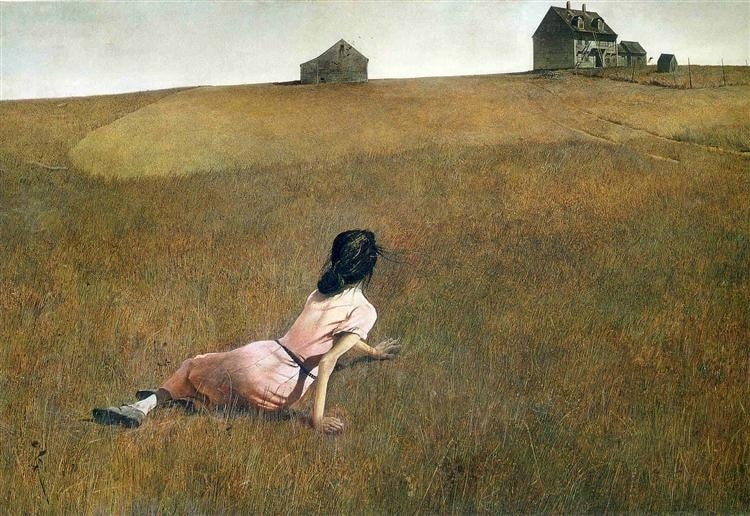
Christina's World by Andrew Wyeth (1948) featuring Olson House (farmhouse and sheds), Vast tawny field, Pink dress, Braced forearms and tense hands

Click on any numbered symbol to learn more about its meaning

Meaning & Symbolism

Wyeth builds meaning from the ground up. The composition straps our gaze to a severe diagonal—figure to house—so the space between becomes the narrative’s engine rather than mere setting 13. In the image, Christina’s forearms are planted, fingers tense, the left leg trailing as if unused; her body aligns with the hillside’s pitch, converting topography into intent. That vector is not decorative: it is the measured distance of resolve. The barely-there sky compresses the world downward, enlarging the field’s tawny acreage until it reads like work itself—arduous, necessary, unavoidable. Wyeth’s egg tempera technique, with its dry, scumbled grasses and weathered clapboards, refuses flourish; the matter-of-fact texture is a moral stance, insisting that endurance is granular, repetitive, and real 13. Within this austerity, the pink dress flashes like a human flare, a calibrated accent Wyeth himself described as an electric jolt; it becomes the painting’s pulse, registering life against dun persistence 3. Wyeth’s realism carries a magic-realist charge precisely because it is so exacting. The Olson House sits high and a touch estranged, its relation to the sheds subtly tightened by the artist to intensify the pull of return 4. The figure is likewise a crafted composite—Christina’s hands and character, with modeled elements from Betsy Wyeth—fusing observation with invention to achieve emblematic clarity 3. That fusion opens the work to layered readings: disability is neither hidden nor sensationalized; it is integrated into the painting’s structure, the braced arms performing both locomotion and meaning 5. Viewers thus confront not a medical case but a proposition: that home, history, and identity often sit uphill, and that dignity consists in the steady, unromantic crawl toward them. In this, the painting resists both nostalgia and cynicism. It neither prettifies rural hardship nor indulges despair; instead, it asserts belonging as a chosen, repeated action. The field’s minute strokes, at times near-abstract, tether Wyeth’s classicism to modernity, aligning his surface energies with contemporary concerns even as mid-century critics favored pure abstraction 37. Consequently, the meaning of Christina’s World exceeds biography while honoring it. The image anchors itself in a real place—the Olson House in Cushing, Maine—and in Christina Olson’s constrained mobility, now often associated with Charcot–Marie–Tooth disease based on family history and the painting’s anatomical cues 45. Yet Wyeth converts these facts into a general statement about perseverance and desire. The farmhouse is not just a destination; it is a repository of time, labor, and identity. The woman’s turned head confirms orientation rather than helplessness; her body is a compass. In refusing spectacle and choosing distance as drama, Wyeth formulates a durable American myth: that the measure of a life is the ground one claims, inch by inch, under an open, unyielding sky. This is why Christina’s World is important today: it models a language of quiet tenacity, where form—diagonal, texture, and pared color—does the ethical work of the story 136.

Explore Deeper with AI

Ask questions about Christina's World

Popular questions:

Powered by AI • Get instant insights about this artwork

💬 Ask questions about this artwork!

Interpretations

Formal Analysis

Wyeth engineers meaning through structure. The low horizon and emphatic diagonal vector harness the field’s rise into narrative pressure, while the barely-there sky compresses attention onto the tawny ground plane. In egg tempera, he stacks scumbled strokes—brittle grasses, chalked earth, weathered clapboards—whose dryness is not cosmetic but ethical: endurance is depicted as accumulated touch. Close viewing reveals passages of near-abstraction in the grasses that vibrate against the painting’s photographic clarity, a push-pull that charges the surface with tension. Wyeth also tightens the spatial relation of house to sheds to intensify centripetal pull, converting architecture into a magnetic anchor. The pink dress, a calibrated chromatic shock, organizes the gaze and supplies the scene’s human pulse without sentimentality 16.

Source: MoMA; Smithsonian Magazine (John Wilmerding)

Disability Studies / Psychological Interpretation

Christina’s condition is neither pathologized nor veiled; it is built into the kinematics of the picture. The braced forearms, clenched left hand, and trailing leg articulate locomotion as will, not spectacle. Medical historians now favor Charcot–Marie–Tooth disease over earlier “polio” accounts, noting Wyeth’s anatomical specificity (hand contracture, forearm wasting) as consistent with CMT phenotypes. Crucially, the posture encodes agency: the turned head orients, the arms propel, making disability the engine of narrative rather than its impediment. Wyeth described striving to do justice to Christina’s “extraordinary conquest of a life,” and the painting recasts “home” as a psychological horizon approached through repeated, deliberate action—resisting pity and elevating dignity as form 78.

Source: J Child Neurology (medical analysis); JAMA Psychiatry (humanities essay)

Place Theory / Historical Context

This is not a generic farmhouse: it is the Olson House in Cushing, Maine—a site Wyeth inhabited for decades, working upstairs and rendering its rooms, fields, and occupants into a personal cosmology. The painting compresses cartographic truth into expressive truth: he subtly revised the spacing of the house and outbuildings to sharpen their gravitational pull. Such revision does not falsify place; it distills it, turning architecture into a repository of labor, memory, and belonging. Betsy Wyeth’s title, Christina’s World, reframes the landscape as a cognitive map radiating from the figure’s ground-level perspective. Wyeth’s own recollection of seeing Christina crawl to a garden underscores the image’s origin in observed routine, then refined in studio to emblematic clarity 35.

Source: Farnsworth Art Museum; PBS American Masters (Wyeth interview)

Reception History & Critical Reassessment

An enduring public icon, Christina’s World long confounded mid-century formalists who prized nonobjective painting; some dismissed it as corny Americana. Yet its staying power prompted reassessment: scholars and critics now stress its existential bite, material rigor, and modernist surface energies. The painting’s split register—hyper-clarity at a distance, gestural complexity up close—positions it less as anti-modern and more as a parallel modernism that stages psychological space without abandoning representation. Recent retrospectives and criticism argue Wyeth’s realism operates with a magic-realist charge: the ordinary made uncanny through exactitude. The critical pendulum thus swings from nostalgia-charge to recognition of a distilled, unsentimental American myth of endurance 461011.

Source: The New York Times; Smithsonian Magazine; Washington Post; The Art Story

Magic Realism & Comparative Modernism

Wyeth’s realism is a delivery system for estrangement. Hyper-lucid objects—grass blades, clapboards, wind-pulled hair—acquire an uncanny stillness, while the tightened architecture and extended slope produce a felt interval bordering on dream-space. Scholars have compared his minute, layered mark-fields to modernist surface autonomy, noting that in passages the tempera’s rhythmic stipple drifts toward abstraction, even as the whole reads as naturalistic. This double register aligns Wyeth with American Magic Realism, where factual description is used to smuggle in metaphysical charge. The effect is not narrative fantasy but ontological pressure: the more exact the world, the more questions it asks about desire, distance, and return 611.

Source: Smithsonian Magazine (John Wilmerding); The Art Story

Related Themes

About Andrew Wyeth

Andrew Wyeth (1917–2009) was a leading American realist rooted in Chadds Ford, Pennsylvania, and coastal Maine, trained by his father N.C. Wyeth and renowned for austere, psychologically charged images rendered in tempera and drybrush. He maintained a decades-long engagement with the Olson House, where he developed the restrained, intensely observed language that culminates in Christina’s World [1][4].
View all works by Andrew Wyeth