The Empty Field in Christina's World
A closer look at this element in Andrew Wyeth's 1948 masterpiece
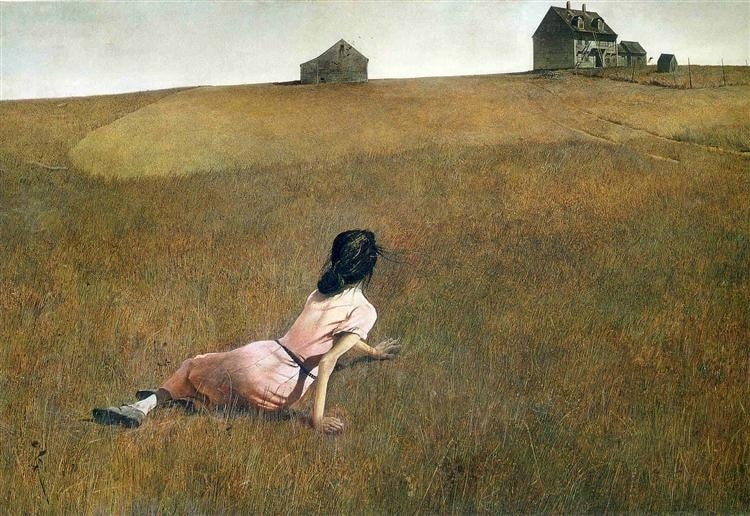
The so‑called “empty field” in Christina’s World is anything but empty: Wyeth expands and reshapes the tawny Maine grassland until it becomes the painting’s protagonist. This broad, sloping expanse turns landscape into psychology, converting distance into the felt measure of Christina’s isolation and resolve.
Historical Context
Andrew Wyeth painted Christina’s World in 1948 after years of observing the Olson farm in Cushing, Maine. The composition grows out of his sight of neighbor Anna Christina Olson moving across those fields; Wyeth built the scene around that experience, then emphasized the ground itself as the drama’s locus. MoMA classifies the painting as a psychological landscape, underscoring that the land records an inner condition rather than a topographic fact 1.
Conservation imaging undertaken by MoMA shows that Wyeth reworked the horizon and buildings to push them farther back, effectively enlarging the acreage between Christina and the house. At a moment when Abstract Expressionism was ascendant, Wyeth persisted with egg tempera realism yet used design changes—especially the expanded field—to communicate lived difficulty and longing with modern expressive force. The result roots a specific Maine site in a postwar sensibility, where observed place and shaped experience converge in the ground itself 2.
Symbolic Meaning
The field functions as a measure of isolation. By widening the terrain and retreating the horizon, Wyeth converts open space into distance one can feel, a visible interval between vulnerability (Christina) and the stability signaled by the farmhouse. MoMA’s description of the work as a psychological landscape makes the point plain: the land is a state of mind. Its breadth signifies effort and time, and its spare, mown surface conveys dryness, exposure, and the unyielding friction of daily passage 12.
Within longer art-historical traditions of the pastoral, Wyeth pointedly withholds bucolic ease. The ground does not invite wandering; it opposes it. The compressed sky cedes emotional territory to earth, while the diagonal climb toward the buildings literalizes aspiration as uphill work. Close looking reveals an animated skin of strokes that enlivens the grass beyond mere description, so the field oscillates between site and sensation. In this way, Wyeth unites realist depiction with modern psychological expressiveness, allowing emptiness to carry narrative weight: longing, endurance, and the stubborn pull of home 12.
Artistic Technique
Wyeth painted the field in egg tempera on a gessoed panel, whose smooth preparation let him place extraordinarily fine, stable strokes. He layers tawny, ocher, and gray-green tones to harmonize the dry grass with the weathered farm buildings and pale sky. From a normal viewing distance the marks fuse into a quiet plane; up close, individual blades and directional strokes reveal meticulous, varied brushwork 12.
Compositionally, the ground occupies most of the picture, rising diagonally to the right so that the sky is minimized and the eye must traverse the field to reach the house. Conservation evidence indicates Wyeth subtly redrew the horizon and structures to amplify that traverse, transforming the slope into a shaped experience of distance 2.
Connection to the Whole
The field is the painting’s structural anchor and its narrative engine. It fills the canvas between the prone figure and the farmhouse, staging the story as a crossing in which effort, time, and desire are made legible by acreage. The diagonal rise pulls the gaze from Christina’s outstretched arm toward the distant buildings, synchronizing our looking with her intended movement 1.
By enlarging and subtly altering the terrain, Wyeth makes landscape equal to portraiture: Christina’s world is literally the ground she must navigate. The painting’s emotional charge—loneliness, resolve, the pull of home—resides in that expanse, so the so‑called backdrop becomes the subject, and the house reads as goal rather than setting 2.
Explore More from This Painting
This detail is one part of Christina's World. Use the links below to return to the full interpretation, browse the full set of details, or view the painting's valuation if available.