The Olson House in Christina's World
A closer look at this element in Andrew Wyeth's 1948 masterpiece
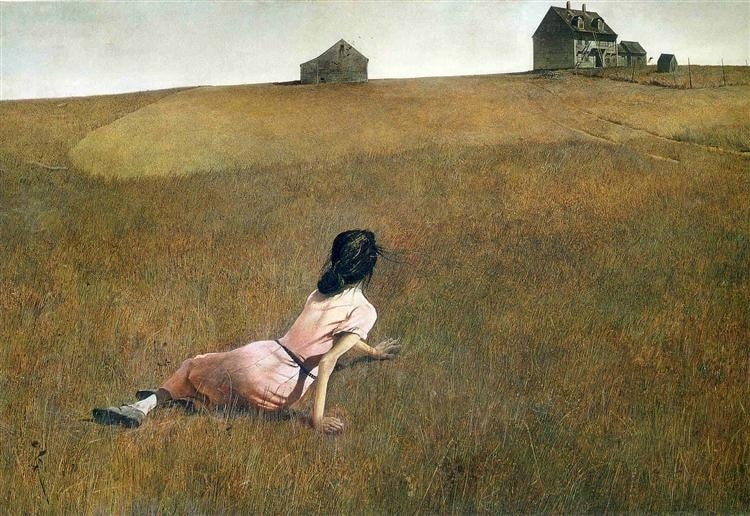
The Olson House—bleached, weathered, and distant on a Maine hill—anchors Andrew Wyeth’s Christina’s World as both a real farmhouse and the mental destination of the painting’s protagonist. Rendered in quiet tempera tones, it transforms an ordinary dwelling into the emblem of home, endurance, and longing that structures the entire scene.
Historical Context
Wyeth painted Christina’s World in 1948 after nearly a decade of working at the Olson farm in South Cushing, Maine, the home of Anna Christina Olson and her brother Alvaro. The Museum of Modern Art describes the farmhouse and outbuildings as “ancient and grayed,” a place inseparable from the artist’s summers and from the title’s promise of a psychological landscape rather than a simple view 1. During these years Wyeth had close, daily access to the property; National Park Service documentation notes that he maintained a workroom on the house’s third floor and enjoyed “unrestricted access to the house,” reflecting an intimacy that made the site a constant in his art from 1939 to 1968 2.
Against this background, including the actual Olson House in Christina’s World was inevitable. It tied the image to lived biography—Christina’s life, Alvaro’s farm, and Wyeth’s own studio routine—while situating the drama on a familiar, windswept hill. The house thus enters the painting not as a backdrop but as the locus of a long relationship between artist, sitters, and place, crystallized in 1948 through the idiom of tempera realism 12.
Symbolic Meaning
Wyeth’s composition turns the Olson House into the goal and gravity of a “psychological landscape.” MoMA’s interpretation makes clear that the title Christina’s World signals an interior state; the farmhouse becomes the mental destination of the figure seen from behind, a far-off anchor that concentrates memory, identity, and will 15. Its modest scale on the horizon, paired with its austere, weathered surfaces, lets it read as both sanctuary and distance—home as haven, but also a challenge to reach. Conservation-based close looking at MoMA shows that Wyeth subtly adjusted the house, shed, and horizon, enlarging the sweep of field the figure must traverse. These refinements intensify the emotional pull of the dwelling as desired yet demanding refuge 3.
Art historians have often described Wyeth’s language as a form of American magic realism: the everyday made metaphorical through hyper-attentive observation. In that vein, the Olson House stands for New England endurance, for time thickened into place, and for the aura of a life bound to a single homestead 9. Its subsequent preservation and interpretation by the Farnsworth Art Museum further cement the building as a character in Wyeth’s oeuvre, the touchstone through which hundreds of images negotiate realism, memory, and myth 4.
Artistic Technique
Wyeth renders the Olson House in egg tempera on panel, a medium whose matte surface and fine, linear strokes support the painting’s restrained tonal harmony. MoMA records the tempered palette in which the farmhouse and outbuildings are “ancient and grayed,” fusing with the tawny field and overcast sky 1. Compositional choices place the house high and to the right, above a long, rising slope. Technical study at MoMA reveals pentimenti—adjustments to the architecture and horizon—that expand the field and increase the interval between figure and house, sharpening the scene’s tension without breaking realism’s spell 3. The result is an image where texture, value, and placement collaborate to make an ordinary structure feel inevitable, remote, and absorbing.
Connection to the Whole
The Olson House supplies the painting’s narrative vector. The figure’s twisted torso, the diagonal pull of the hillside, and the faint tracks in the grass all point toward the farmhouse, making it the scene’s compass and goal 13. By holding the house small yet distinct against a pale sky, Wyeth stretches the psychological space the protagonist must cross. That distance carries biographical weight: the building is the subject’s home and the artist’s long-time workplace, fusing lived experience with pictorial design 2. In Christina’s World, then, the house is not auxiliary architecture—it is the keystone that binds story, mood, and setting into a single, resonant orbit.
Explore More from This Painting
This detail is one part of Christina's World. Use the links below to return to the full interpretation, browse the full set of details, or view the painting's valuation if available.
Sources
- MoMA Collection Record: Andrew Wyeth, Christina’s World
- National Park Service – Best Practices Review, Issue 13 (NRHP/NHL documentation on Olson House and Wyeth’s access)
- MoMA Magazine: A (Much) Closer Look at Christina’s World
- Farnsworth Art Museum: Olson House
- MoMA Magazine: One on One—Andrew Wyeth’s Christina’s World
- Journal of Humanities in Rehabilitation: Inside ‘Christina’s World’
- Image & Narrative: Authentically Home—The Olson House and Andrew Wyeth’s Christina’s World
- NPS: National Register of Historic Places Asset Detail—Olson House
- The Art Story: Andrew Wyeth—Overview and Analysis