Christina's Pink Dress in Christina's World
A closer look at this element in Andrew Wyeth's 1948 masterpiece
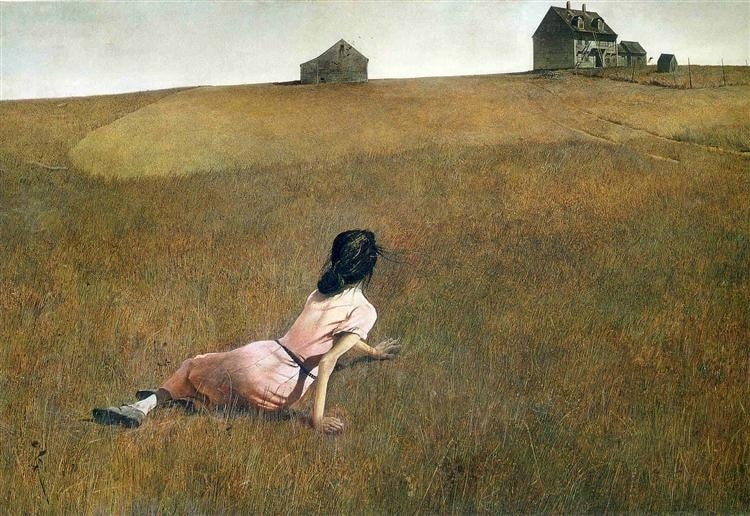
The pale pink housedress in Andrew Wyeth’s Christina’s World is both a faithful remnant of the real Christina Olson and the painting’s chromatic anchor. Against the bleached Maine field, its soft warmth fixes our gaze on the figure and fuses documentary specificity with psychological charge.
Historical Context
Painted in 1948 and set at the Olson House in Cushing, Maine, Christina’s World grew out of Wyeth’s sustained observation of his neighbor Anna Christina Olson, who lived with a severe, progressive disability. Wyeth watched her traverse the grass using her arms and conceived the image from that sight and place 1.
While Wyeth built the figure from multiple sources—famously asking his wife, Betsy, to pose for the torso—he retained Christina’s own pink housedress and her aged arms and hands. Recent scholarship consolidates this point, stating that only the pink dress and the arms/hands are directly modeled on Olson, a choice that preserves her presence within an otherwise hybrid construction 23. The dress therefore operates as a historically specific marker of the sitter within the MoMA-held tempera panel and ties the image to the real rhythms of Olson’s household and farm life, which Wyeth recorded over many years around the Olson property and its buildings 19.
Symbolic Meaning
MoMA frames Christina’s World as a “psychological landscape,” a state of mind rendered through place and figure rather than a literal portrait. Within that register, the pale pink of the housedress humanizes the vast field—an intimate note of domestic life and personhood set against distance, effort, and the pull of home 1. The garment’s everydayness signals the routines of rural labor and femininity without melodrama, grounding the image’s emotion in ordinary fabric and fit.
Disability-focused art history sharpens this reading. By combining Betsy Wyeth’s youthful torso with Christina Olson’s hands and dress, Wyeth shapes how viewers apprehend disability—complicating expectations while keeping Christina’s identity legible through the dress that was hers 2. Museum educators similarly invite audiences to consider how depictions of disability are mediated by artistic choices; here the housedress becomes a non-sentimental conduit to resilience and agency in the scene 5. Its tender color also reads as a quiet emblem of care and vulnerability amid an austere environment, a counterweight to the painting’s distance and diagonal pull toward the farmhouse. In short, the dress is the work’s soft but decisive sign of the subject’s inner life and ordinary dignity 6.
Artistic Technique
Wyeth painted in egg tempera on panel, a medium that rewards patience and precision. With tiny brushes and layered strokes, he modeled the dress’s folds, seams, and highlights so that the fabric reads crisp at the shoulder and waist while remaining supple across the lap 14.
Chromatically, the pale pink sits against sun-bleached, tawny grasses, creating a controlled burst of warmth that arrests the eye; writers have noted how that pink feels almost explosive in the otherwise subdued palette 7. Compositional choices—a low, close vantage and the figure’s diagonal orientation—let the dress’s light value outline the body cleanly against the field, amplifying its role as focal accent and narrative hinge between foreground presence and distant buildings 8.
Connection to the Whole
The pink dress is the painting’s warm key within a cool, far-reaching field, the element that immediately asserts a living subject inside a psychological landscape 1. Its color and value anchor the foreground figure, initiating the diagonal that carries the eye toward the farmhouse and back again, binding desire, exertion, and place into a single visual arc 8.
Because it is authentically Christina’s garment, the housedress also reconciles the work’s hybrid figure with the real woman who inspired it, preserving documentary truth while serving the composition’s drama 23. In doing so, the dress embodies the painting’s central tension—between intimacy and distance, idealization and fidelity—and makes that tension legible at a glance.
Explore More from This Painting
This detail is one part of Christina's World. Use the links below to return to the full interpretation, browse the full set of details, or view the painting's valuation if available.
Sources
- MoMA collection entry: Andrew Wyeth, Christina’s World
- Image & Narrative (2024 dossier) citing Randall C. Griffin on the figure’s construction
- Wyeth Hurd Gallery: Egg tempera notes and Betsy/Christina model information
- MoMA Magazine: A (Much) Closer Look at Christina’s World
- MoMA Magazine: Museum education perspective on Wyeth and disability
- Journal of Child Neurology: Medical-humanities context for Christina Olson
- Smithsonian Magazine: Wyeth’s World
- MoMA Magazine: One on One – Andrew Wyeth’s Christina’s World
- Farnsworth Art Museum: Olson House context