Abra Holding Holofernes Down in Judith Slaying Holofernes
A closer look at this element in Artemisia Gentileschi's c. 1612–13 masterpiece
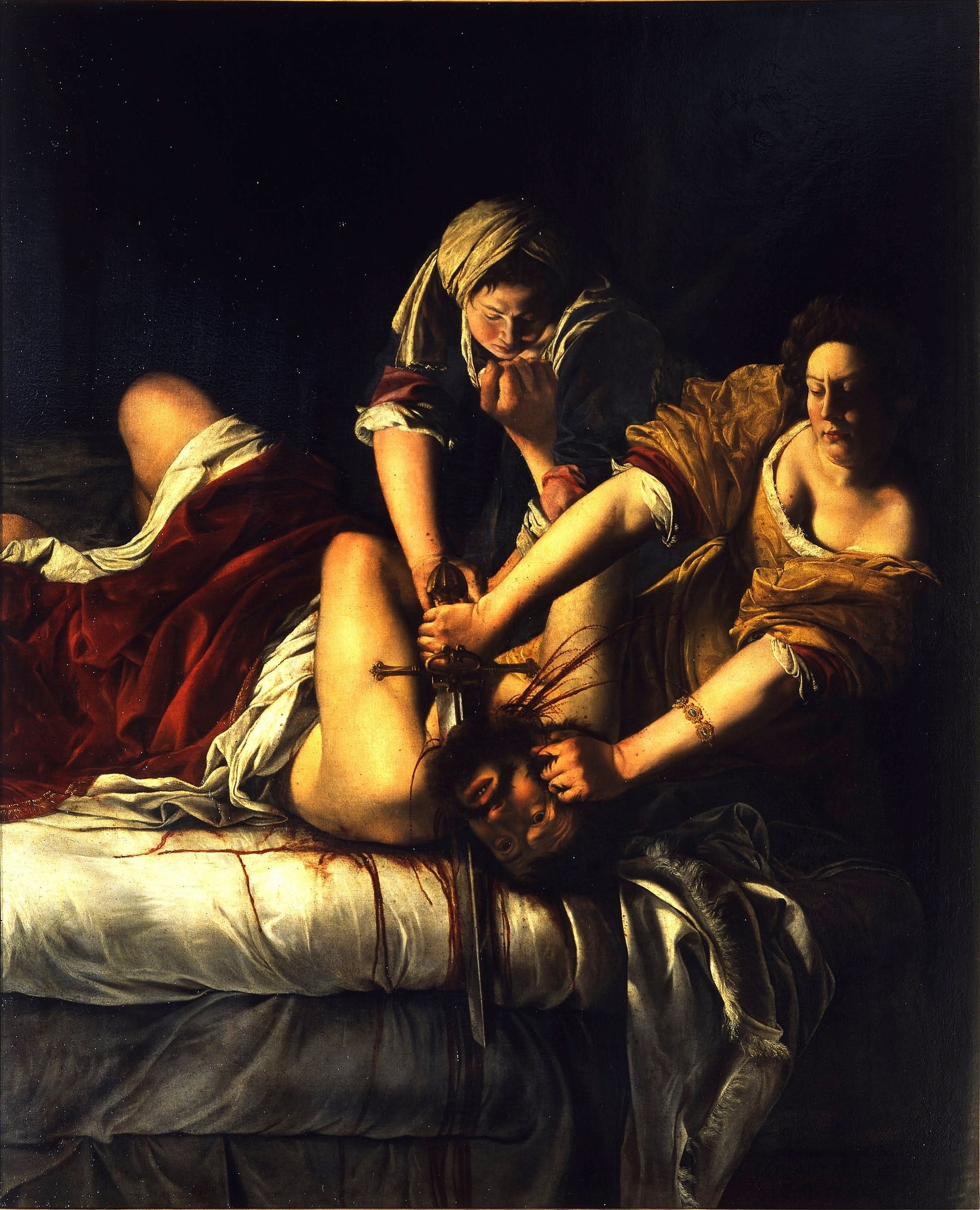
Artemisia Gentileschi turns Judith’s maid—traditionally called Abra—into a co‑assassin who throws her weight onto Holofernes to pin him in place. By moving the servant inside the tent and into the struggle, Gentileschi fuses visceral realism with a bold image of coordinated female agency.
Historical Context
Artemisia Gentileschi painted Judith Slaying Holofernes in Naples around 1612–13 and returned to the subject in Florence c. 1620–21. In both, the maid does not wait outside the tent (as in the Book of Judith) but actively restrains Holofernes—an invention that makes the servant an essential partner in the kill 1. This decision crystallizes the early Baroque taste for high‑drama narrative taken at the instant of maximum tension.
Her staging reflects close engagement with Caravaggesque naturalism—tenebrism, compressed space, and bodies locked in struggle. The Uffizi underscores the later canvas’s frightening realism and the shock it caused on arrival in Florence, traits already present in the Naples version’s brutal immediacy 2. By recasting the maid as a physical force within the tent, Artemisia both answers Caravaggio’s precedent and sharpens the competitive, theatrical energy that defined the period’s Judith‑and‑Holofernes vogue 12.
Symbolic Meaning
Abra’s grip on Holofernes signals female solidarity and shared agency. Rather than a passive attendant, the maid becomes Judith’s “active partner,” a characterization tracked in feminist art history and musicology that treats the pair as coordinated protagonists rather than heroine and helper 56. Baylor’s teaching dossier even notes Holofernes’s desperate reach toward the maid—visual confirmation that she is the immediate threat restraining him 7.
The collaboration also intensifies the Renaissance–Baroque topos of the Power of Women—stories in which women defeat or outwit tyrants. Here, virtue and justice are embodied not only in Judith’s courage but in the duo’s combined fortitude (virtus), literalized as weight and counterforce on the general’s thrashing body 45. Against Caravaggio’s version, where an older maid looks on tensely, Artemisia’s youthful, muscular servant transforms the moral into a credible act of teamwork, making the assassination physically plausible and ethically legible as righteous deliverance 410. The result is a symbol of collective female power that matches Baroque expectations for gripping truthfulness while advancing a distinctly Artemisia vision of women’s efficacy 35.
Artistic Technique
Gentileschi renders the maid with tenebrist lighting that carves her arms and shoulders from darkness, a sculptural clarity that reads as braced leverage rather than ornament. Tight cropping thrusts the viewer beside the bed; diagonals run from Abra’s forearms through the sword to Holofernes’s torso, composing a vise that locks him down 24. In the Naples canvas the maid’s red gown and rolled sleeves, paired with Judith’s blue‑gold dress, are practical cues of labor and resolve; their exposed forearms announce work, not ceremony 19. Blood is not flourish but a structural element—arterial spurts track the motion and fix the knife’s progress, while the thick impastoed highlights on linen, flesh, and metal make the struggle immediate and tactile 24.
Connection to the Whole
The maid’s restraining action is the painting’s hinge. Her body closes a tight triangle with Judith and Holofernes, concentrates the force at the neck, and visually counters the general’s last convulsions—turning a famous biblical decapitation into a believable joint operation 13. This cooperation clarifies the work’s argument: justice against tyranny is achieved through coordinated female strength. Critics who saw the reunited canvases in 2020 aptly summed it up as “two women versus one man,” which is exactly how Artemisia structures both composition and meaning 8. Without Abra’s weight and grip, Judith’s act would read as emblem; with them, it reads as fact—and as a manifesto for shared resolve 13.
Explore More from This Painting
This detail is one part of Judith Slaying Holofernes. Use the links below to return to the full interpretation, browse the full set of details, or view the painting's valuation if available.
Sources
- Museo e Real Bosco di Capodimonte – curator essay on Judith Slaying Holofernes (Naples)
- Uffizi Galleries – Judith Beheading Holofernes object page
- National Gallery, London – Artemisia (2020) exhibition press materials
- Smarthistory/Khan Academy – Gentileschi, Judith Slaying Holofernes
- Mary D. Garrard – Artemisia Gentileschi: The Image of the Female Hero in Italian Baroque Art (Princeton, 1989)
- Cambridge Core – article citing Bettina Baumgärtel on the maid as an "active partner"
- Baylor University, Center for Christian Ethics – Women in the Bible: Art & Exegesis (Gentileschi dossier)
- The Guardian – Artemisia Gentileschi review (2020)
- Wikipedia – Judith Slaying Holofernes (Artemisia Gentileschi, Naples)
- Wikipedia – Caravaggio, Judith Beheading Holofernes