Holofernes's Head in Judith Slaying Holofernes
A closer look at this element in Artemisia Gentileschi's c. 1612–13 masterpiece
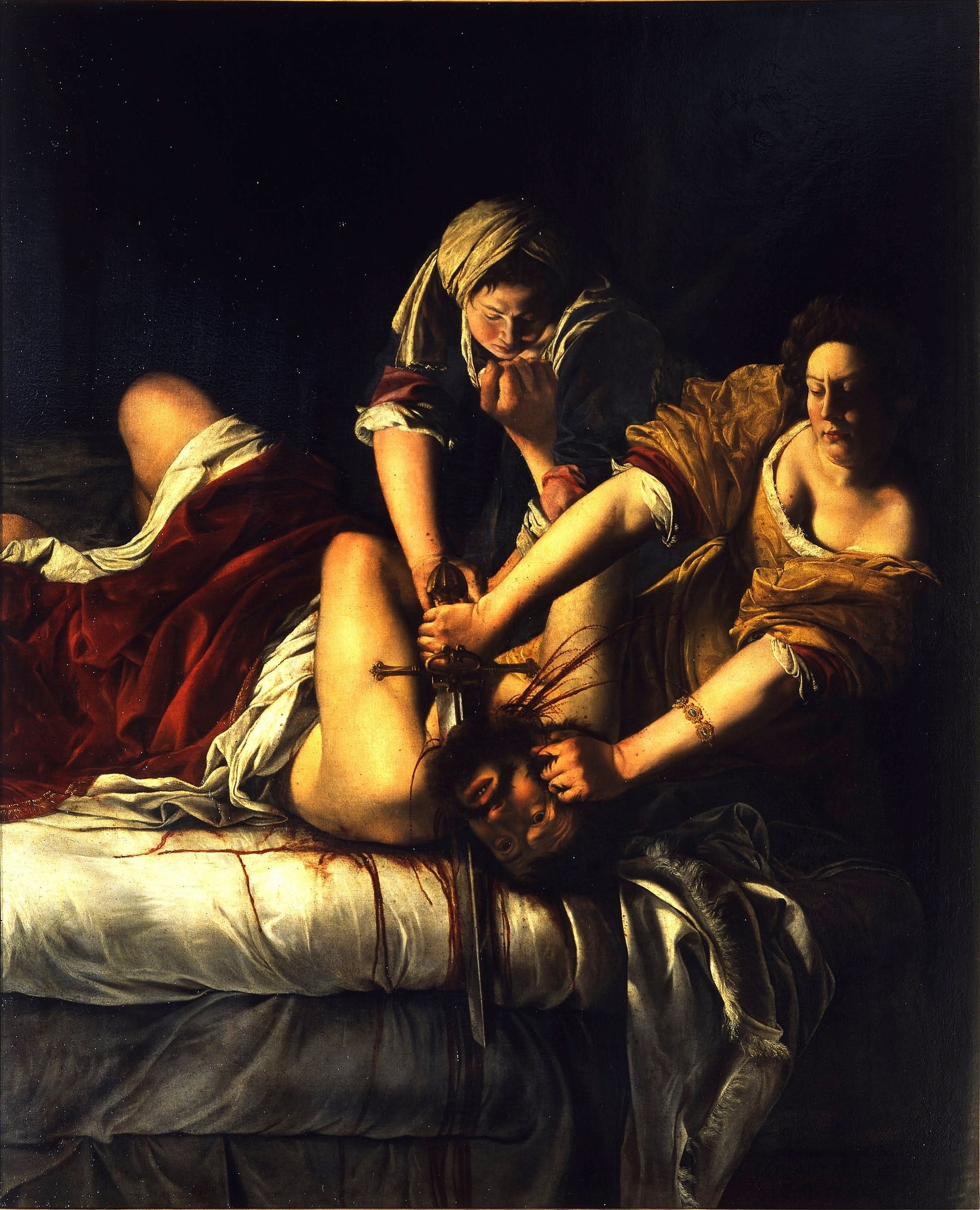
Holofernes’s head is shown at the split second of its severing—hair clutched, blade biting, blood slashing across white linens—turning a biblical trophy into the painting’s explosive core. Artemisia Gentileschi makes the head the hinge of action and meaning, where female resolve and divine justice meet Baroque immediacy.
Historical Context
Painted in Artemisia Gentileschi’s early career and now in Naples, the scene fixes on the instant of execution rather than the aftermath that many earlier artists preferred. Both the Capodimonte and Uffizi texts emphasize the same compositional decision: Judith seizes Holofernes’s hair as the sword sinks into his neck, and blood jets across the white sheets—details that proclaim a Caravaggesque taste for unflinching naturalism 12. Capodimonte describes the Naples canvas as "più cruda" (more raw), a quality heightened by later cropping that brings the head startlingly close to the viewer and by technical reworking (pentimenti) that refines its placement and lighting 1.
Chronologically, the work is usually dated c. 1612–13, with some scholars proposing a slightly later date around 1617; in either case it belongs to a moment when patrons prized visceral, persuasive sacred drama. The Uffizi frames Judith’s deed as victory accomplished "by the hand of a woman," aligning the motif of the head with scriptural deliverance and the moral urgency that early‑seventeenth‑century audiences expected from religious painting 2.
Symbolic Meaning
In the Book of Judith, the severed head is the proof that rallies a besieged community; across Renaissance and Baroque imagery it functions as a portable, public token of victory. Artemisia intensifies that significance by showing the decisive act itself, so the head reads not as an inert trophy but as the charged site where tyranny is overthrown and divine justice is enacted "by the hand of a woman" 23.
The motif participates in the European Power of Women topos, where female virtue and cunning check male arrogance. For Florentine viewers who later saw her related Uffizi version, Judith’s beheading resonated with civic warnings against tyranny familiar from earlier art and texts on the subject 6. At the same time, National Gallery curators caution against collapsing the image into biography alone: Artemisia’s graphic head aligns with a wider Baroque appetite for stark realism and persuasive narrative, not merely a private vendetta 4. By fusing biblical sanction, public proof, and female agency, Holofernes’s head becomes a multivalent emblem—at once trophy, verdict, and instrument—whose meaning is inseparable from the moment of its making visible 2346.
Artistic Technique
Artemisia renders the head through forceful chiaroscuro and tenebrism: a raking light carves the face and neck against a black ground, while the white linens amplify the arterial reds that spatter and stream 2. Crossing diagonals—the sword, Judith’s forearms, and Abra’s bracing grip—drive the eye to the neck, where the blade meets flesh. In Naples, enamel‑blue and gold accents around Judith heighten chromatic drama framing the head, and later cropping intensifies its proximity to us 12.
Technical rethinking (pentimenti) suggests Artemisia adjusted placement and scale to concentrate impact, and comparison with her later Uffizi version shows how she refined awkward passages around the head to sharpen clarity and force 15.
Connection to the Whole
Holofernes’s head is the painting’s visual and moral center: every line of motion converges there, and the stark contrast of white linen and red blood turns the beheading into the canvas’s brightest, most legible event 12. By picturing the instant of decapitation, Artemisia bridges viewers’ knowledge of what follows—the display and transport of the head—while insisting on the struggle that earns it, deepening Judith’s heroism 3.
Formally, the head anchors the orthogonal of the bed and the diagonals of the figures, locking narrative time to compositional structure. Conceptually, it articulates the work’s claim that justice is achieved through embodied action, carried out with resolve and witnessed in the tangible, world-staining evidence of the tyrant’s fall 123.
Explore More from This Painting
This detail is one part of Judith Slaying Holofernes. Use the links below to return to the full interpretation, browse the full set of details, or view the painting's valuation if available.
Sources
- Museo e Real Bosco di Capodimonte – Giuditta decapita Oloferne (Artemisia Gentileschi) overview
- Gallerie degli Uffizi – Judith Beheading Holofernes (c. 1620) object page
- Art Institute of Chicago – What Happened to Holofernes’s Head?
- National Gallery, London – Artemisia (press and exhibition context)
- Smarthistory/Khan Academy – Artemisia Gentileschi, Judith Slaying Holofernes
- National Gallery, London – Judith in the Tent of Holofernes (iconographic context)