Judith's Sword in Judith Slaying Holofernes
A closer look at this element in Artemisia Gentileschi's c. 1612–13 masterpiece
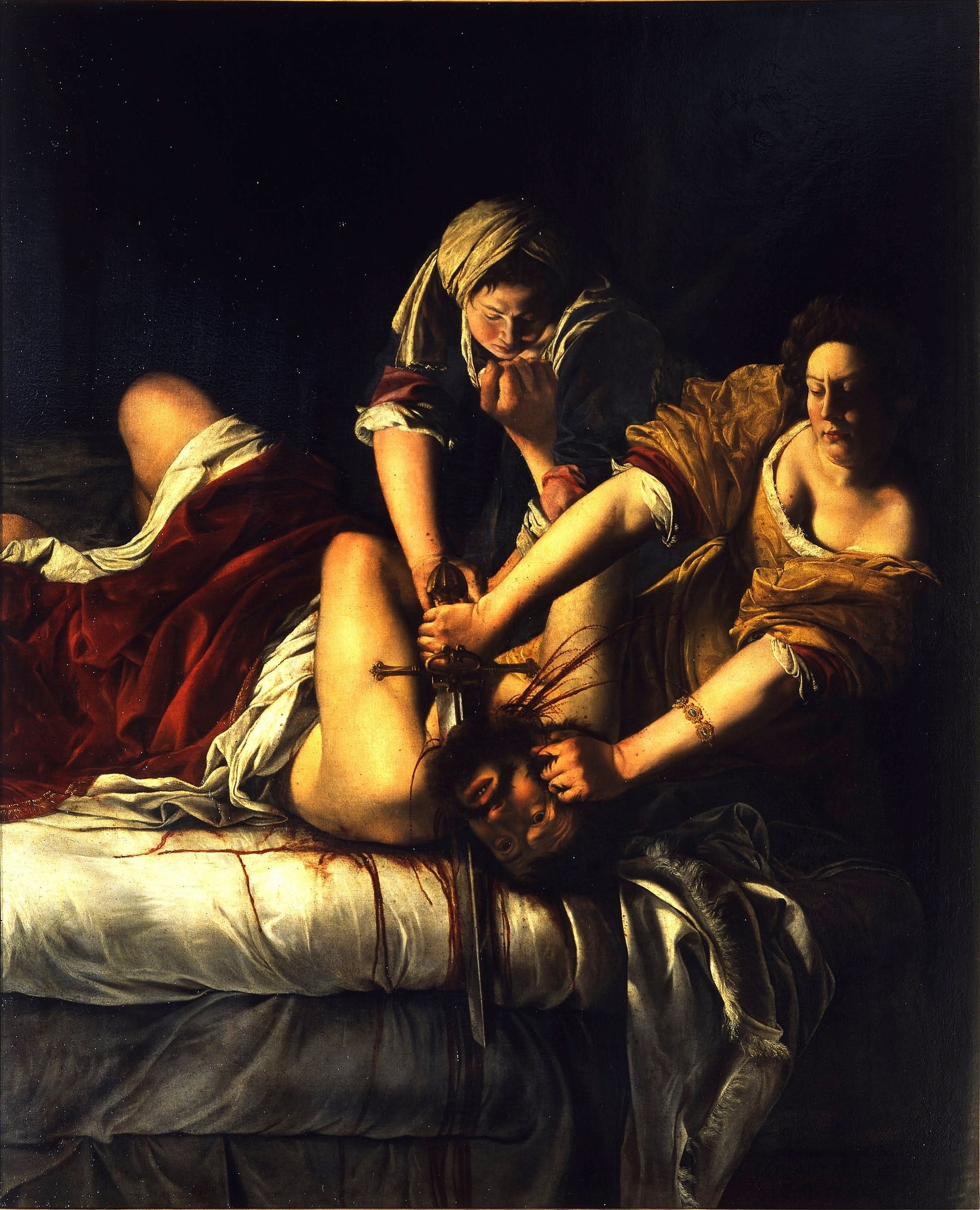
In Artemisia Gentileschi’s Judith Slaying Holofernes, the sword is not a prop but the engine of the drama: cold steel bites into Holofernes’s neck at the painting’s blazing center. Artemisia shows the very blade the tyrant once owned turned against him, fusing narrative shock with a statement of justice and resolve.
Historical Context
Painted in Naples around 1612–13, Judith Slaying Holofernes belongs to Artemisia’s Caravaggesque phase, when close-up action, tenebrism, and physical truth defined her style. In both this early canvas and her closely related Florentine version, museum texts emphasize that Artemisia seizes the biblical story at the split second of execution: the sword is pushed to mid‑canvas and made operative, not ornamental 1. That choice aligns with early Baroque taste for violent immediacy and with patrons who expected scriptural scenes to read with gripping clarity.
The Book of Judith dictated this staging. Judith enters Holofernes’s tent, lifts his own sword from beside the bed, and beheads him—details reiterated in authoritative iconographic summaries 2. Counter‑Reformation viewers knew the episode and its moral contours; by showing the very weapon specified in the text, Artemisia grounds her ferocious realism in biblical fidelity. The sword’s presence is therefore historically necessary and theatrically heightened: a theologically correct instrument made the visual keystone of a Baroque martyr‑tyrant tale 12.
Symbolic Meaning
Across Renaissance and Baroque art, Judith’s blade carried the charge of divine justice—Virtue overthrowing Tyranny. Scholars surveying the tradition describe the sword as a sign that condenses the story’s ethics into a single, decisive stroke; Artemisia’s version radicalizes this by making justice physically visible in the incision itself 4. Writers and curators also invoke the “double‑edged sword” of Judith 13:8, a phrase that sharpened viewers’ sense of righteous finality and God‑backed judgment 5.
Modern criticism has further read the weapon through gendered power. The Sword of Judith gathers interpretations of the blade as a phallic, even castrating sign—an inversion of male domination enacted by a woman’s hand; Artemisia’s emphatic, working sword sits at the center of these arguments 4. Museum iconography also stresses the motif “his own sword,” underscoring poetic reversal: the tyrant’s instrument becomes the means of his undoing 6. By refusing a sanitized trophy scene and insisting on a righteous tool in motion, Artemisia rejects traditions that prettified Judith and dulled the weapon’s meaning; Chicago curators note that many images treat the sword as an accessory, whereas here it is agency made metal 3. Together these strands make the blade a compact emblem of justice, reversal, and female resolve.
Artistic Technique
Artemisia renders the sword with Caravaggesque tenebrism: a bright seam of light hits the steel so it reads with icy clarity against black ground and white sheets. The blade’s hard highlight, the glinting cross‑guard, and the spray of blood are described in museum and exhibition texts for the related Uffizi canvas, which praise the painting’s brutal naturalism 13.
Compositionally, the sword becomes an axis. Analyses describe it as the structural line around which the three bodies lock, driving the eye straight into the wound 10. Recent scholarship notes how the cutting edge and arcing blood don’t just depict force—they carve pictorial space, turning the weapon into a device that organizes surface and depth at once 9.
Connection to the Whole
The sword is the painting’s visual and moral center. Its diagonal fixes the composition, uniting Judith’s braced arms, the maid’s grip, and Holofernes’s twisting torso into a single machine of deliverance; critics describe this as the fulcrum that fuses form and theme 10.
By staging the beheading as it happens, Artemisia moves the subject from attribute to action—an approach curators contrast with images that parade a sheathed blade or post‑event trophy 3. Exhibition materials that brought the Naples and Florence versions together underline the same thesis of violent, justice‑driven immediacy, while Capodimonte’s feature situates the scene within Artemisia’s mature commitment to narrative truth 78. In short, the sword doesn’t accompany the story; it declares it.
Explore More from This Painting
This detail is one part of Judith Slaying Holofernes. Use the links below to return to the full interpretation, browse the full set of details, or view the painting's valuation if available.
Sources
- Gallerie degli Uffizi – Judith Beheading Holofernes (related version)
- Vatican Museums – Judith and Holofernes (Sistine Chapel pendentive iconography)
- Art Institute of Chicago – What Happened to Holofernes’s Head?
- The Sword of Judith: Judith Studies Across the Disciplines
- National Trust Collections – Judith iconography with Judith 13:8 citation
- Getty CONA – Iconography record: Judith beheading Holofernes
- National Gallery, London – Artemisia exhibition press release
- Museo e Real Bosco di Capodimonte – Curatorial feature on Judith Slaying Holofernes
- Cambridge – Blood on Artemisia Gentileschi’s Judith Slaying Holofernes
- Violence & Virtue: Artemisia Gentileschi’s Judith Slaying Holofernes
- The Met Heilbrunn Timeline – Judith with the Head of Holofernes