The Blood-Soaked Sheets in Judith Slaying Holofernes
A closer look at this element in Artemisia Gentileschi's c. 1612–13 masterpiece
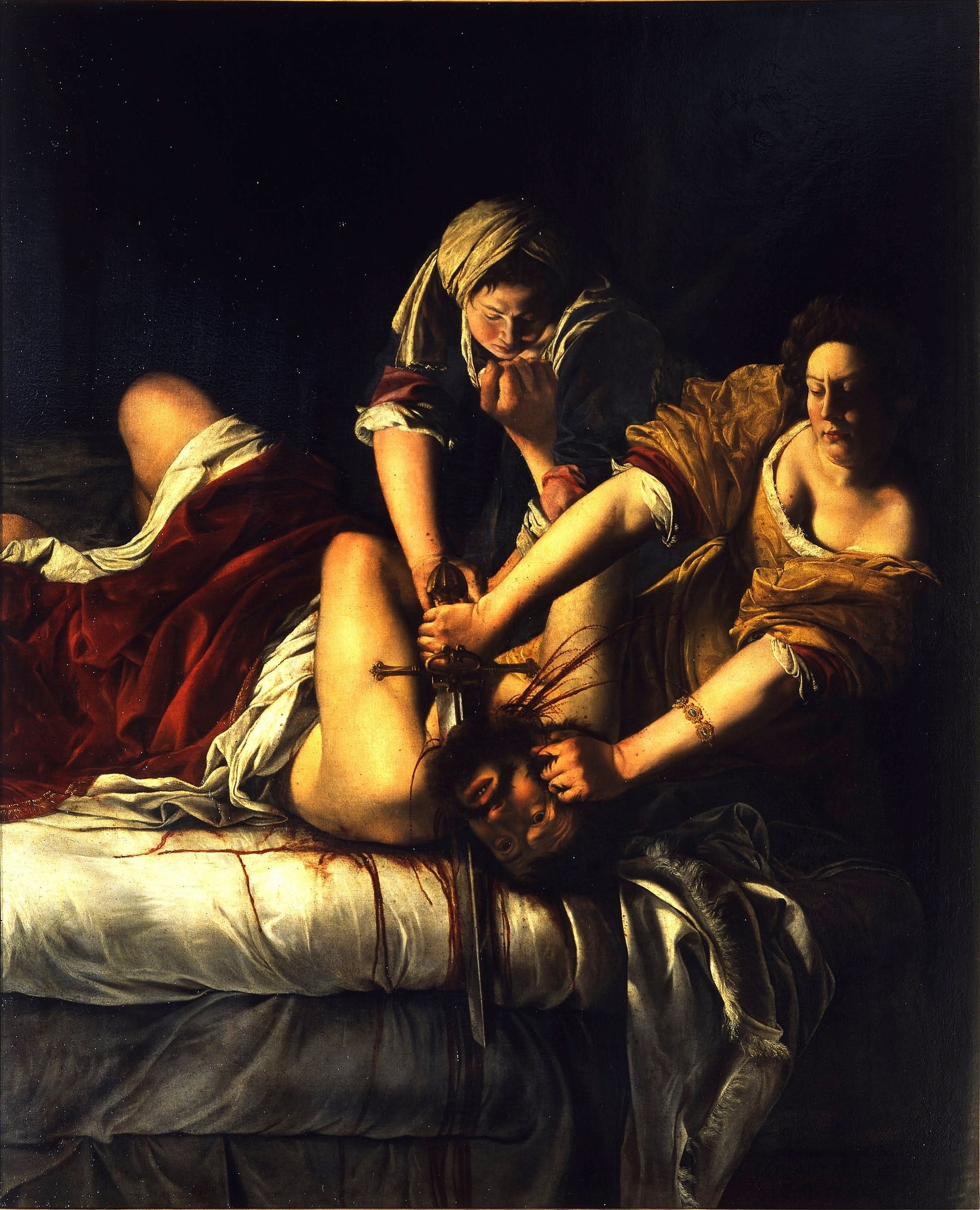
The white bed-linens, quickly stained by the flow from Holofernes’s neck, form the painting’s visual stage and moral shock. Artemisia Gentileschi uses these blood-soaked sheets to pin the action to the general’s bed while heightening Baroque immediacy through a stark white-and-crimson contrast [1][2].
Historical Context
Artemisia Gentileschi painted the Naples Judith Slaying Holofernes around 1612–13, at the height of early Baroque naturalism shaped by Caravaggio’s tenebrism and commitment to physical truth. Setting the murder on Holofernes’s bed follows the biblical narrative of Judith’s assassination in the enemy general’s tent; the white sheets align the scene with that textual locale while anchoring the action in a recognizably furnished world 1. In this version, the blood runs and pools rather than erupting in theatrical jets (a feature Artemisia intensifies in the later Uffizi canvas). Contemporary museum commentary on the Naples painting stresses the jolt produced by blood darkening the “candide lenzuola,” a frankness that audiences still register as startlingly real 2. The linens thus serve both narrative fidelity and Baroque rhetoric: they are plausible props from a soldier’s bedchamber and, simultaneously, the clearest surface on which to legibly stage the fatal moment—an approach consistent with Seicento strategies for gripping viewers in the very instant of the deed 12.
Symbolic Meaning
Against the cool, luminous fabric, the crimson stains read as an emblematic clash of purity and violence. Many interpreters regard the chromatic opposition—white linen versus red blood—as a concise moral polarity: domestic order and chastity abruptly transformed by righteous violence that liberates a besieged people 1. Because Judith’s stratagem begins with seduction and access to Holofernes’s bed, the staining of the sheets literalizes the narrative reversal: the bed ceases to be a site of male power and becomes the scene of his undoing. The marks on the bedding, close to the viewer’s space, underline the intimacy and risk of a face‑to‑face execution carried out by women.
Yet leading museum and scholarly writing also treats the linens less as free‑floating allegory than as a functional device for clarity: a bright ground on which blood is unmistakable, making the act unflinchingly present 12. In other words, the sheets can bear layered meanings—purity violated; erotic control overturned—while primarily operating as the optical engine that communicates the narrative’s blunt fact: Judith’s success is bodily, immediate, and irrevocable 12.
Artistic Technique
Gentileschi models the bedding with caravaggesque chiaroscuro: cool whites and pearly greys catch a concentrated light, crisply describing folds and creases against a surrounding darkness. This luminous plane becomes the painting’s brightest register, so every rivulet and smear of blood reads with maximum legibility 1. In the Naples version, the blood’s movement is rendered with thin, translucent strokes that suggest fluid sinking into absorbent cloth and trailing over seams; the flow gathers along edges and wrinkles, a studied observation that avoids the later canvas’s spurting arcs 12. Compositional placement—low and near center—makes the sheets the locus of action, aligning blade, hands, and stains along a tight diagonal that fixes the eye where death is decided 12.
Connection to the Whole
The blood-soaked sheets fuse place, plot, and purpose. They certify the setting (Holofernes’s bed), convert seduction into downfall, and supply the optical ground that intensifies Judith’s force and Abra’s assistance 12. By concentrating brightness at the bed’s edge, Artemisia presses the viewer into the room and onto the very surface that receives Holofernes’s blood, collapsing distance between spectator and event. Across both versions, this element governs the painting’s drama: in Naples, it concentrates horror without spectacle; in the later Uffizi work, the same ground magnifies catastrophe. Either way, the linens articulate the work’s thesis with Baroque directness—heroism enacted in real time, written in red upon white 12.
Explore More from This Painting
This detail is one part of Judith Slaying Holofernes. Use the links below to return to the full interpretation, browse the full set of details, or view the painting's valuation if available.