How Much Is Forgive Us Our Trespassing Worth?
Last updated: July 8, 2026
Quick Facts
- Last Sale
- $3.3M (2023, Phillips — 20th Century & Contemporary Art Evening Sale, London)
- Methodology
- comparable analysis
For a Pest Control‑authenticated original of Banksy’s Forgive Us Our Trespassing (2011), comparable evening‑sale results support a realistic auction/value range of approximately $2.5M–$9.5M. Final placement inside that band depends primarily on format/size, Pest Control authentication, provenance/exhibition history and sale venue.
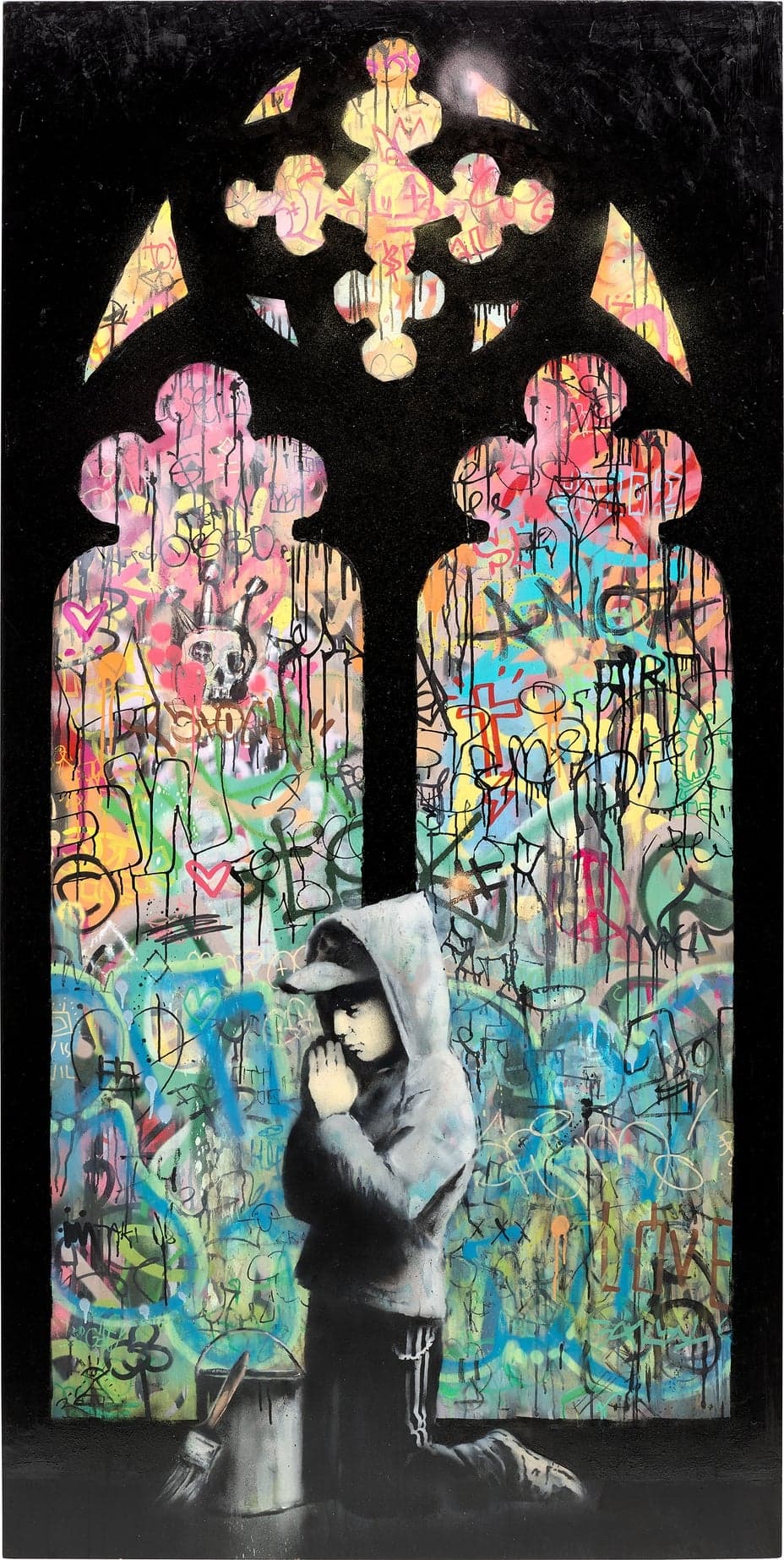
Forgive Us Our Trespassing
Banksy, 2011 • Acrylic, spray paint and mixed media (multi-panel / large-scale)
View more by Banksy →Valuation Analysis
Valuation conclusion: Using direct, recent auction comparables for authenticated examples of Banksy’s Forgive Us Our Trespassing, the appropriate valuation range for a verified original is approximately $2,500,000–$9,500,000. This estimate is driven by two concrete evening‑sale outcomes: a museum‑scale four‑panel example sold at Sotheby’s Hong Kong (Oct 2020) for HK$64,112,000 (≈US$8.27M) [1], and a smaller plywood panel sold at Phillips London (Oct 2023) for £2,710,000 (≈US$3.31M) [2].
Comparables and their implications: The Sotheby’s lot (four‑part, museum‑scale) demonstrates top‑end demand for large, authenticated, well‑provenanced versions of the composition; that example carried institutional exhibition history and a strong private‑collection provenance, which materially lifted competition [1]. The Phillips plywood sale is the closest documented match for smaller single/multi‑panel board versions and sets a clear mid‑market precedent [2]. Together these results justify a valuation corridor that spans the Phillips result at the lower/mid end and the Sotheby’s museum‑scale realisation at the top end.
Conditional scenarios: If the object you hold is Pest Control‑authenticated, complete (no missing panels), and accompanied by strong provenance/exhibition history (gallery/catalog/institutional loans), expect competitive bidding in the mid‑to‑high portion of the range. A large, museum‑scale, authenticated example with catalogue/exhibition history would trend toward the >$7M region; a smaller authenticated plywood/single panel would likely sit in the ~$2.5M–$4M band. If the work lacks Pest Control authentication, or is a removed/fragmented mural or an edition/print, market value drops sharply (prints/posters generally trade in the hundreds to low thousands; unauthenticated originals are heavily discounted).
Practical advice for sale or insurance: Obtain/confirm Pest Control documentation, a full provenance chain, high‑resolution images and a conservator’s condition report before marketing. For sale, consign to a major evening sale (Sotheby’s/Christie’s/Phillips) in the appropriate season (London/Hong Kong/New York) with strong catalogue placement and institutional marketing to maximize price discovery and competition. Absent authentication or strong provenance, pursue private sale or specialist advisory routes rather than an evening‑sale estimate that risks non‑sale or large reserve discounts.
References: This valuation is grounded in the documented Sotheby’s Hong Kong 2020 and Phillips London 2023 sales of Forgive Us Our Trespassing variants, which are cited below as the primary comparables [1][2].
Key Valuation Factors
Authentication (Pest Control)
High ImpactBanksy’s market is effectively bifurcated by Pest Control authentication. A current Pest Control certificate converts a previously risky asset into a marketable, institutionally acceptable work; without it, many major houses will refuse to consign or will substantially reduce estimates, and buyer pools shrink dramatically. Authentication mitigates forgery risk, simplifies title diligence for buyers and underpins placement in evening sales. The documented Sotheby’s and Phillips sales were both accompanied by Pest Control confirmation — that documentary chain is therefore the single most important variable in assigning a multi‑million dollar valuation.
Provenance & Exhibition History
High ImpactClear, continuous provenance and institutional exhibition history materially increase realised value. The Sotheby’s multi‑panel benefited from high‑quality provenance (ex‑Steve Lazarides) and MOCA LA exhibition history; that pedigree attracted competitive bidders and supported a seven‑figure premium. Provenance reduces buyer risk, aids museum loans, and justifies marketing narratives that drive cross‑region interest. Absent documented provenance or with a patchy ownership record, bidders apply steep discounts to cover potential title and authenticity issues.
Size/Format & Condition
High ImpactSize and substrate (multi‑panel museum scale vs. single plywood panel vs. canvas/print) are primary price differentiators. Larger, more complex installations command a premium due to rarity and visual impact; smaller plywood panels sell for substantially less even when authenticated (as the Phillips example shows). Condition matters equally: panel joins, losses, repairs or surface degradation reduce competitive tension and lower achievable prices. Complete, stabilized, well‑conserved works perform best in evening sales.
Market Venue & Timing
High ImpactPlacement in a major international evening sale (Sotheby’s/Christie’s/Phillips) during London/New York/Hong Kong sale weeks amplifies buyer competition and maximises realisation. Guaranteed bids, cross‑regional marketing and strategic timing (aligning with contemporary art weeks) materially influence final sale prices. Private sales may realize quicker liquidity but often at a discount to well‑executed evening‑sale results. Market sentiment during the sale season (collector appetite, economic backdrop) also shifts outcomes.
Sale History
Phillips — 20th Century & Contemporary Art Evening Sale, London
Sotheby's — Contemporary Art Evening Sale, Hong Kong
Banksy's Market
Banksy is a globally recognised, institutionally acknowledged street‑artist whose authenticated originals routinely achieve multi‑million dollar results. The market is concentrated: a relatively small number of authenticated, well‑provenanced originals command premium evening‑sale attention, while a large secondary tier of prints/posters trade at far lower prices. Authentication, institutional exhibition and provenance have become decisive in converting public notoriety into sustained collector value. Major auction houses treat Banksy as an established, headline artist and position his most important works in international sales.
Comparable Sales
Forgive Us Our Trespassing (2011) — multi-panel
Banksy
Same composition: museum-scale, four-part original executed 2011; sold with Pest Control COA and strong provenance/exhibition history (Steve Lazarides; MOCA LA). Represents the top-end market for this composition.
$8.3M
2020, Sotheby's Hong Kong — Contemporary Art Evening Sale
~$9.6M adjusted
Forgive Us Our Trespassing (2011) — plywood panel
Banksy
Exact title/composition on plywood (signed/dated), sold with Pest Control certificate; direct size/format comparable for smaller unique panels of this image.
$3.3M
2023, Phillips — 20th Century & Contemporary Art Evening Sale, London
~$3.5M adjusted
Boy and Dog in Stop and Search (Banksquiat) / major Banksy original
Banksy
High-profile authenticated Banksy original sold in an international evening sale (~$9.7M). Useful as a market benchmark for buyer appetite and price levels for major authenticated Banksy originals.
$9.7M
2023, Phillips — New York Evening Sale
~$10.3M adjusted
The Leopard and Lamb (2016)
Banksy
Authenticated Banksy original sold in Asia season; mid-range multi‑million result indicating pricing for certain mid‑size originals and strong regional demand.
$4.7M
2024, Phillips — Hong Kong Sale
~$4.8M adjusted
Current Market Trends
The contemporary/street‑art market has stabilised following the post‑pandemic boom; collectors are more selective and prize authentication and institutional provenance. Demand remains strong for marquee authenticated works, with Asia, London and New York continuing as primary price‑discovery centres. Prints and unauthenticated items are relatively liquid but sit at much lower price tiers.