How Much Is Show Me the Monet Worth?
Last updated: July 8, 2026
Quick Facts
- Last Sale
- $9.9M (2020, Sotheby's London)
- Methodology
- comparable analysis
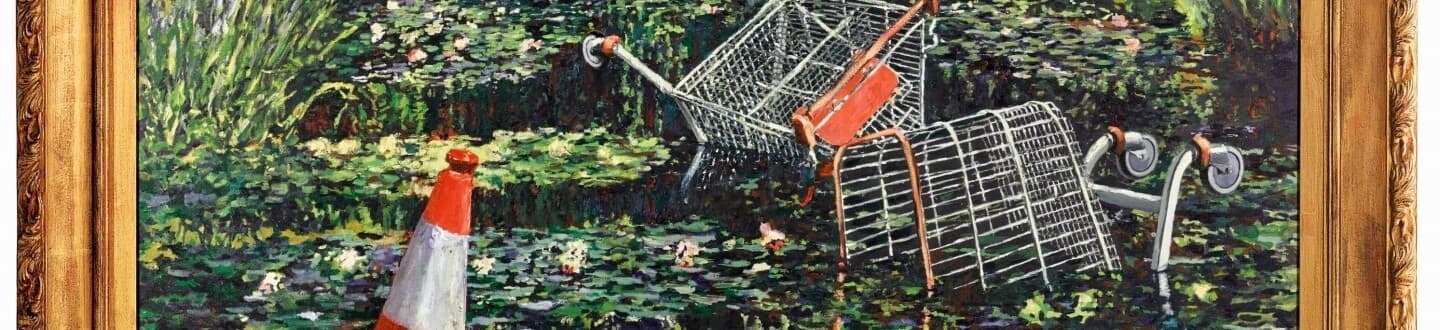
Anchored to Sotheby’s 21 Oct 2020 price realised of £7,551,600 (~USD 9.9M) for the authenticated original with a Pest Control certificate and Lazarides provenance, I value an authenticated, good‑condition original oil‑on‑canvas Show Me the Monet at USD $8,000,000–$12,000,000 in a typical major‑house evening sale. Exceptional circumstances (museum interest, headline marketing, highly competitive bidding) can push the price toward USD $12–20M.
Valuation Analysis
Valuation conclusion: The clearest market anchor for the original oil‑on‑canvas Show Me the Monet is Sotheby’s London’s 21 October 2020 price realised of £7,551,600 (≈USD 9.9M) for the authenticated canvas offered with a Pest Control certificate and provenance from Steve Lazarides [1]. That sale demonstrates demonstrable buyer willingness at near‑ten‑million dollars for a properly authenticated, exhibited and well‑documented original. On that basis I place the fair‑market value for an authenticated, good‑condition Show Me the Monet at USD $8,000,000–$12,000,000 for a typical major‑house evening sale; in exceptional circumstances (institutional interest, headline marketing, strong cross‑border bidding) the lot could reasonably achieve higher, in the USD $12–20M zone.
Comparables and market anchors: Sotheby’s 2020 sale functions as a direct like‑for‑like anchor because it is the same unique canvas, sold with Pest Control authentication and Lazarides provenance [1]. Broader market data for Banksy canvases from the same era — including headline results for works such as Devolved Parliament and other mid‑2000s oils — indicate a market capable of low‑double to mid‑double‑digit millions for high‑quality, unique works. Press coverage and auction summaries around these sales underscore how provenance narratives and event‑driven interest can expand realized prices [2]. Taken together, the comparable set supports the mid‑single to low‑double‑million valuation band proposed above.
Authentication and provenance impact: Authentication via Pest Control and an unbroken chain of title (notably acquisition from Steve Lazarides shortly after execution) are the single most powerful positive drivers of value. Major houses will not place unauthenticated Banksy canvases in evening sales; buyers at the multi‑million level generally require certificate and provenance to underwrite bids. Conversely, missing authentication or provenance gaps typically force sales into lower‑visibility channels and can reduce realized value materially — commonly by factors rather than percentages, depending on buyer risk tolerance.
Condition, conservation and lot presentation: A professional condition report is essential. Surface abrasion, inpainting, canvas relining, or structural issues materially alter buyer appetite and will be reflected in the house’s pre‑sale estimate and realised outcome. High‑quality restoration documentation mitigates discounting; conversely, undocumented or recent amateur interventions commonly reduce buyer interest and suppress achieved prices. Framing, photography, and exhibition history (e.g., the 2005 Crude Oils show) also influence both marketing traction and institutional interest.
Sale strategy and next steps: To maximize value, confirm Pest Control authentication, obtain a written conservator’s report, assemble full provenance/exhibition documentation, and approach contemporary‑art specialists at a major evening sale with institutional outreach. If any of those elements are missing, prioritize authentication and condition work before market exposure. For owners seeking confidentiality or rapid sale, private treaty can produce competitive offers but typically at a discount versus competitive evening auctions.
Final note: This valuation assumes the work is the unique 2005 hand‑painted canvas authenticated by Pest Control and in sound condition. Absent authentication or with notable condition/provenance issues, a materially lower valuation is appropriate. Primary sources: Sotheby’s lot documentation and contemporary press reporting [1][2].
Key Valuation Factors
Art Historical Significance
High ImpactBanksy’s Show Me the Monet is an explicit and high‑quality appropriation of Monet’s Water Lilies, replacing the serene natural scene with supermarket trolleys and urban detritus. Executed in 2005, the canvas crystallizes Banksy’s principal strategies—art‑historical quotation, social critique and accessible visual irony—and is among his most recognisable painted works. That combination of iconic imagery and conceptual clarity increases institutional interest and exhibition potential, which in turn boosts marketability and price. Collectors prize canonical dialogue with art history; the work’s capacity to travel in exhibitions and attract press coverage materially enhances realized value relative to less narratively rich canvases.
Authentication & Provenance
High ImpactAuthentication (Pest Control) and a clear chain of title are decisive for monetary value. A Pest Control certification converts attribution uncertainty into marketable certainty, permitting evening‑sale placement and institutional loans. Provenance—particularly acquisition from Steve Lazarides and early exhibition history (Crude Oils, 2005)—further reduces buyer hesitation and supports pricing. Where authentication or provenance is absent, auction houses may refuse placement or limit exposure; buyers demand steep discounts to compensate for attribution risk. For major Banksy canvases, provenance and authentication commonly produce multi‑million‑dollar uplifts; provenance gaps can push the work into lower‑value channels or require significant undercutting of reserve/estimate.
Condition & Conservation
High ImpactPhysical condition is a primary transactional determinant. Collectors bidding in the seven‑ to eight‑figure range expect a full conservator’s report documenting structural stability, paint surface integrity and any interventions. Issues such as flaking, overpainting, relining, staining or structural repairs materially reduce buyer confidence and require adjustments to pre‑sale estimates. Well‑documented, professionally executed conservation mitigates negative impact; undocumented amateur restoration often triggers substantial discounts. Condition clarity via photographic documentation and conservator statements is therefore a prerequisite for placement as a marquee lot and for achieving the top of the estimated band.
Comparable Auction Results & Market Anchors
High ImpactThe strongest anchor is the Sotheby’s 21 Oct 2020 price realised for this exact canvas, sold with Pest Control authentication and Lazarides provenance. Additional headline results for other mid‑2000s Banksy canvases demonstrate consistent buyer appetite for unique, well‑provenanced works and define realistic pricing ceilings and floors. Market behavior shows that evening‑sale placement, institutional interest, and press‑driven narratives can produce premiums above baseline comparable sales. Auction comparables therefore establish both a reliable valuation band and the conditions under which the lot may outperform that band.
Public Recognition & Liquidity
Medium ImpactShow Me the Monet is highly recognisable in popular culture, which increases the potential buyer pool and liquidity. That recognisability reduces marketing friction and attracts a broader set of bidders, including institutions and cross‑discipline collectors. However, widespread reproduction (prints, merchandise) can cause confusion among casual buyers; clear authentication is required to convert public recognition into top‑tier price. When marketed with exhibition loans and press, recognisability consistently translates into stronger competitive bidding and improved sale outcomes.
Sale History
Banksy's Market
Banksy has evolved from street‑art outsider to a blue‑chip contemporary market presence. Since the 2000s authenticated canvases have been handled as marquee lots by major houses; headline events and strong media narratives (shredding episode, political works) have increased public visibility. Pest Control authentication and robust provenance now materially affect market access and pricing. While results fluctuate with provenance, condition and narrative, Banksy retains durable demand and liquidity among modern collectors and institutions; authenticated works consistently achieve mid‑ to high‑seven figures and can exceed that when event‑driven interest aligns.
Comparable Sales
Show Me the Monet
Banksy
Direct anchor: the identical authenticated original (Pest Control certificate) sold at a major evening sale; same medium, provenance and exhibition history.
$9.9M
2020, Sotheby's London
~$11.5M adjusted
Devolved Parliament
Banksy
Major headline sale and then-record for Banksy; large, unique canvas by the same artist—useful high-end anchor for market appetite for large Banksy paintings.
$12.2M
2019, Sotheby's London
~$14.6M adjusted
Sunflowers from Petrol Station
Banksy
Same period (mid-2000s), unique oil-on-canvas and sold in a major house — a directly comparable era/medium canvas that traded above the Show Me the Monet result.
$14.6M
2021, Christie's New York
~$16.4M adjusted
Trolley Hunters
Banksy
Contemporary canvas (2006) sold at a major evening sale — a mid-market comparable for Banksy unique canvases from the same era and similar collectability.
$6.7M
2021, Sotheby's New York
~$7.5M adjusted
Girl With Balloon (later known as Love is in the Bin)
Banksy
Iconic work whose provenance/event (on-sale shredding) materially increased cultural significance and market profile—illustrates how provenance/story can create a large premium even if not directly size/period-comparable.
$1.4M
2018, Sotheby's London
~$1.7M adjusted
Current Market Trends
Banksy’s market peaked in public attention during 2018–2021 with strong auction demand; the pandemic accelerated online bidding and broadened buyer access. Since 2022, global market caution has tempered some segments, but blue‑chip Banksy canvases have shown resilience. Short‑term pricing sensitivity now correlates with macroeconomic conditions, auction‑house confidence and the presence of strong provenance/exhibition history. Expect steady demand for authenticated, museum‑quality Banksy canvases but continued dispersion: top works remain highly saleable while unauthenticated or compromised pieces face reduced liquidity and deeper discounts.