The Cradle Veil in The Cradle
A closer look at this element in Berthe Morisot's 1872 masterpiece
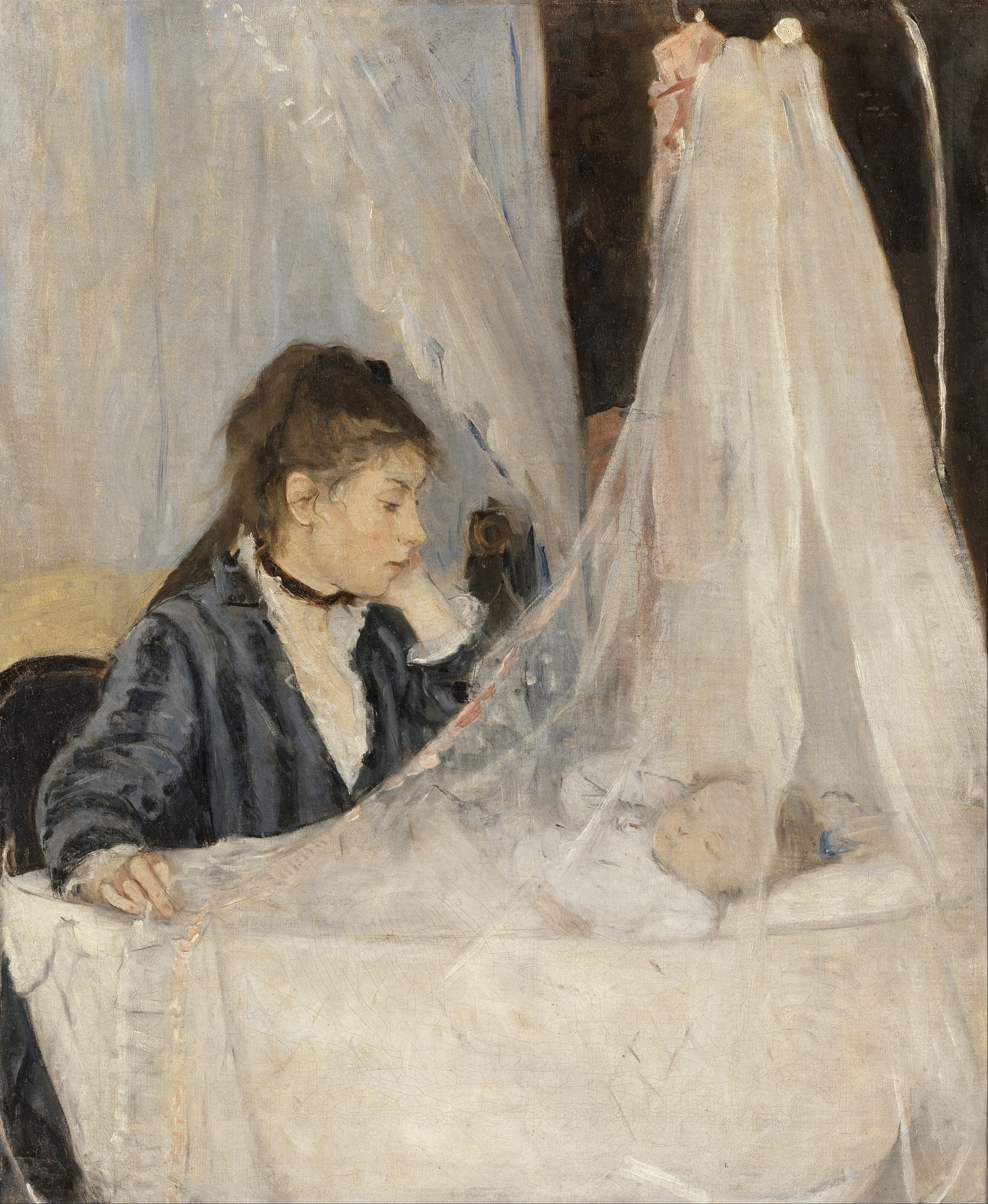
The cradle veil in Berthe Morisot’s The Cradle turns a humble nursery net into the painting’s emotional and visual hinge. Drawn by the mother between viewer and infant, it asserts privacy, filters light, and binds mother and child along a luminous diagonal—defining Morisot’s modern vision of caregiving.
Historical Context
Painted in Paris in 1872, The Cradle shows Morisot’s sister Edma watching her sleeping baby, Blanche, in a middle‑class interior where a sheer net canopy was standard nursery equipment. The Musée d’Orsay notes that Edma draws the veil between spectator and child, a gesture that concentrates the scene’s intimacy and protection 1. Smarthistory frames the work within the realities of bourgeois domestic life available to women artists, who made modern subjects from the interiors they inhabited and knew firsthand 2.
The veil also situates the picture squarely in its time: a practical accessory against drafts and light in a contemporary nursery, not an anecdotal prop. When Morisot exhibited the canvas at the first Impressionist exhibition in 1874, this frank, contemporary image of maternity helped introduce a theme she would revisit across her career, rooting Impressionist modernity in the textures and rituals of everyday care 12.
Symbolic Meaning
The veil operates as a potent symbol of privacy, protection, and boundary. Orsay’s curators describe it as explicitly drawn "between the spectator and the baby," signaling that our view is secondary to the infant’s rest and the mother’s vigilance 1. The Rouen museum similarly stresses how the net is interposed between cradle and viewer, staging an intimate space that resists public scrutiny 3.
At the same time, Morisot modernizes sacred prototypes. The triangular sweep linking mother to child recalls Madonna‑and‑Child groupings, but the translucent, utilitarian net replaces sanctifying drapery with an object of everyday care; tenderness is articulated through contemporary things, not religious allegory 2. The veil thus mediates spectatorship: it slows our looking, asks us to see through a scrim of maternal duty, and acknowledges a maternal gaze that supersedes our own. Scholarship on Morisot’s “minor intimacies” clarifies this choreography of access—the painting makes intimacy itself a subject and a limit, authored by a woman artist inside the domestic sphere 5. The result is a quietly radical image in which a commonplace nursery veil becomes the emblem of modern motherhood’s ethics of attention and guardedness 1235.
Artistic Technique
Morisot renders the veil with brisk, feathery strokes that let ground and light breathe through the paint, achieving convincing translucency without firm contour. A restricted palette of whites, creams, and cool blues diffuses across the right half of the canvas; the veil filters this light into a diaphanous field around the cradle 2. A faint pink edging—picked out with quick touches—animates the net’s rim and echoes the infant’s complexion 2.
Compositionally, the veil arcs downward from Edma’s fingers to the bassinet, establishing the long diagonal that structurally binds mother to child. Orsay highlights this diagonal as the picture’s armature, with the mother’s pinching gesture both activating the line and embodying protective care 1.
Connection to the Whole
The veil is the work’s hinge: it shapes the light, sets the principal diagonal, and calibrates how much of the child we may see. By placing a sheer screen between us and the infant, Morisot translates caregiving into pictorial architecture—our access is filtered just as the nursery light is 12.
This device anchors the painting’s larger meaning: modern, attentive motherhood in a private interior. The net’s practical function—regulating air and light—aligns with contemporary concerns about infant sleep and environment, which recent scholarship has traced in relation to the painting’s subject 4. In The Cradle, form and theme coincide: the veil is both compositional strategy and ethical statement, fusing Impressionist luminosity with a distinctly modern code of domestic protection 124.
Explore More from This Painting
This detail is one part of The Cradle. Use the links below to return to the full interpretation, browse the full set of details, or view the painting's valuation if available.
Sources
- Musée d’Orsay, Le Berceau (object page)
- Smarthistory, Berthe Morisot, The Cradle
- Réunion des Musées Métropolitains Rouen Normandie, Le Berceau
- Art Bulletin, “The Cradle: Berthe Morisot and the Medicalization of Babies’ Sleep” (2022)
- “Minor Intimacies and the Art of Berthe Morisot” (2021)
- Peter Schjeldahl, The New Yorker, “Berthe Morisot, Woman Impressionist” (2018)