The Mother's Gaze in The Cradle
A closer look at this element in Berthe Morisot's 1872 masterpiece
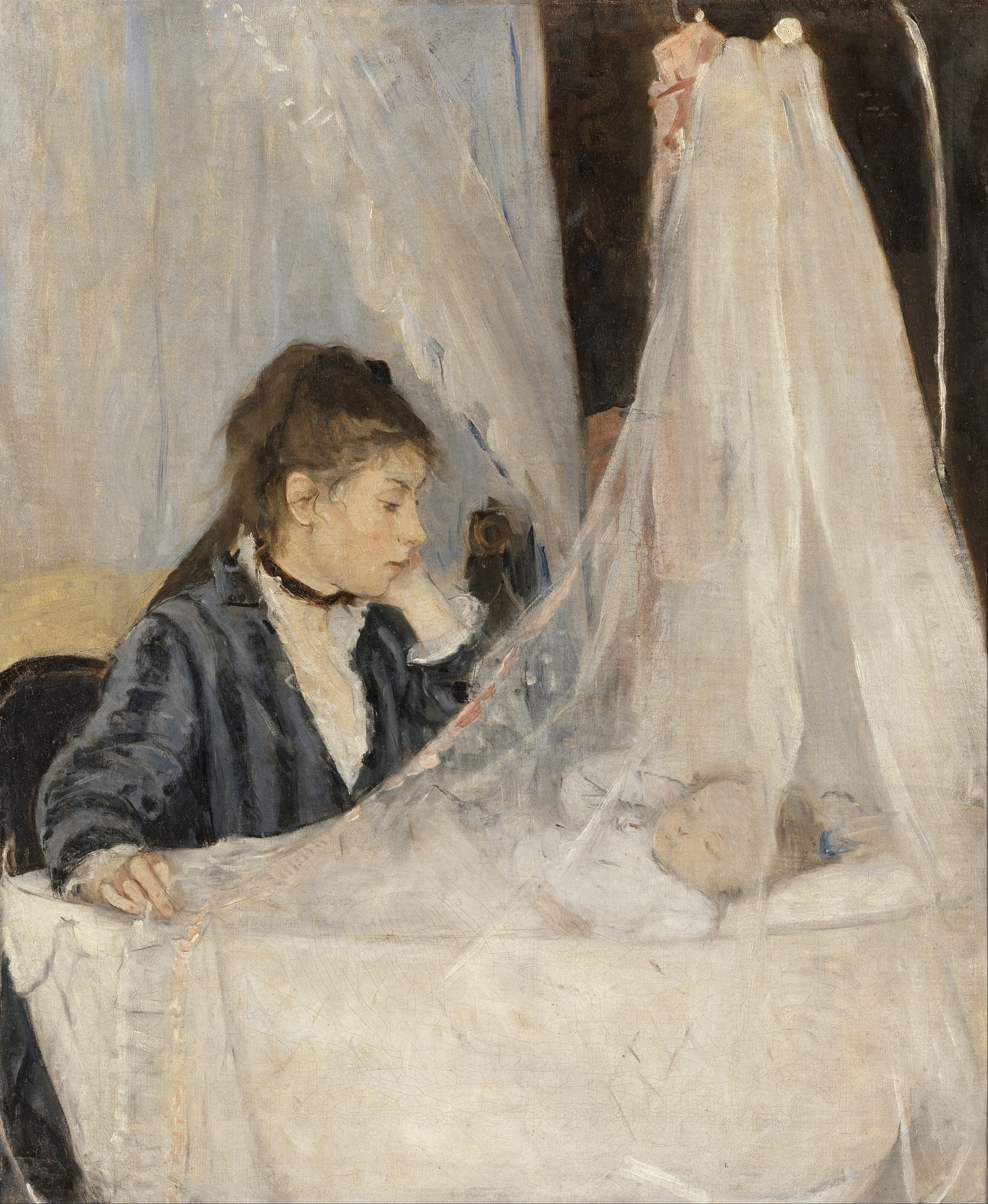
In The Cradle (1872), Berthe Morisot turns a quiet look into the engine of the painting: a mother’s lowered gaze that meets her sleeping child across a gauzy veil. This tender, watchful focus binds the pair in a strict diagonal and asserts a modern ethics of privacy, recasting motherhood as a serious, contemporary subject.
Historical Context
Painted in 1872 and shown at the first Impressionist exhibition in 1874, The Cradle introduces motherhood as a central theme in Morisot’s work. The sitter is her sister, Edma, contemplating her infant, Blanche. Morisot worked from the domestic interior available to her, aligning with Impressionism’s commitment to modern life while reflecting the circumscribed spaces open to bourgeois women artists. The Musée d’Orsay emphasizes how the mother’s gaze and gesture with the veil establish the painting’s emotional and structural core, an approach that Smarthistory likewise reads as sober contemplation rather than sentimentality 12.
Biography sharpens the picture’s modern stakes: Edma largely abandoned professional painting after marriage in 1869, a shift that Morisot registers by depicting the gravity of maternal attention within a private nursery. The scene thus merges an avant‑garde interest in everyday life with a woman artist’s first‑hand access to domestic subjects, situating the maternal gaze as both personal testimony and modern motif 4312.
Symbolic Meaning
The mother’s downward gaze evokes a long tradition of devotional images—especially Mary contemplating the Christ Child—yet Morisot relocates that sacred tenderness into a contemporary Parisian nursery. By translating the motif into bourgeois modernity, she converts veneration into intimate vigilance. Smarthistory notes how the pensive, chin‑on‑hand pose signals responsibility as much as affection, reframing motherhood as thoughtful labor rather than mere feeling 2. The partially drawn veil is crucial: it protects the baby, regulates what the viewer may see, and marks an inviolable domestic sphere—a modern boundary that the painting asks us to respect 12.
Recent scholarship extends the reading beyond symbolism to social practice. Gal Ventura interprets the mother’s watch over the infant’s sleep through the lens of nineteenth‑century pediatrics: the mother becomes a “sleeping agent,” managing routine and health. In this view, the maternal gaze is both loving and regulatory, an emblem of modern caregiving and surveillance 5. Psychological readings have likewise stressed the mirroring of poses between mother and child, linking the gaze to attachment and the shared pleasures of rest 6. Feminist historians (e.g., Anne Higonnet) situate Morisot’s domestic scenes as alternatives to objectifying modes of looking; here, the mother’s gaze is self‑directed and protective, while the veil constrains our own, complicating spectatorship in a distinctly modern way 82.
Artistic Technique
Morisot forges the mother’s gaze into a compositional axis. A clear diagonal runs from the woman’s bent arm and lowered lids to the infant’s closed eyes and arm, uniting the figures while the net curtain creates a soft screen between them and us 1. Her brushwork is loose yet precise: feathery strokes in whites, creams, pale blues, and pinks model fabric and skin with airy economy, while small notations—the pink trim of the net, the mother’s fingers—pinpoint key cues of touch and care 2. Critics have also observed interlocking triangular structures (around Edma and within the veil) and a close crop that heighten immediacy, borrowing the snap of photographic modernity and placing the mother’s gaze at the apex of a balanced, intimate design 912.
Connection to the Whole
The mother’s gaze is the painting’s hinge—both the emotional center and the line that organizes the whole. It anchors the diagonal that links bodies and directs every other element: the curtain’s sweep, the cradle’s edge, the baby’s pose. By drawing the veil, the mother literalizes a boundary to our seeing, so that form (screens, diagonals, cropping) and meaning (privacy, care, modern domesticity) reinforce each other 12. As Morisot’s first sustained image of motherhood, The Cradle inaugurates a career‑long focus on women’s interior lives; it also replaces the era’s dominant, eroticized spectatorship with an ethics of protection and attention. Even the calm neutrality of Edma’s expression—read by some as reflective—adds modern ambiguity, acknowledging the gravity and complexity of maternal work in an Impressionist language of light and immediacy 4103.
Explore More from This Painting
This detail is one part of The Cradle. Use the links below to return to the full interpretation, browse the full set of details, or view the painting's valuation if available.
Sources
- Musée d’Orsay, Le Berceau (The Cradle), object page
- Smarthistory, Berthe Morisot, The Cradle
- The Metropolitan Museum of Art, Impressionism: Art and Modernity (Heilbrunn Essay)
- National Gallery, London, Berthe Morisot (artist page)
- Gal Ventura, “The Cradle: Berthe Morisot and the Medicalization of Babies’ Sleep,” The Art Bulletin 104, no. 2 (2022)
- Elinor Kapp, “The Cradle, Berthe Morisot,” Psychiatric Bulletin 19, no. 6 (1995)
- The Art Story, Berthe Morisot
- Anne Higonnet, Berthe Morisot (Harvard University Press) – feminist interpretations
- The Art Story, compositional analyses (interlocking triangles, cropping)
- The Atlantic, “The Exhibit That Will Change How You See Impressionism” (2024)