The Sleeping Baby in The Cradle
A closer look at this element in Berthe Morisot's 1872 masterpiece
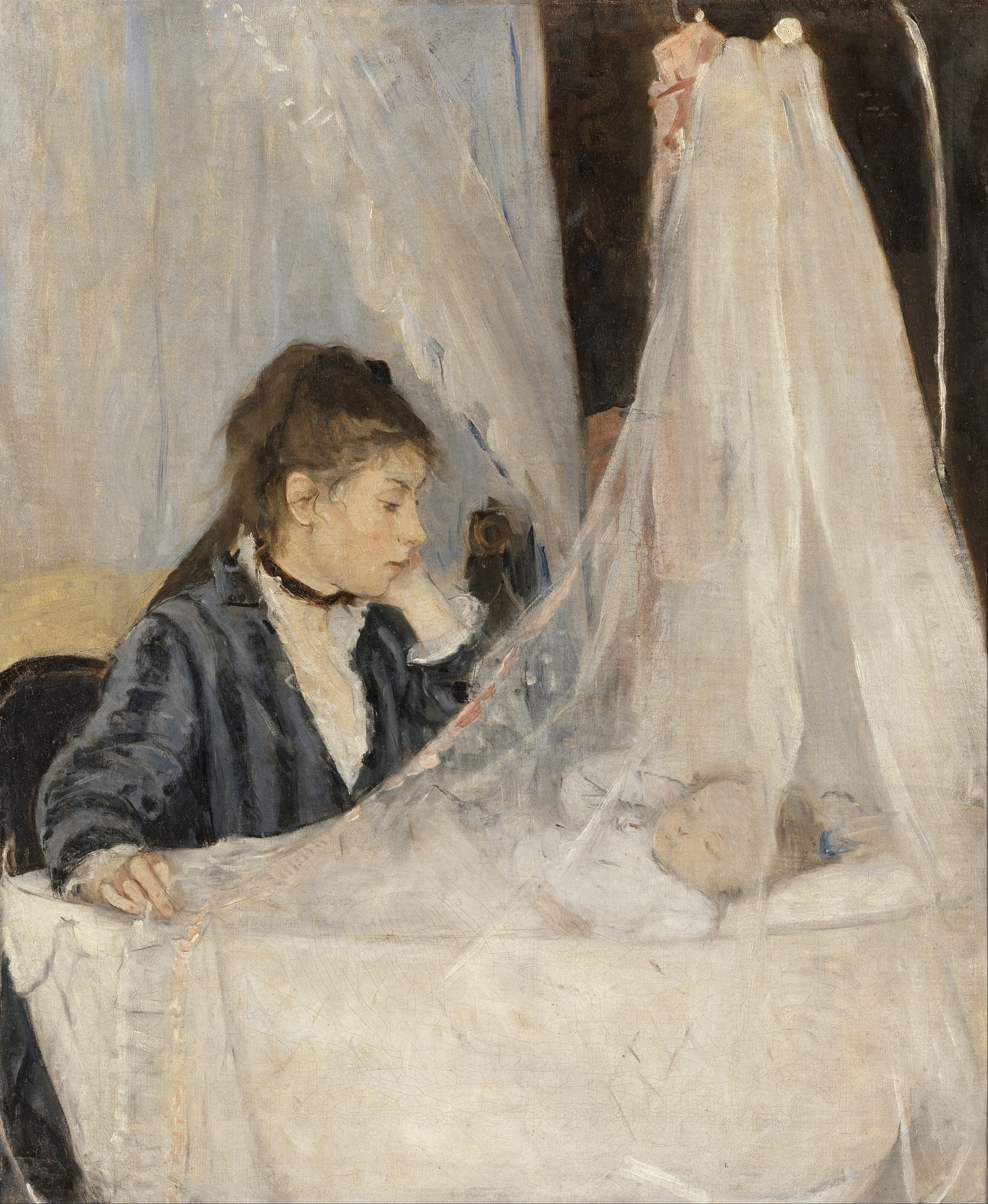
The sleeping baby in Berthe Morisot’s The Cradle is Blanche Pontillon, dozing beneath a diaphanous veil that both reveals and shields her. This quiet, modern nursery moment becomes the painting’s emotional anchor, where maternal vigilance and domestic intimacy converge in a new, Impressionist language of everyday life.
Historical Context
In 1872, Berthe Morisot painted her sister Edma watching her newborn daughter, Blanche Pontillon (born December 23, 1871), during a family stay in Passy. The infant’s sleep offered a timely, personal motif grounded in Morisot’s own household, and it allowed her to depict an intimate scene to which she had privileged access. The Musée d’Orsay identifies Blanche and emphasizes how the cradle’s veil stages this closeness while maintaining a boundary of privacy 1. Panorama de l’art similarly situates the work in the family’s immediate circumstances following Blanche’s birth, which made the infant’s repose a natural subject for Morisot’s brush 2.
Morisot soon presented The Cradle at the first Impressionist exhibition in April 1874, signaling her commitment to modern-life subjects available within bourgeois interiors. The painting also marked the debut of motherhood in her oeuvre, a theme she would pursue for decades. By featuring a sleeping baby—an emblem of domestic routine—Morisot aligned Impressionism’s fresh optics with a woman artist’s realm of experience, turning a private nursery into a public statement about modern painting’s scope and authority 12.
Symbolic Meaning
The gauze drawn between viewer and child functions as a protective veil, asserting care, privacy, and the right to regulate access to the infant. Curators at the Musée d’Orsay read this netting as both a sign of affection and a device that modulates our entry into the scene, casting the baby in a cocoon of safety and maternal love 1. Smarthistory describes the domestic setting as a “protected, insular space,” where the sleeping infant appears almost angelic under the veil’s soft light—innocence held within vigilance 3.
At the same time, Morisot reframes the venerable mother-and-child tradition. Instead of a sacred Madonna and Child, the sleeping baby anchors a secular, middle‑class interior, translating timeless tenderness into the rhythms of modern domestic life 32. Recent scholarship places the image within nineteenth‑century discourse on the medical regulation of infant sleep—light management, veiling, schedules—so the baby’s sleeping state signals contemporary childcare practice as well as affection 5. The veil, then, is both symbol and technology: a boundary of propriety, a filter of light, and a marker of modern, respectable motherhood. Its tender barrier keeps the child at a slight remove, a structural tension critics have noted, tightening the web of arcs and lines that gather protectively around the sleeper 6.
Artistic Technique
Morisot renders the infant with loose, feathered strokes and a luminous palette of whites, creams, and pale blues. Quick, delicate touches describe the gauze so that transparency becomes a pictorial event: the veil both softens and reveals the baby’s features, letting light skim the forms without hard edges 3. Pink accents stitched along the netting sharpen the cradle’s rim and guide the eye to the child’s small, bent arm. Compositionally, the mother’s left arm echoes the baby’s, and slanting curtains and veil create diagonals that converge on the sleeper in the lower right—devices the Musée d’Orsay highlights as crucial to directing attention and to staging intimacy behind a permeable screen 1.
Connection to the Whole
The sleeping baby is the painting’s visual and emotional fulcrum. The mother’s absorbed gaze, the mirrored bend of arms, and the sweep of veils funnel attention toward the cradle, crystallizing themes of maternal vigilance and modern domestic life 13. By interposing the veil, Morisot determines how much of the private sphere becomes visible, asserting authorship over intimacy and turning discretion itself into a compositional principle 12. Critics have noted how the arcs of fabric and netting create a taut, enclosing rhythm around the infant, reinforcing the structured calm of the scene while preserving the child’s slight remove—a poised balance between tenderness and distance that animates the entire canvas 6.
Explore More from This Painting
This detail is one part of The Cradle. Use the links below to return to the full interpretation, browse the full set of details, or view the painting's valuation if available.
Sources
- Musée d’Orsay — The Cradle (object record and curatorial text)
- Panorama de l’art (RMN–Grand Palais) — Analysis of The Cradle
- Smarthistory — Morisot, The Cradle (Harris/Zucker)
- POP (French Ministry of Culture) Joconde — Official record
- The Art Bulletin (2022) — The Cradle and the Medicalization of Babies’ Sleep
- The Atlantic — Formal observations on Morisot’s structuring arcs/lines
- Wikipedia — The Cradle (Morisot) overview