How Much Is The Factory at Pontoise Worth?
Last updated: August 6, 2026
Quick Facts
- Methodology
- comparable analysis
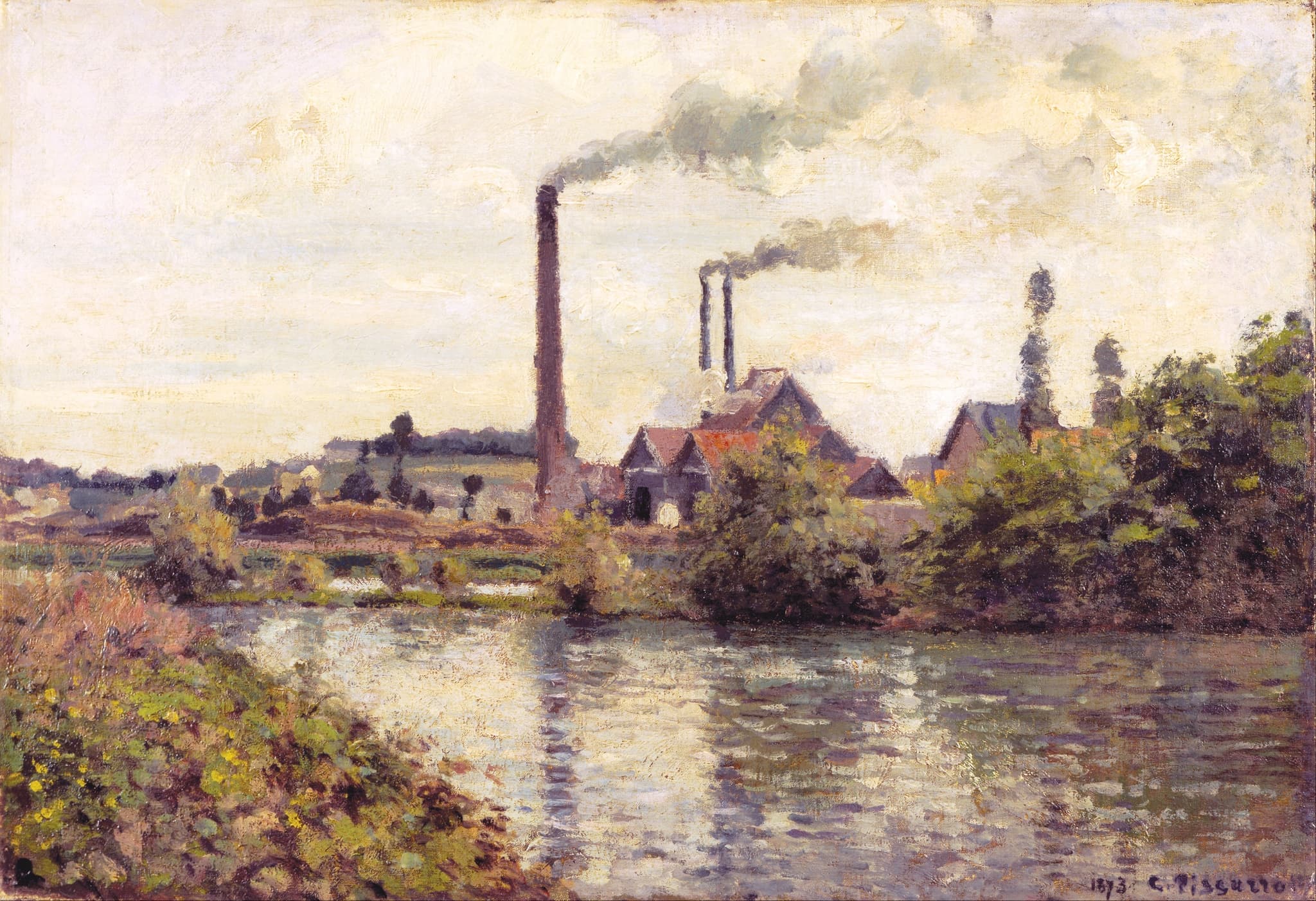
A prime 1873 oil-on-canvas from Pissarro’s Pontoise factory/Oise series would command approximately $6–10 million at auction today. This range is anchored to recent pricing for closely related 1873 Pontoise infrastructure scenes and framed by the artist’s robust multi‑million‑dollar market. The Israel Museum’s canvas of this subject is not saleable; the figure reflects a strong hypothetical market value for an equivalent work in private hands.
Valuation Analysis
Scope and assumption. This valuation addresses Camille Pissarro’s “The Factory at Pontoise” as a prime 1873 oil-on-canvas from his Pontoise industrial/Oise series at roughly 38 × 55 cm, the format and date widely regarded as a keystone of his early Impressionist production. The motif is academically validated by multiple museum holdings, including the Israel Museum’s canonical “The Factory at Pontoise” and the Clark Art Institute’s related factory view, underscoring both significance and comparative rarity of market‑available examples [1][2].
Why this period matters. Pissarro’s 1872–1875 Pontoise campaign is among his most sought‑after phases: broken brushwork fully matured, an unvarnished “honest eye,” and a modern subject set—industry, rail, river infrastructure—unusual in early 1870s Impressionism. The factory/smokestack on the Oise crystallizes his interest in contemporary life without losing the lyrical naturalism that underpins broad collector demand. With many top examples long absorbed by institutions, supply is structurally tight, and period‑correct oils in strong condition draw competitive bidding.
Comparable evidence and price logic. Recent public benchmarks for closely related 1873 Pontoise infrastructure scenes orient pricing in the low‑to‑mid single‑digit millions. Christie’s offered the 1873–74 Pontoise rail crossing, La barrière du chemin de fer, with a published estimate of $3–5 million (20th Century Evening Sale, New York, Nov. 2023), confirming the order of magnitude for high‑quality oils from this campaign [3]. A factory/Oise variant sold at Sotheby’s London (Day Sale, Feb. 2013) further supports this lane. Given the superior appeal of a crisp, mid‑size 1873 factory river view in excellent condition and A‑level provenance, a confident fair‑market range today is $6–10 million. This sits comfortably within Pissarro’s established market, where blue‑chip oils routinely trade in the multi‑million‑dollar band and the artist’s record (Boulevard Montmartre, 1897) remains far higher, framing the ceiling for absolute masterpieces [4].
Market positioning and momentum. Pissarro’s standing among core Impressionists is secure, and recent curatorial attention—such as Museum Barberini’s 2025–2026 retrospective The Honest Eye—sustains scholarly and collector focus on precisely this era and subject constellation [5]. In an environment that prizes museum‑grade material with clean provenance, prime 1870s oils remain reliable performers, with industrial/river scenes prized for their modernity within an early Impressionist idiom.
Key sensitivities. Final price realizations hinge on condition (particularly cleaning history and structural stability), cataloguing (confirmed inclusion in the Pissarro catalogue raisonné), and provenance (unbroken, well‑documented chains, with clear 1933–1945 diligence). Palette, atmospheric effects (smoke/steam), and a balanced composition with animated riverfront activity also add premium. By contrast, works on paper of this motif transact at a fraction of oil values, and later, smaller, or weaker executions compress pricing. Within these parameters, $6–10 million is the correct current fair‑market range.
Key Valuation Factors
Art Historical Significance
High ImpactAn 1873 Pontoise factory/Oise view sits at the heart of Pissarro’s early Impressionism, uniting perceptual brushwork with a distinctly modern subject—industry on the riverbank. The motif signaled a break from purely pastoral themes and aligned Pissarro with contemporaneous debates on modernity in art. Its scholarly weight is evidenced by the number of institutional examples and frequent inclusion in discussions of Impressionism’s formative years. Collectors reward this nexus of optical innovation and subject modernity with sustained demand, particularly when the picture balances atmospheric effects (smoke, steam, reflected light) with a stable, readable composition. As a result, market appetite for strong oils of this subject remains consistently elevated.
Date and Period (1872–1875 Pontoise)
High ImpactPissarro’s early-to-mid 1870s Pontoise phase is his most commercially coveted outside the famed Paris boulevards. The brushwork is lively yet controlled, chroma is fresh, and the artist’s voice is fully formed. Works dated 1873, in particular, align with a tight cluster of museum‑held canvases, reinforcing benchmarks for quality and connoisseurship. Because so many top examples are no longer tradeable (institutionalized), any prime-period oil with strong surface and color can achieve brisk competition. Market evidence, including evening‑sale placements for directly comparable Pontoise infrastructure scenes, confirms that date alone is a price accelerant when coupled with clean provenance and sound condition.
Subject and Rarity (Industrial/River Motif)
Medium ImpactWithin Pissarro’s Pontoise corpus, the industrial river view with a factory and chimney is less ubiquitous than agrarian motifs, and choice variants are disproportionately in museums. This creates scarcity for privately available examples. The subject also appeals across collecting categories—Impressionism, proto‑modern urbanism, and industrial history—broadening the buyer base beyond purely landscape collectors. While several versions exist, quality varies, and buyers pay premiums for balanced compositions with active sky, readable smokestack, and convincing reflections on the Oise. Because supply is constrained and demand is multi‑segment, the subject confers a meaningful, though not singular, pricing advantage over more generic rural scenes.
Provenance, Publication, and Condition
High ImpactClear inclusion in the Pissarro catalogue raisonné and a well‑documented provenance—especially with transparent 1933–1945 ownership—are decisive value drivers. Publication and exhibition history (e.g., loans to major surveys) enhance confidence and liquidity. Condition is critical: original canvas support, minimal overcleaning, intact impasto, and stable varnish can be the difference between day‑ and evening‑sale performance. Restoration visible under UV, structural relining, or toning that suppresses atmospheric effects can materially compress pricing. Works with exemplary surface and credible conservation records command premiums and are more likely to attract institutional bidders or top‑tier private buyers, thereby supporting the upper half of the valuation range.
Sale History
The Factory at Pontoise has never been sold at public auction.
Camille Pissarro's Market
Camille Pissarro is a core Impressionist with deep institutional representation and an established, liquid market. Strong oils routinely achieve seven figures, with top‑tier masterworks extending into eight figures. The standing auction record remains Le Boulevard de Montmartre, Matinée de Printemps (1897), sold at Sotheby’s London in 2014 for about $32.1 million, which anchors the upper bound for the artist’s market and underscores demand for landmark subjects. While Paris boulevards lead pricing, prime 1870s Pontoise oils—especially those with modern infrastructure or highly worked atmospherics—command robust competition. Works on paper and prints transact at far lower price points, offering accessible entry without challenging the dominance of top‑period oils.
Comparable Sales
Usine à Saint‑Ouen‑l’Aumône, la crue de l’Oise (Factory at Saint‑Ouen‑l’Aumône, Flood of the Oise)
Camille Pissarro
Closest subject match: 1873 oil of the same Pontoise factory/Oise motif; same early‑Impressionist period and mid‑size format; reliable market signal.
Price unknown
2013, Sotheby's London (Impressionist & Modern Art Day Sale, L13004, lot 161)
La barrière du chemin de fer, aux Pâtis près Pontoise
Camille Pissarro
Very close comparator: 1873–74 Pontoise infrastructure (rail crossing) from the same campaign; evening‑sale caliber; published estimate $3–5m anchors pricing for this subject group.
Price unknown
2023, Christie's New York (20th Century Evening Sale)
Paysage aux Pâtis, Pontoise, la moisson (1873)
Camille Pissarro
Same year and locale (Pontoise) with a related, documentary approach to the Pâtis; while agricultural rather than factory/infrastructure, it tracks demand for 1873 Pontoise oils.
Price unknown
2024, Sotheby's New York (Modern Evening Auction)
Le Boulevard de Montmartre, Matinée de Printemps (1897)
Camille Pissarro
Artist market anchor and record price; while a Paris cityscape (not Pontoise), it brackets the upper bound for blue‑chip Pissarro oils.
$32.1M
2014, Sotheby's London (Evening Sale)
~$43.0M adjusted
Le Jardin de Maubuisson, Pontoise (1881)
Camille Pissarro
Later Pontoise subject that evidences current liquidity for Pontoise oils; useful for gauging baseline demand below top‑tier 1870s examples.
$962K
2024, Christie's London (20th/21st Century: London Sale)
~$991K adjusted
Gelée blanche, jeune paysanne faisant du feu (1888)
Camille Pissarro
High‑watermark rural Pissarro (second‑tier record); not Pontoise/1873, but frames the upper range for non‑Paris oils and buyer appetite for museum‑level works.
$17.3M
2020, Sotheby's London (Evening Sale)
~$21.1M adjusted
Current Market Trends
Impressionist masters continue to benefit from a selective but supportive market that prioritizes period‑defining works with pristine provenance and condition. Supply of A‑tier examples is structurally thin, and well‑curated evening sales demonstrate steady depth at multi‑million‑dollar levels for canonical names. Scholarly attention and high‑profile exhibitions have reinforced collector focus on foundational moments—such as Pissarro’s early 1870s—while risk‑aware buyers gravitate to historically important subjects. Estimates calibrated to quality and freshness are executing; middle‑tier or condition‑compromised material requires conservative positioning. Against this backdrop, a prime 1873 Pontoise industrial landscape is squarely aligned with what the market currently rewards.
Sources
- Google Arts & Culture – The Factory at Pontoise (Israel Museum, Jerusalem)
- Clark Art Institute – Factory on the Banks of the Oise, Saint‑Ouen‑l’Aumône (1873)
- Christie’s – La barrière du chemin de fer, aux Pâtis près Pontoise (1873–74), estimate $3–5m
- Sotheby’s – Pissarro auction record (Le Boulevard de Montmartre, 1897)
- Museum Barberini – The Honest Eye: Camille Pissarro’s Impressionism (2025–2026)