How Much Is The Harvest, Pontoise (La Récolte, Pontoise) Worth?
Last updated: March 11, 2026
Quick Facts
- Methodology
- comparable analysis
If placed on the open market today, The Harvest, Pontoise (La Récolte, Pontoise) would likely realize in the range of $1.5–4.0 million USD. This non‑binding estimate is based on recent auction comparables for Pissarro’s Pontoise/Éragny landscapes, the painting’s modest dimensions (≈46 × 55.2 cm) and its strong Robert Lehman → Metropolitan Museum provenance.
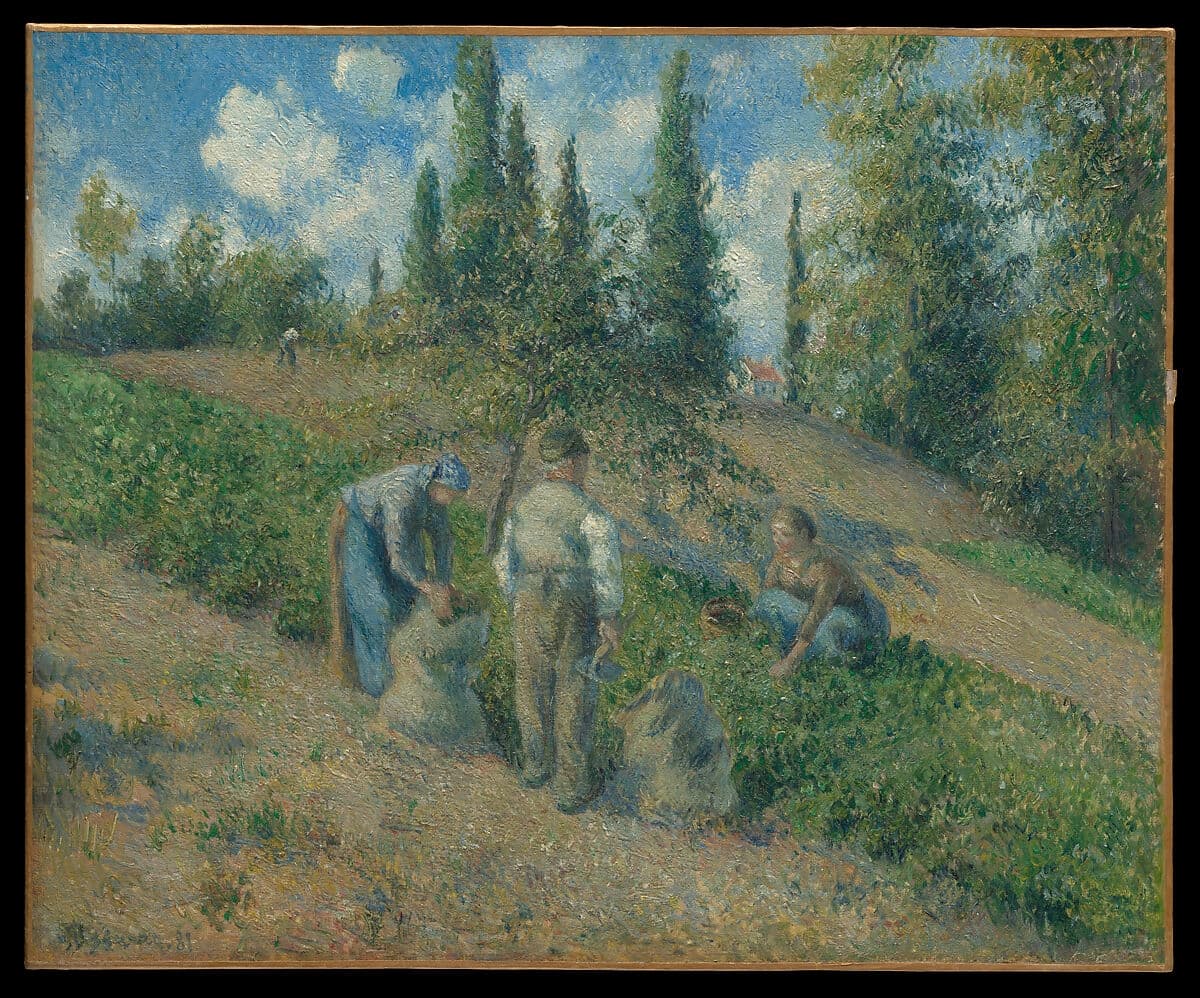
The Harvest, Pontoise (La Récolte, Pontoise)
Camille Pissarro, 1881 • Oil on canvas
View more by Camille Pissarro →Valuation Analysis
Valuation conclusion: If offered on the open market under current conditions, I estimate a likely auction range of $1,500,000–$4,000,000 (hammer to final, depending on buyer’s premium and market venue) for Camille Pissarro’s The Harvest, Pontoise (La Récolte, Pontoise), assuming confirmed attribution, conventional provenance documentation, and no major conservation issues. The painting is currently held in the Robert Lehman Collection at The Metropolitan Museum of Art (accession 1975.1.197) and is therefore off‑market; this figure is a hypothetical, non‑binding estimate for sale planning and insurance discussions [1].
Basis and methodology: This opinion is grounded in a comparable‑sales analysis of Pissarro’s late‑19th‑century rural landscapes, with adjustments for scale, provenance and condition. Relevant auction anchors include Christie’s Matin, soleil d’automne à Éragny (realized ≈ $2.05M, May 2025) and a 2025 Sotheby’s New York Pontoise landscape (reported ≈ $2.49M), which together define the mid‑market band for authenticated Pontoise/Éragny oils offered in recent cycles [2][3]. Earlier harvest‑subject sales such as La récolte des pommes de terre (Christie’s, Rockefeller sale, 2018; realized ≈ $1.57M) provide a lower benchmark after inflation and market movement adjustments [4]. Pissarro’s auction record remains an outlier and functions only as an upper‑market ceiling rather than a direct comparable for this modestly scaled canvas [6].
Adjustments and assumptions: The Met object’s dimensions (≈46 × 55.2 cm) place it in a modestly scaled size class; size alone typically reduces expectations compared with larger, more imposing canvases. Conversely, the Robert Lehman → Metropolitan Museum provenance materially strengthens market confidence and typically commands a premium versus works with uncertain ownership histories, increasing institutional and private‑buyer interest [1]. I have assumed the work is in sound, museum‑conserved condition; any discovered structural issues, heavy overpainting, or unresolved attribution queries would lower the estimate materially, while a published catalogue‑raisonné entry, recent exhibition, or loan history could push the work toward or above the top of the stated range.
Weighting and venue considerations: Venue and sale department influence outcomes: evening‑sale listings in New York or London for Impressionist & Modern works can lift results versus day‑sale placement. For a work of this size and subject, a major‑house New York evening sale with authoritative catalogue support and strong pre‑sale marketing would maximize the result; conversely, a day‑sale placement or regional sale would likely realize toward the lower end of the range. Buyer’s premium, currency conversion and lot placement (evening vs day) can affect realized totals by tens of percent and are accounted for implicitly in the range given here [2][3].
Market context and final note: Impressionist market dynamics since 2024 have been selective; top examples retain strength while the mid‑market is more price‑sensitive. Major exhibitions and renewed scholarship on Pissarro in 2025 have supported demand for museum‑quality examples and thus favour the upper portion of the range if the Met canvas were to be offered with documentation and institutional backing [5]. This estimate is non‑binding and contingent on the items above; I recommend a formal condition survey, catalogue‑raisonné confirmation and an auction house pre‑sale estimate if you require an insured or sale figure.
Key Valuation Factors
Art Historical Significance
High ImpactCamille Pissarro’s Pontoise and Éragny works form a central, well‑studied portion of his mature oeuvre, and harvest scenes exemplify his late‑19th‑century commitment to rural life, light, and social subject matter. A dated 1881 Pontoise harvest view is art‑historically desirable to both institutions and private collectors because it sits squarely within the period when Pissarro’s technique and palette were fully developed. While not one of the handful of iconic Pissarros that generate record prices, this subject and date carry meaningful scholarly and market interest, improving marketability and institutional appeal relative to peripheral or undated works.
Provenance & Exhibition History
High ImpactProvenance is a decisive value driver here: the painting’s presence in the Robert Lehman Collection and its accession into The Metropolitan Museum of Art confer immediate credibility and reduce ownership risk for buyers. Museum provenance often commands a measurable premium in auction markets because it signals clear title, curatorial review and potential exhibition history. If the Met accession is accompanied by catalogue references or prior exhibition loans, that will further lift perceived value. Conversely, the lack of published catalogue‑raisonné entry or absence from major exhibitions would constrain the upside until scholarship is confirmed.
Condition & Conservation
High ImpactPhysical condition and conservation history materially affect market value. Museum stewardship implies a baseline of stable conservation, but a formal, written condition report is required to quantify adjustments. Structural issues (weak canvas, major relining), heavy restoration, or paint loss can reduce market value substantially (often 20–50% or more depending on severity). Conversely, documented, minimal, museum‑quality conservation supports the top of the estimate band. Given that this work is in the Met, the working presumption is sound conservation, but this remains an assumption until verified by inspection.
Comparables & Market Evidence
High ImpactRecent sales provide the principal calibration for the estimate: authenticated Pontoise/Éragny oils have realized in the roughly $1.5–2.5M window in 2024–2025, with higher results for larger or exceptionally well‑documented works (examples of >$10M exist). These auction data points, adjusted for size, provenance and timing, place a modest, well‑provenanced Met canvas in the $1.5–4.0M range. The estimate gives weight to near‑term comparables while recognizing a wider ceiling for rarer, museum‑grade Pissarros.
Size, Scale & Subject Desirability
Medium ImpactAt approximately 46 × 55.2 cm the work is relatively small for an oil landscape, which tends to moderate price expectations compared with larger, more decorative canvases. The harvest subject is appealing—evocative of Pissarro’s rural practice—but is not as singularly iconic as a major urban street scene that has historically set the artist record. Size and subject together favor steady institutional and private collector interest but generally limit the painting’s ability to push into the highest price tiers absent exceptional provenance or exhibition history.
Sale History
The Harvest, Pontoise (La Récolte, Pontoise) has never been sold at public auction.
Camille Pissarro's Market
Camille Pissarro (1830–1903) remains a blue‑chip Impressionist whose mature oil landscapes are consistently sought by museums and collectors. Market activity places many authenticated late‑19th‑century Pissarros in the mid‑six to low‑seven‑figure range, while the rare, iconic canvases can reach double‑digit millions (artist auction record ~£19.68M / ≈$32M in 2014). The market is selective: provenance, condition and catalogue support are decisive in driving premiums. Institutional exhibitions and scholarship continue to underpin demand for museum‑quality works, making strong provenance examples particularly liquid compared with lesser‑documented lots.
Comparable Sales
Matin, soleil d’automne à Éragny
Camille Pissarro
Same artist; Éragny landscape (close locale to Pontoise), oil on canvas; recent market sale showing demand for Pissarro country landscapes.
$2.0M
2025, Christie's New York
Bords de l’Oise à Pontoise (1872)
Camille Pissarro
Direct Pontoise subject — same town as the Met canvas; strong recent sale (2025) making it a highly relevant location/subject comparable.
$2.5M
2025, Sotheby's New York
La récolte des pommes de terre
Camille Pissarro
Directly comparable subject (harvest) and Impressionist rural theme; useful as a harvest‑subject benchmark though sold in 2018 at a lower mid‑market level.
$1.6M
2018, Christie's (Rockefeller sale)
~$1.9M adjusted
Jardin et poulailler chez Octave Mirbeau, Les Damps
Camille Pissarro
High‑end rural/genre landscape by Pissarro that realized >$10M (2019); demonstrates the ceiling for top museum‑quality works with strong provenance/exhibition history.
$10.3M
2019, Christie's New York (Impressionist & Modern Evening Sale)
~$12.3M adjusted
Le Louvre, matin, printemps (1902)
Camille Pissarro
Mid‑to‑high‑million Pissarro sale (2023); though an urban subject and later date, it indicates buyer willingness to pay multiple millions for high‑quality oils.
$4.2M
2023, Sotheby's (Modern/Evening series)
~$4.3M adjusted
Current Market Trends
The Impressionist market has shown a two‑tier dynamic since 2024: top, museum‑quality works remain resilient while the broader mid‑market has been more price‑sensitive. By 2025 selective recovery appeared in segments supported by major exhibitions and renewed scholarship; these conditions favor well‑documented Pissarros. Venue, marketing and lot placement (evening vs day sale) remain material to realized outcomes.
Sources
- Metropolitan Museum of Art object page: The Harvest, Pontoise (La Récolte, Pontoise), Camille Pissarro (accession 1975.1.197)
- Christie's press release: Impressionist & Modern day sale (Matin, soleil d’automne à Éragny realized ≈ $2,046,500, May 13, 2025)
- Report on Sotheby’s New York Pontoise sale (Bords de l’Oise à Pontoise, reported ≈ $2.49M, 2025)
- Christie’s press/materials — Rockefeller sale (La récolte des pommes de terre realized $1,572,500, May 10, 2018)
- Museum Barberini / Denver Art Museum exhibition: The Honest Eye: Camille Pissarro’s Impressionism (2025)
- HENI / reporting on Pissarro record sale: Le Boulevard Montmartre, Matinée de Printemps (Sotheby’s London, 2014)