Bacchus's Dirty Fingernails in Bacchus
A closer look at this element in Caravaggio's c. 1598 masterpiece
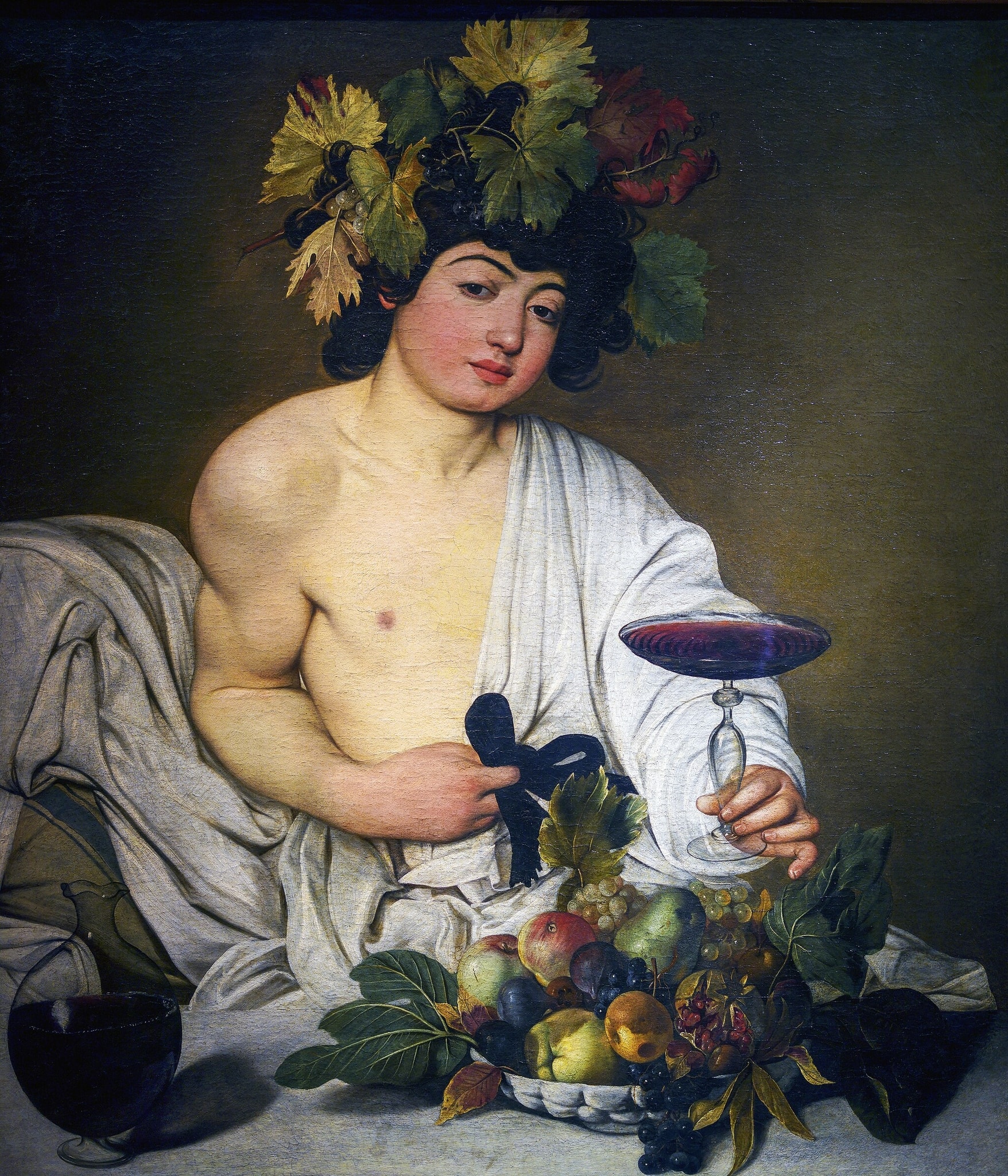
Caravaggio’s Bacchus confronts us with a god who has dirt under his nails. That tiny crescent of grime, painted on the hand offering wine, collapses myth into lived reality and announces the artist’s uncompromising naturalism.
Historical Context
Caravaggio painted Bacchus in Rome around 1596–1598 while working in the refined yet experimental circle of Cardinal del Monte. The Uffizi, which now houses the work, characterizes it as a masterful exercise in naturalism and records its gift from del Monte to the Medici in 1608—anchors that place the picture at the start of the artist’s Roman career and his pursuit of painting directly from life (dal naturale) 1.
In these years Caravaggio became known for using real models and everyday objects without idealizing them, a method later singled out by curators and historians as one of the most original aspects of his art. The “dirty fingernails” belong to this program: they read as the unfiltered facts of a sitter’s body retained on the canvas, an intentional break with polite decorum that helped distinguish his practice from academic norms of perfected gods and heroes 2.
Symbolic Meaning
The grimy nails press the divine Bacchus back into the human world. Rather than an untouchable deity, we meet a flesh‑and‑blood youth whose body bears tiny signs of use—just like the bruised fruit, scuffed vine leaves, and wine that quietly fizzes nearby. The Uffizi’s reading of the still life as infused with Horatian moderation and time’s passing aligns with this detail: dirt at the nail bed underscores a mortal, worldly presence within a scene of cultivated pleasure 1.
Contemporary and later viewers have treated such “grimy fingernails” as shorthand for Caravaggio’s commitment to reality, a deliberately provocative signature that contrasts with classicizing ideals 34. Within vanitas traditions, the nails deepen the painting’s meditation on transience: pleasures are offered, yet their surfaces already show wear. The Art Institute of Chicago points to these lowly details—dirty nails, dirty feet—as recurrent markers of his realism, reinforcing that the choice is programmatic rather than incidental 6. A modern clinical essay even reads the nails, alongside facial flush, as indices of poor hygiene and alcohol use; while not canonical art history, it shows how this specific motif continues to invite diagnostic—and moral—interpretations 5.
Artistic Technique
Caravaggio renders the grime as small, cool brown‑gray crescents beneath the pink, softly modeled nails, catching the same top‑left light that glints along the glass rim and the wine’s surface. High‑resolution imaging makes the precision of these touches unmistakable, revealing their integration into the painting’s meticulous observational fabric 7.
The placement is strategic: the soiled nails appear on the hand that extends the cup toward us, turning a micro‑detail into the literal point of contact between figure and viewer. Many accounts connect the left‑handed offer to the artist’s mirror‑bound working process when painting from life, further tying the detail to his dal naturale method 18.
Connection to the Whole
The nails lock the painting’s themes together. At the very moment of invitation—the proffered wine—they assert the sitter’s everyday humanity, aligning with the overripe fruit, wilted leaves, and minute bubbles to frame pleasure as immediate yet time‑bound 1.
Because Caravaggio made such earthbound facts a hallmark of his style, the detail also functions as a signature: a small disruption that resists idealization and keeps the scene uncomfortably close. Museum writers often cite these “grimy fingernails” as emblematic of his realism, and in Bacchus they sharpen the central tension between classical guise and lived, imperfect reality 3.
Explore More from This Painting
This detail is one part of Bacchus. Use the links below to return to the full interpretation, browse the full set of details, or view the painting's valuation if available.
Sources
- Uffizi — Caravaggio, Bacchus (official catalogue entry)
- National Galleries of Scotland — Beyond Caravaggio (on painting dal naturale)
- National Gallery, London — The Last Caravaggio (curatorial text noting grimy fingernails)
- NEH Magazine — Caravaggio Was the Other Michelangelo
- Frontiers in Psychiatry — Alcohol Use Disorder: Caravaggio’s Bacchus (visual diagnosis reading)
- Art Institute of Chicago — Caravaggio’s Dramatic Life and Paintings
- Wired — Uffizi Gigapixel Imaging of Caravaggio
- Artble — Caravaggio, Bacchus (left-hand/mirror discussion)