The Fruit Basket in Bacchus
A closer look at this element in Caravaggio's c. 1598 masterpiece
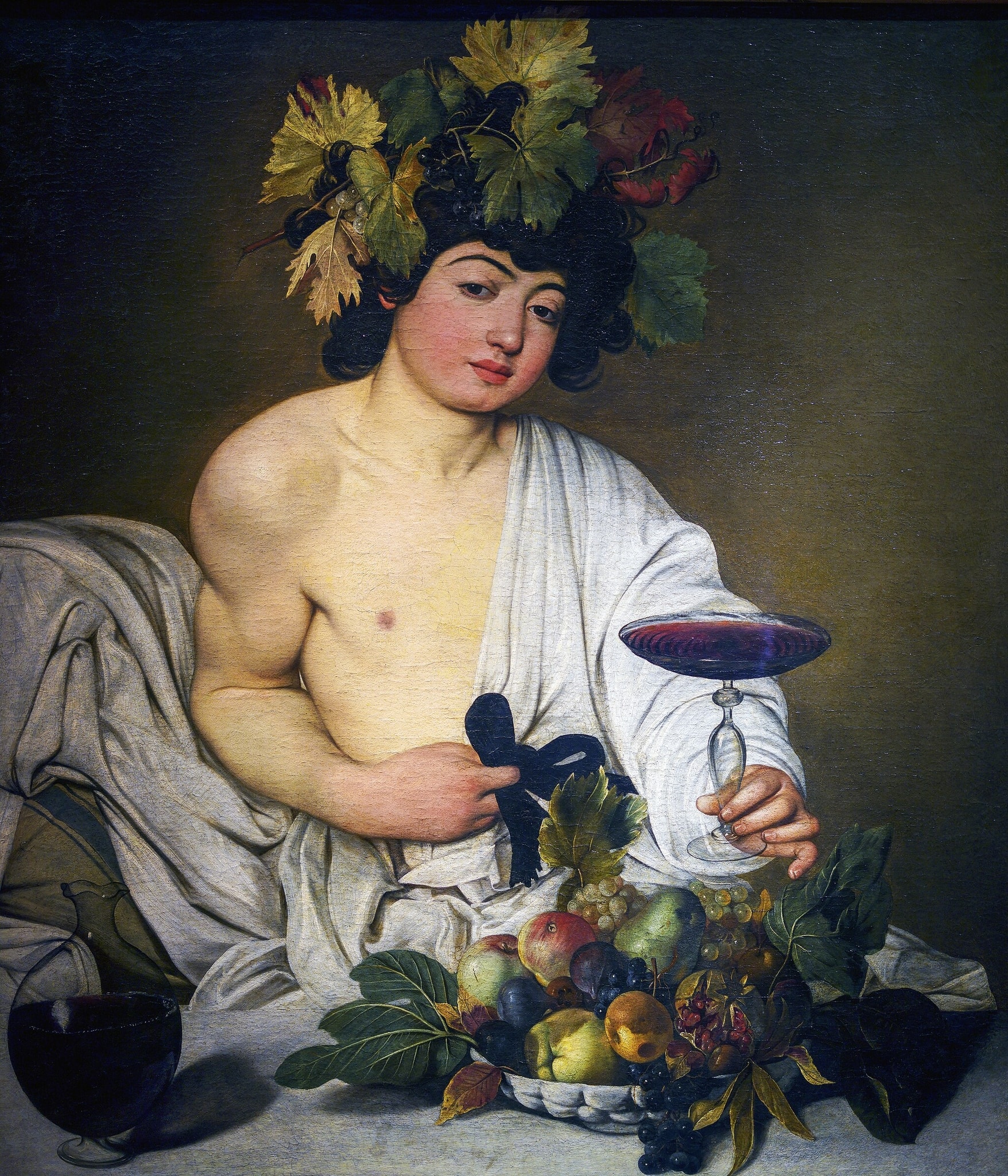
Caravaggio’s fruit basket in Bacchus is both an opulent offering and a sober reminder of time’s bite. Set at the table’s edge with grapes, a cracked pomegranate, and blemished fruit, it greets the viewer with lifelike abundance even as its withering leaves whisper vanitas.
Historical Context
Painted in Rome about 1596–97 in Cardinal del Monte’s circle, Bacchus belongs to Caravaggio’s early half-length figures where a table-edge still life operates as a showpiece of observation and craft. The Uffizi ties this canvas to the artist’s contemporaneous fruit-centered works and to a studio practice that staged living models alongside meticulously rendered objects prized by learned patrons 1. The basket before Bacchus continues this pattern: a conspicuous, tangible ensemble that reflects the collector’s taste for naturalism and witty material culture.
At the same moment, still-life painting was rising as a distinct and celebrated genre in southern Europe. Caravaggio’s commitment to painting directly from nature helped catalyze this shift, bringing unprecedented focus to everyday things and their textures. The basket in Bacchus participates in that new prestige—functioning as an independent still-life tour de force—while remaining integral to the figure composition and to the culture of urbane Roman sociability around 1600 2.
Symbolic Meaning
The basket signals Bacchic abundance and sociability. In the Uffizi’s reading, the pairing of the fruit basket with the offered wine is a Horatian invitation to conviviality: cultured pleasure, friendship, and moderation rather than excess. The offering sits within reach at the picture plane, turning the viewer into a guest at the feast 1.
Yet the feast is not untroubled. Caravaggio records cracked pomegranate, spotted apple, and curling, senescent leaves—details that activate a vanitas chord: the perishability of sweetness, the brevity of youth, and the limits of earthly delight. Museum discussions of his related fruit pieces and comparative readings of the Ambrosiana Basket of Fruit emphasize worm-holes, withered foliage, and rot as signs of time’s passage, a logic that sharpens the Bacchus basket’s moral undertone 357.
Scholars have also proposed learned syncretism. Maurizio Calvesi’s Christological interpretation aligns elements of Bacchus—basket included—with the Bridegroom imagery of the Song of Songs, suggesting a metaphor of the Church as a gathered “basket” of fruits. Such dual registers, pagan and Christian, exemplify the intellectual play prized by Caravaggio’s Roman audience 6.
Artistic Technique
Caravaggio renders the basket with from-life naturalism under raking lateral light: grape bloom, bruised skins, and papery leaf-edges are modeled with minute specificity. The still life is set at the viewer’s height on the same tabletop as the glass, fusing figure and object in a single optical field 1.
Warm autumnal hues—ambers, reds, dusky purples, and deep greens—are pitched against the pale ground and white drapery, while oil’s translucency conveys the wet sheen of grapes and the fibrous tear of the pomegranate. Contemporary testimony and technical commentary on Caravaggio’s early works stress his belief that “tiny things” demanded as much artistry as figures; the basket’s finish embodies that credo and the observational method celebrated by the National Gallery’s account of his early Roman practice 4.
Connection to the Whole
Structurally, the basket is the still-life counterpart to the proffered wine: together they advance across the table like a staged invitation, collapsing distance between painting and viewer. This rhetorical reach is central to Bacchus’s seduction 1.
At the same time, the basket’s decay cues a counter-theme. Signs of ripeness tipping into decline turn the invitation into reflection, aligning pleasure with transience and temperance. Read alongside Caravaggio’s other early fruit pieces, the basket anchors the painting’s double register—sensual allure and moral awareness—so that Bacchus reads not as simple hedonism but as a deliberately poised image of culture, appetite, and time 37.
Explore More from This Painting
This detail is one part of Bacchus. Use the links below to return to the full interpretation, browse the full set of details, or view the painting's valuation if available.
Sources
- Uffizi Galleries, Bacchus (official entry)
- The Met Heilbrunn Timeline, Still-Life Painting in Southern Europe, 1600–1800
- Smarthistory, Caravaggio: Boy with a Basket of Fruit
- National Gallery, London, Boy Bitten by a Lizard
- Pinacoteca Ambrosiana, Caravaggio’s Basket of Fruit
- Finestre sull’Arte, on Calvesi’s Christological reading of Bacchus
- Frontiers in Psychiatry, interpretive essay on Caravaggio’s Bacchus