The Wine Glass in Bacchus
A closer look at this element in Caravaggio's c. 1598 masterpiece
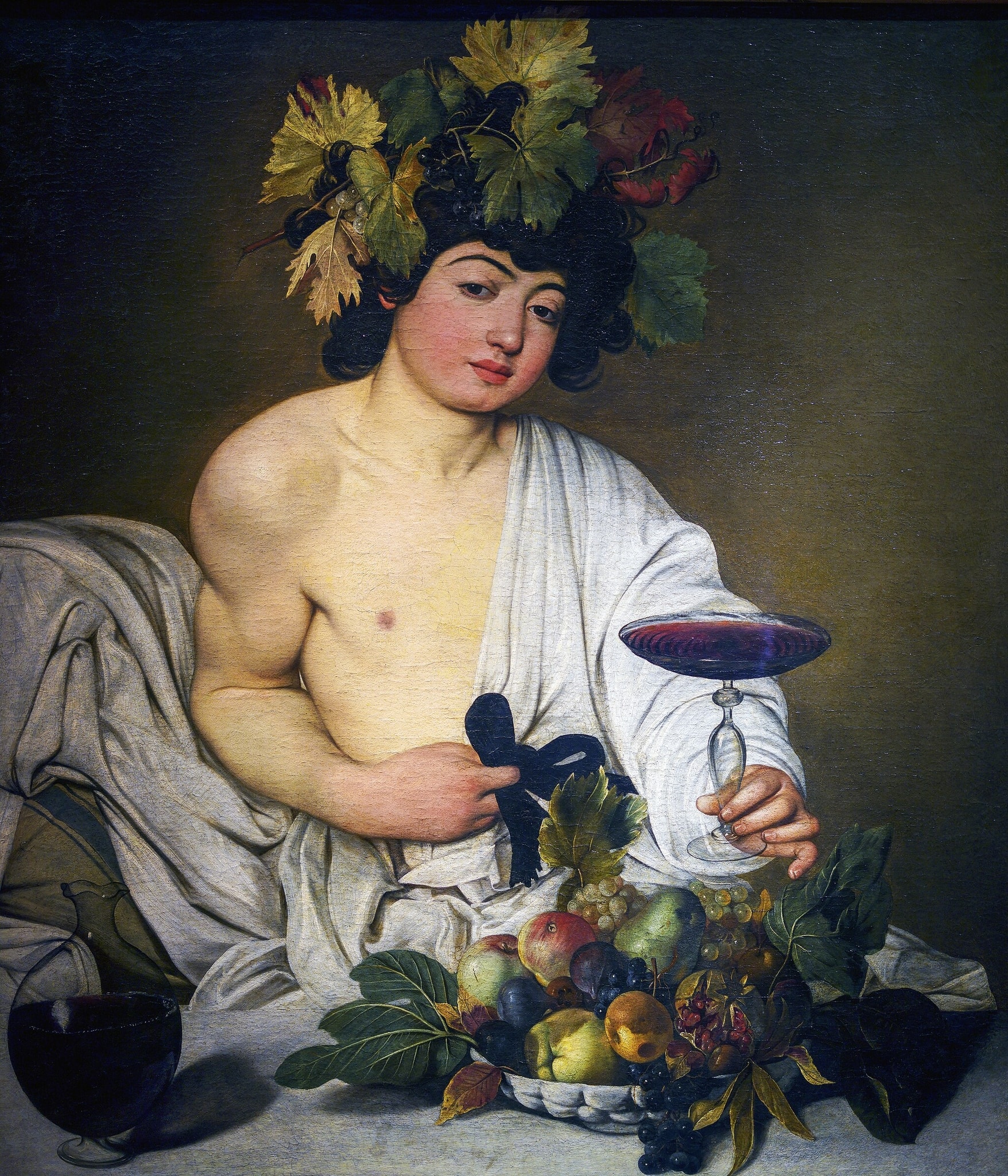
Caravaggio turns a simple wine glass into a theatrical offering: a shallow Venetian tazza brimming with red wine, held out as if to enter our hands. At once a luxury object and an optical laboratory, the glass stages his bravura with light, reflection, and human touch, while inviting us into the drama of Bacchus.
Historical Context
Caravaggio painted Bacchus in his early Roman years under Cardinal Francesco Maria del Monte, around 1598. The Uffizi’s entry foregrounds “the cup of wine proffered by the god,” marking the glass as a showcase of the still‑life naturalism prized within del Monte’s circle and in Roman humanist salons. The work belongs to Caravaggio’s half‑length figures painted in chiaro, where virtuoso objects at the table advertise a new, empirical attention to life observed at close range 1.
The vessel itself is a Venetian tazza, a shallow, stemmed cup made of Murano cristallo. Getty scholars identify the Uffizi painting’s drinking vessel and companion bottle as Venetian, aligning the picture with courtly taste for refined glass and for the visual riddles it enabled—transparencies, refractions, and mirrored glints 2. The painting later entered Medici collections as a gift from del Monte in 1608, precisely the elite context where such glass signaled discernment and connoisseurship 1.
Symbolic Meaning
The extended cup reads first as invitation: a Horatian call to conviviality and friendly moderation rather than excess. Uffizi curators link the offered wine—paired with cultivated fruit—to ideas of sociable restraint and ethical pleasure, casting Bacchus as a civilizing presence rather than a dissolute one 1. In the Italian entry, Mina Gregori places the gesture within the atmosphere of Bacchic rites and the celebration of the senses, which heightens the ritual charge of the glass as an instrument of festivity 7.
Scholars have also drawn a Christian undertow. Following Maurizio Calvesi, Finestre sull’Arte frames the wine as a Eucharistic sign—an allusion to the blood of Christ—so that the proffered tazza doubles as a chalice and the pagan god’s offering becomes a typological echo of sacrament 3. A peer‑reviewed discussion in Frontiers reinforces this Eucharistic reading and even notes the cup’s poised instability, as though the surface might spill—an image of grace offered yet precarious in human hands 6. Within the still‑life program, the glass also participates in vanitas: its shimmering liquid and “flickering” rings on the surface evoke pleasure’s transience and the fragility of the moment 3.
Artistic Technique
Caravaggio renders the glass with optical bravura. Light skims the rim and stem, while the wine shows “gradations of ruby red” shifting with illumination; concentric ripples tremble across the surface. The god’s fingers pinch the fragile edge—dirty nails and all—so that flesh, glass, and liquid meet in a single, startling register of realism 3. Composed at the picture’s threshold, the tazza thrusts into our space, a hallmark of his tight cropping and chiaroscuro half‑lengths 1. Conservation imaging publicized in 2009 underscored the painting’s sustained study of reflection and refraction, an optical play amplified by the echoing glass carafe on the table 4. The vessel’s specifically Venetian make—sleek, weightless cristallo—lets these effects read with crystalline clarity 2.
Connection to the Whole
The tazza is the painting’s rhetorical bridge: an offered drink that collapses distance and turns spectators into guests. Its theatrical reach outward completes the tableau of fruit and linens, fixing our gaze at the very point where hospitality becomes touch 13. Yet the invitation is double. As a Bacchic prop it promises delight; as a Horatian emblem it counsels measure; as a potential Eucharistic sign it intimates sacrament, binding sensual surface to moral and spiritual resonance 16. Optically, the glass partners the nearby carafe—site of the tiny reflected self‑portrait—to declare Caravaggio’s manifesto of painting from life through light itself 4.
Explore More from This Painting
This detail is one part of Bacchus. Use the links below to return to the full interpretation, browse the full set of details, or view the painting's valuation if available.
Sources
- Uffizi Galleries — Bacchus (official object entry, English)
- Getty Publications — The Arts of Fire: identifying the Venetian tazza
- Finestre sull’Arte — Caravaggio’s Bacchus: analysis and Calvesi’s reading
- The Art Newspaper (2009) — Conservation imaging and optical studies
- The Metropolitan Museum of Art — Renaissance Venetian tazza, typology and prestige
- Frontiers in Psychiatry (2013) — Eucharistic interpretation and mirror/left‑hand note
- Uffizi Galleries — Bacco (Italian entry; Mina Gregori’s interpretation)