Holofernes's Scream in Judith Beheading Holofernes
A closer look at this element in Caravaggio's 1599 masterpiece
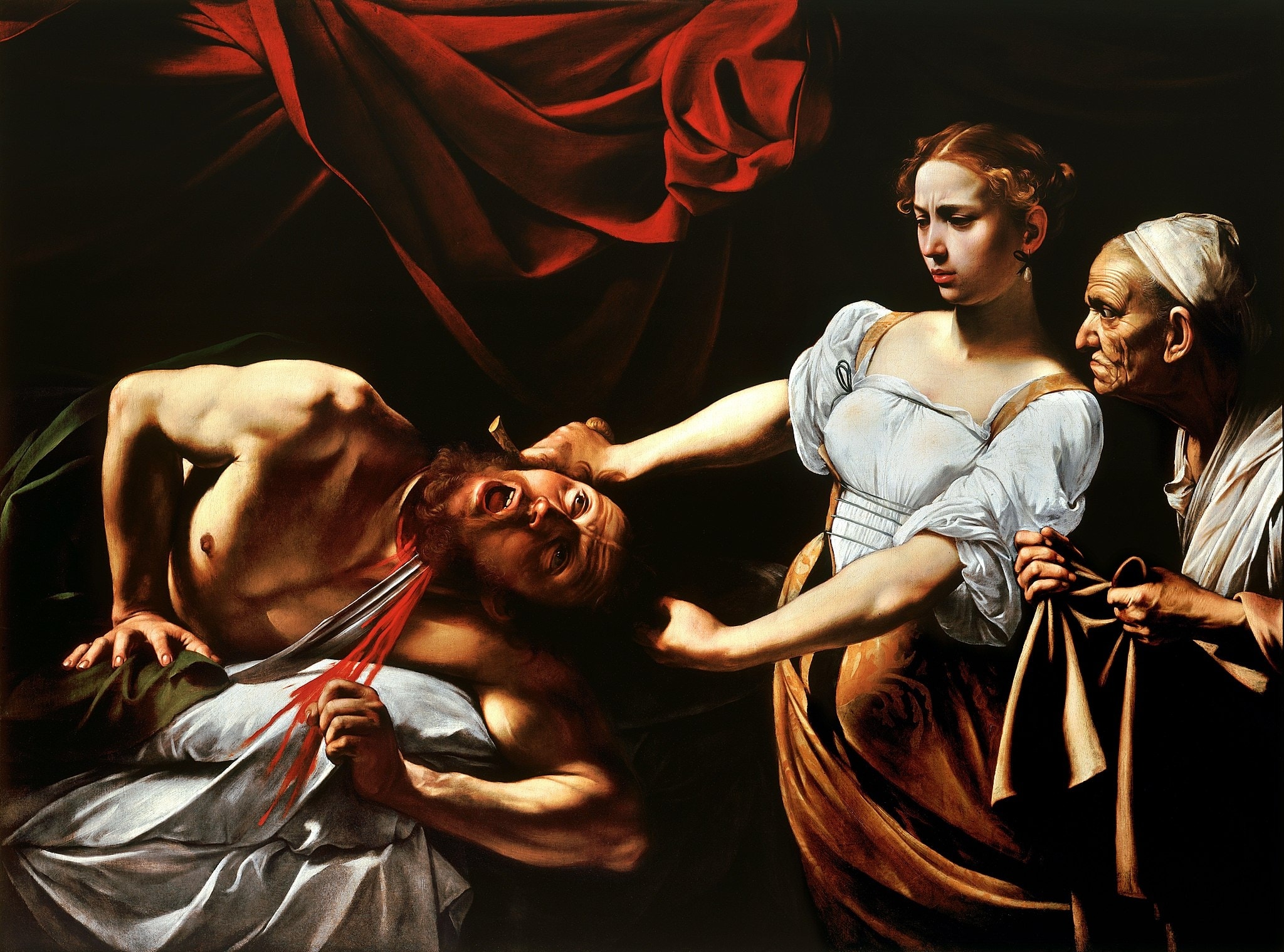
Holofernes’s Scream is the painting’s audible center—a gaping, last-breath outcry that Caravaggio freezes at the split second between life and death. By fixing our gaze on the open mouth, the artist fuses sound with sight to deliver Counter‑Reformation immediacy and a moral reckoning in real time.
Historical Context
Painted in Rome around 1599 for the banker Ottavio Costa, Caravaggio’s Judith Beheading Holofernes was the artist’s first large-scale history subject. The Barberini object text stresses his decision to halt the action at the most volatile instant: Judith’s sword is mid‑stroke, blood spurts, and “the general’s mouth gapes in a strangled cry.” This is Caravaggio’s program of presentness—to insist that sacred history looks and feels like something happening before the viewer 1.
The choice resonated with late‑sixteenth‑century expectations for forceful, affective imagery. In Counter‑Reformation culture the Judith narrative served as an image of Ecclesia triumphans—the Church’s triumph over impious power—making the subject and its climactic instant especially fit for patrons seeking visceral engagement and moral clarity 2. Caravaggio’s freeze‑frame of Holofernes’s last cry satisfies both aims: it confronts the spectator with unvarnished physical reality while delivering a theologically legible moment of judgment 12.
Symbolic Meaning
Across Renaissance and Baroque art, Judith personifies chastity, humility, and the people of God, while Holofernes embodies lust, pride, and tyrannical force. In that tradition, the open mouth functions as the extinguishing “voice” of vice: a final, futile protest as moral order is restored. The Counter‑Reformation reading of Judith as virtue over tyranny (Ecclesia triumphans) makes the scream legible as the collapse of oppressive power at the very instant it is unmasked 2.
Caravaggio heightens this symbolism by choosing the precise hinge‑moment when sound would carry the furthest—yet already fails. The mouth’s oval, teeth bared and tongue pressed back, becomes a sign of passing from life to death, a transition the Barberini text underscores by describing a “strangled cry” 1. Set against Judith’s concentrated, almost reluctant resolve, the howl creates a psychological counterpoint that sharpens ethical contrast: his disordered, animal panic versus her controlled, purposeful act. The motif thus performs double duty—narratively announcing the end of the tyrant and theologically staging the silencing of sin. Seen this way, Holofernes’s Scream is not only noise made visible but also power made null, the sound-image of defeat within a long moralizing tradition 12.
Artistic Technique
Caravaggio renders the scream through rigorous tenebrism: a hard, directional light from the upper left isolates Holofernes’s head, forcing the mouth into ruthless clarity against deep shadow. Within a restricted palette, the brilliant white sheet and the saturated red canopy channel the eye to the lit flesh passages where the mouth sits like a visual alarm. Warm, blood‑flushed midtones model the lips and cheeks, while an abrupt dark cavity articulates the throat; small highlights pick out teeth and saliva, tightening the sense of breath forced outward. The “freeze‑frame” composition—sword mid‑arc, blood spurting in arterial ribbons—locks the facial mask at maximum tension, so the cry reads instantly even from mid‑distance 1.
Connection to the Whole
The scream anchors the painting’s narrative and formal structure. It lies on the central action axis that links the flashing sword, the severed neck, and the light-struck sheet, making it the work’s audible-visual fulcrum. As Judith’s composed face meets Holofernes’s contorted one, the motif crystallizes the drama’s ethical polarity and delivers the scene’s climax with arresting clarity 1.
For contemporary viewers, that suspended outcry enacted the Counter‑Reformation ideal: a picture that convicts the senses and the conscience at once. The vanishing “voice” of oppression literalizes Judith’s victory, transforming a biblical beheading into a present-tense triumph of virtue over tyranny. Caravaggio’s staging makes the cry almost hearable, binding spectators to the moment of judgment that defines the whole painting 21.
Explore More from This Painting
This detail is one part of Judith Beheading Holofernes. Use the links below to return to the full interpretation, browse the full set of details, or view the painting's valuation if available.