Judith's Hesitant Expression in Judith Beheading Holofernes
A closer look at this element in Caravaggio's 1599 masterpiece
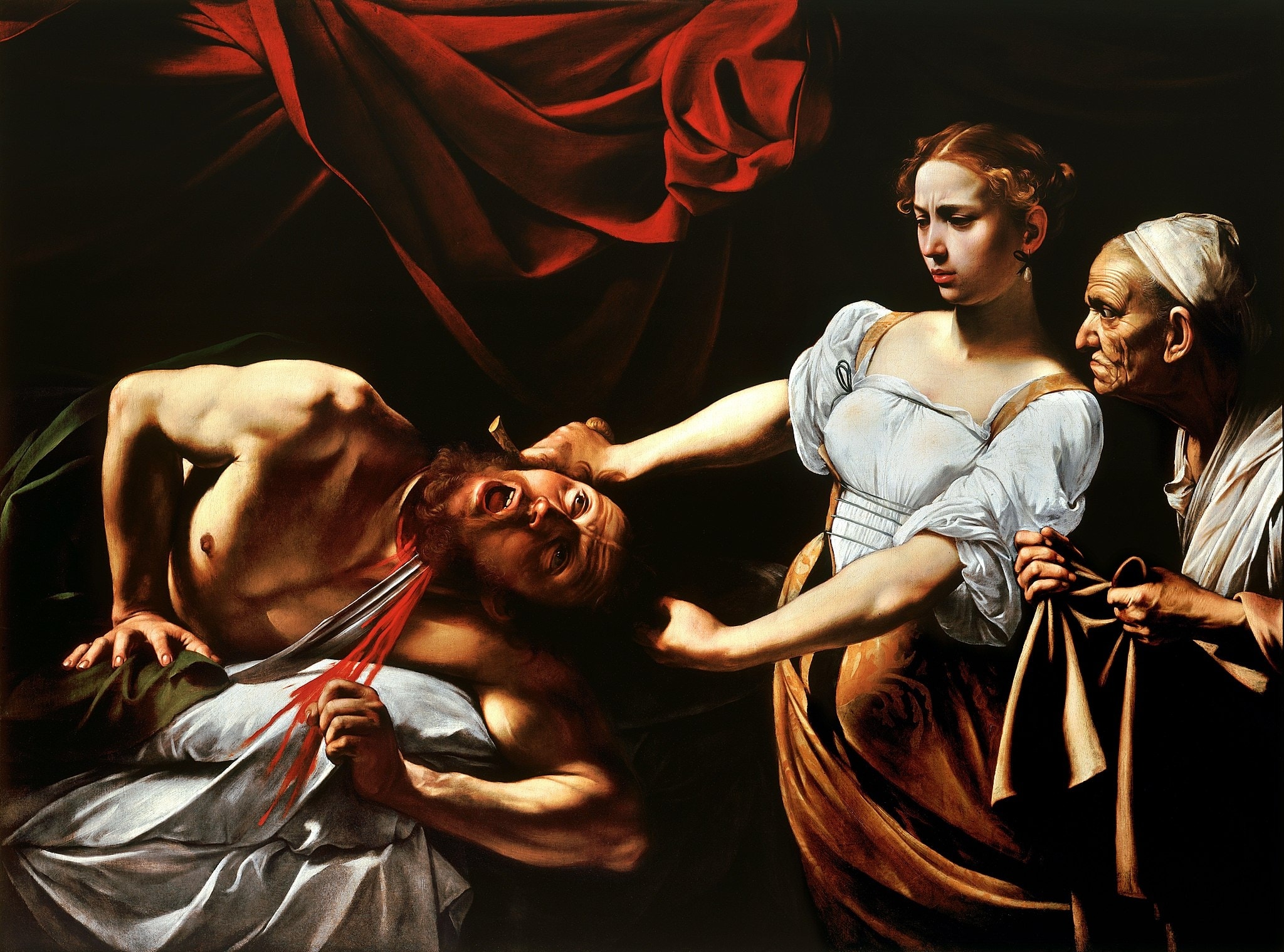
Judith’s face in Caravaggio’s Judith Beheading Holofernes holds the scene’s moral voltage: a furrowed brow and averted gaze that register revulsion even as the sword bites. By pinning this hesitation in raking light, Caravaggio fuses Counter‑Reformation urgency with raw psychology, making virtue look difficult—and therefore real.
Historical Context
Painted in Rome around 1599, Caravaggio’s canvas answers the Counter‑Reformation charge to make sacred stories immediate, intelligible, and affective. His Judith is not an emblem frozen in triumph but a young woman caught in the instant where duty collides with disgust. The Palazzo Barberini describes the light falling "in full" on her face, where her brow tightens as she steels herself to complete the killing—an expressly human reaction staged at point‑blank range 1. The Metropolitan Museum frames Judith’s story as a moral exemplar in early modern Europe, symbolizing civic virtue and just deliverance; Caravaggio’s psychological naturalism channels that didactic aim through lived sensation rather than idealized rhetoric 2.
The result is a new kind of history painting: a "theater of contrasts" condensed into a single, decisive second. The diagonal beam from the upper left isolates Judith’s expression and hands while plunging the rest into tenebrist shadow, a device that turns her hesitation into the narrative engine of the scene 1.
Symbolic Meaning
Across Renaissance and Baroque art, Judith embodies the triumph of Virtue over Tyranny—a figure for justice that liberates her people. Caravaggio keeps that emblematic charge while stripping it of triumphal gloss. Her tightened brow, slightly averted eyes, and controlled lips articulate recoil at necessary violence, signaling pious humility rather than relish. In this key, the expression argues that righteousness may demand action while refusing cruelty, aligning with broader readings of Judith as a civic and moral agent 21.
At the same time, the face remains deliberately double. The Kimbell emphasizes Judith’s resolve at the fatal instant, an interpretation that reads her features as concentrated focus rather than squeamishness 3. Smarthistory notes how Caravaggio renders her "dainty," seemingly holding herself at arm’s length—a physical and emotional distance that supports the sense of hesitation 4. The Web Gallery of Art underscores the moral-allegorical frame—Virtue overcoming Evil without eroticized vengeance—into which her restraint squarely fits 5. Caravaggio therefore stages an ethical balance: iron duty lacking bloodlust. The equivocal expression is not a flaw to be clarified but the very sign of moral seriousness in a world where justice exacts a cost.
Artistic Technique
Caravaggio sculpts Judith’s psychology with tenebrism. A raking beam from the upper left isolates her face and forearms, sharpening the furrowed forehead and compressed mouth while letting the background collapse into darkness 1. Her body angles backward, arms fully extended; the pristine white linen catches arterial red, heightening the dissonance between elegance (pearls, fitted bodice) and gore. The three-figure choreography—youthful heroine, straining victim, intent maid—presses inward beneath a blood‑colored drape, compressing space so the eye returns to Judith’s lit visage again and again 13. Edge‑lighting, crisp contours, and the cool pallor of skin against a warm ocher skirt focus our reading on recoil rather than frenzy; the lighting isn’t decorative but a tool for legible emotion in real time.
Connection to the Whole
Judith’s hesitant face is the painting’s ethical hinge. Opposed to Holofernes’s scream and Abra’s flinty concentration, her conflicted look stabilizes the tableau as a drama of conscience rather than spectacle. That contrast—youth versus age, recoil versus resolve, life versus imminent death—creates the Barberini’s "realistic theater of contrasts," guiding viewers to weigh righteous action against human cost 1.
By anchoring the narrative at the level of expression, Caravaggio fulfills Counter‑Reformation aims for stirring, morally charged clarity while preserving the story’s emblematic force of civic virtue and justice 2. The beheading supplies the plot; Judith’s face supplies the meaning, keeping the scene on the side of Virtue without lapsing into triumphalism.
Explore More from This Painting
This detail is one part of Judith Beheading Holofernes. Use the links below to return to the full interpretation, browse the full set of details, or view the painting's valuation if available.
Sources
- Gallerie Nazionali Barberini Corsini – Object page for Caravaggio’s Judith Beheading Holofernes
- The Metropolitan Museum of Art – Judith iconography and context
- Kimbell Art Museum – Exhibition page: Caravaggio, Judith Beheading Holofernes
- Khan Academy/Smarthistory – Artemisia Gentileschi’s Judith (with comparison to Caravaggio)
- Web Gallery of Art – Caravaggio, Judith Beheading Holofernes
- Jonathan Jones, The Guardian – Critical essay on Caravaggio’s Judith