The Old Maidservant in Judith Beheading Holofernes
A closer look at this element in Caravaggio's 1599 masterpiece
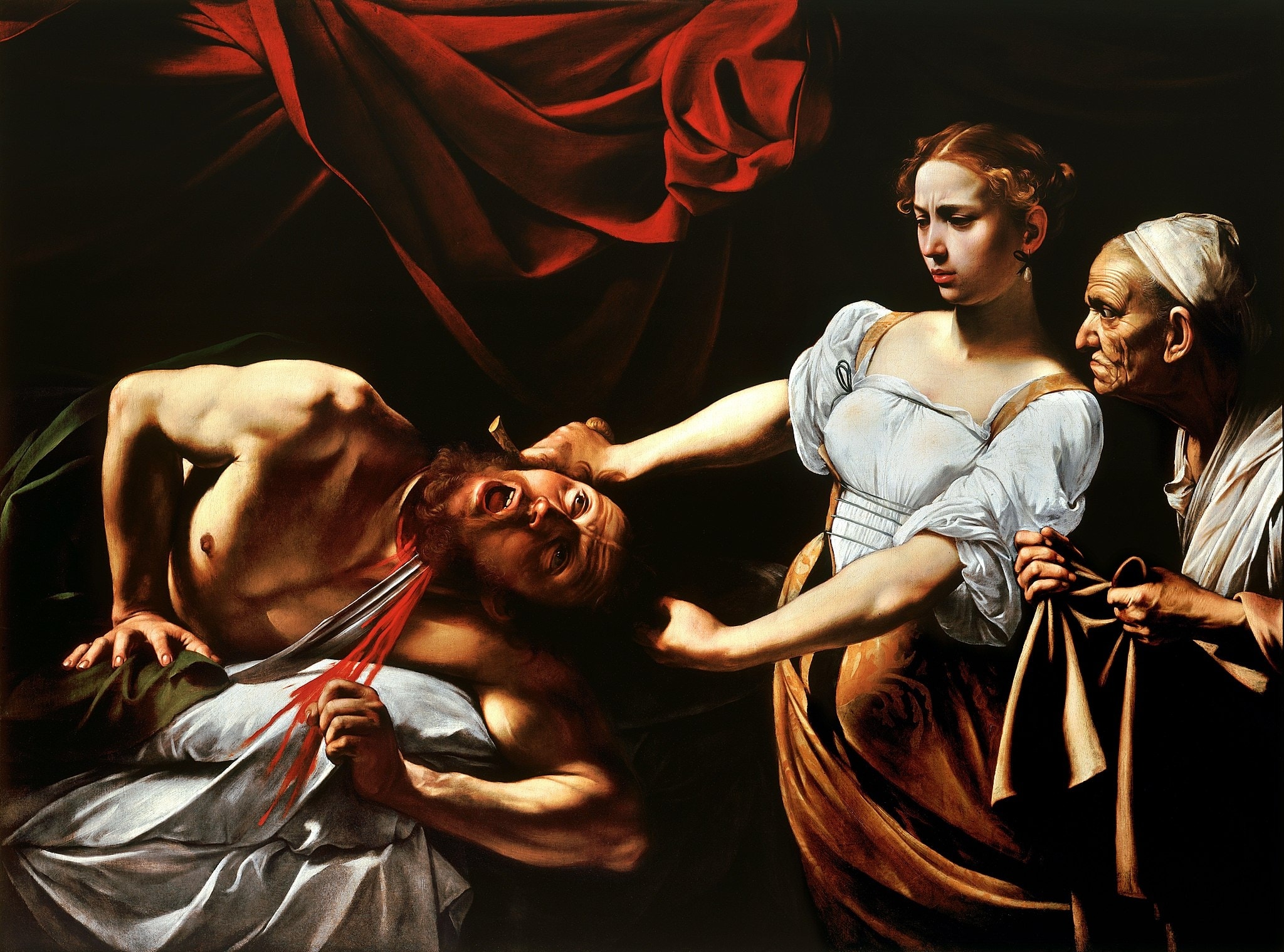
Caravaggio’s old maidservant—traditionally called Abra—stands at the painting’s right edge, sack open, ready to hide Holofernes’s head. Her lined face and fixed stare turn her into a visceral witness and logistical accomplice, sharpening the scene’s brutal present-tense and heightening Judith’s youth and resolve.
Historical Context
Painted in Rome around 1599, Caravaggio’s Judith Beheading Holofernes compresses a biblical climax into a three-figure drama lit by a raking beam. The painting’s owning museum identifies the maid as Abra and stresses that, although Scripture does not mark her age, Caravaggio deliberately renders her as a “wrinkled old woman with hallucinated eyes,” positioned at the right as a terrified witness 1. The Kimbell’s loan text clarifies her precise narrative task at this instant: she opens a sack to conceal the head as soon as Judith completes the beheading—an action that propels the story from killing to escape 2.
Caravaggio’s staging—a red tent drape, a glaring white sheet, and figures carved from darkness—centers the deed while giving the maid a crucial, active presence at the threshold between the scene and the viewer. Her aging physiognomy, half-caught in the light, ties the work to period conventions that often cast the attendant as elderly, yet Caravaggio intensifies the figure’s psychological charge by making her watchful, transfixed, and indispensable to the plot’s next move 12.
Symbolic Meaning
The maid operates as a deliberate foil to Judith. Barberini curators frame the painting as a theater of oppositions—darkness/light, age/youth, life/death—and Abra’s crone-like visage heightens Judith’s beauty and moral purpose while registering the scene’s horror. Her “hallucinated” eyes become the painting’s internal witness, modeling the viewer’s own shock and binding us emotionally to the act we behold 1.
Her open sack is not a prop but an emblem of shrewdness and complicity grounded in the Book of Judith: after the beheading, the maid places the head in her bag so the women can flee, a logistical detail Caravaggio presses into the very instant of action 3. The figure also situates the work within a durable iconographic tradition—seen in Mantegna’s circle and countless prints—in which the servant holds the bag for the severed head 4. Early modern painters often aged the maid to telegraph worldly prudence; commentary on related Judith images notes this widespread convention even when some artists depart from it 5. Modern Judith studies trace how “Abra” emerges by name in later tradition and how artists amplify her from attendant to co-agent; Caravaggio’s vigilant, elderly Abra epitomizes that accomplice/witness type 6.
Artistic Technique
Caravaggio renders the maid with tenebrist economy: a raking light from the upper left grazes her creased profile and hands while leaving much of her body in shadow, keeping her close to us yet secondary to Judith. The red tent drapery and the lit sheet set a theatrical stage; against this, the maid’s knotted kerchief, sinewed wrists, and bunched sack read with tactile immediacy 1. Her angled head and the oval mouth of the bag create a receiving vector that completes the diagonal of Judith’s sword-arm, a compositional cue to the imminent concealment the Kimbell text singles out 2. Physiognomic exactitude—beaklike nose, folded skin, intent eyes—turns age into narrative information: capability born of experience, braced for flight the instant the blade finishes its work 12.
Connection to the Whole
The maid is the painting’s structural hinge. Caravaggio reduces the story to a tight triad: Judith acts, Holofernes suffers, and Abra guarantees consequence—concealment and escape. Her placement flush with the right edge aligns our vantage with hers, so that our witness mirrors her own and the violence feels inescapably present 1. Iconographic continuity—the servant with the sack—anchors the scene in a known Judith type while Caravaggio’s focus on the very instant of killing makes that convention do new narrative work: it secures the plot’s coherence and affirms a tactical virtue that topples tyranny through nerve and prudence 34. In short, Abra binds deed to aftermath, ethics to logistics, and image to viewer.
Explore More from This Painting
This detail is one part of Judith Beheading Holofernes. Use the links below to return to the full interpretation, browse the full set of details, or view the painting's valuation if available.
Sources
- Gallerie Nazionali Barberini Corsini, collection entry: Judith Beheading Holofernes
- Kimbell Art Museum, exhibition text: Caravaggio’s Judith Beheading Holofernes
- Bible Gateway (NRSVCE), Judith 13:9–11
- National Gallery of Art (Washington), iconographic precedent: Judith with the Head of Holofernes (after Mantegna)
- Nasjonalmuseet (Oslo), on the age-convention for the maid: Judith and her Maidservant with the Head of Holofernes
- Open Book Publishers, The Sword of Judith: Judith Studies across the Disciplines