How Much Is The Calling of Saint Matthew Worth?
Last updated: February 26, 2026
Quick Facts
- Methodology
- comparable analysis
Notional, insurance-style valuation for Caravaggio’s The Calling of Saint Matthew: $500 million to $1 billion. As a prime-period, canonical masterpiece installed in the Contarelli Chapel and protected under Italian heritage law, it is effectively non-tradeable; the range reflects a hypothetical, freely tradable scenario benchmarked against top Old Master trophies.
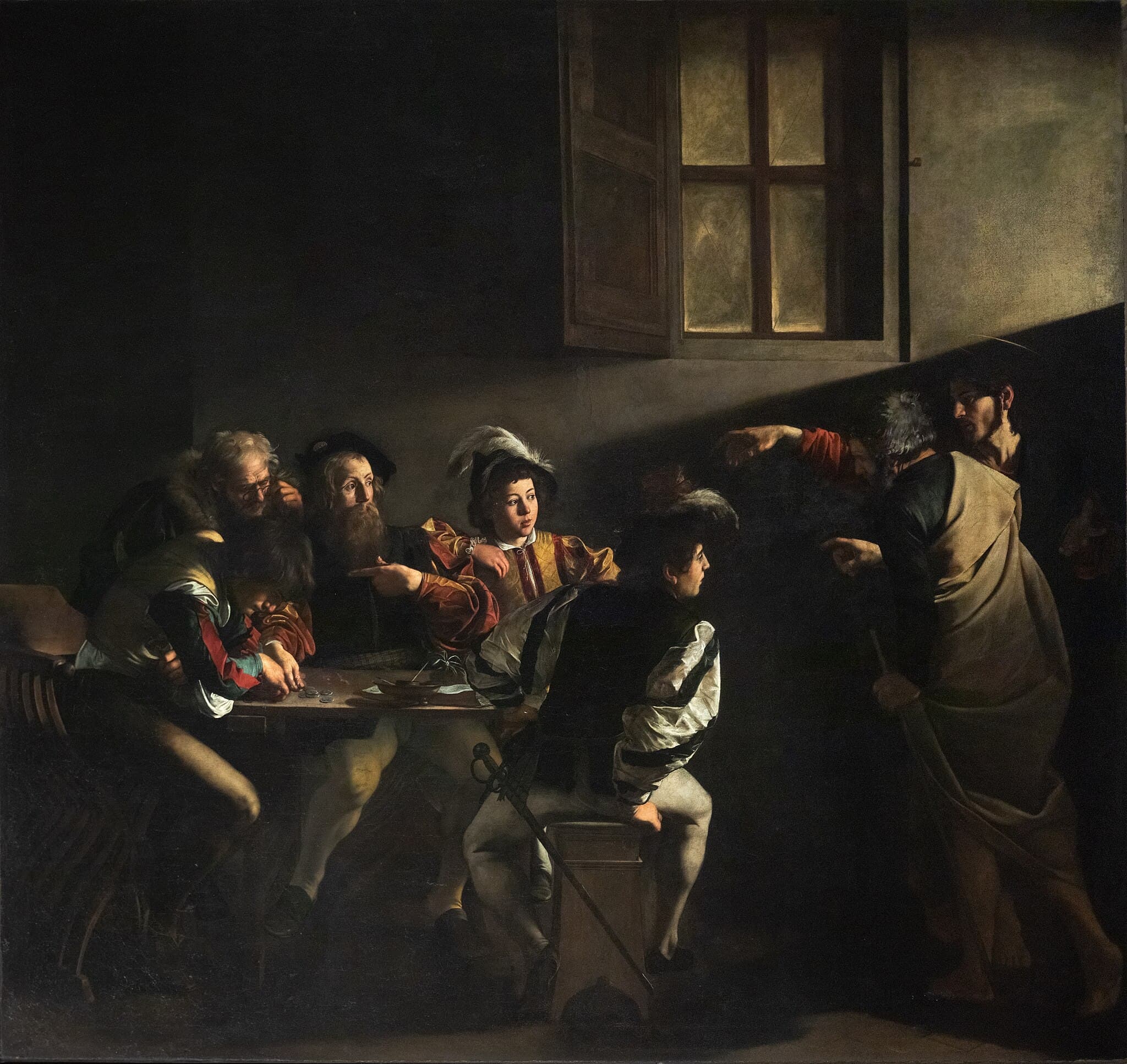
The Calling of Saint Matthew
Caravaggio, 1599–1600 • Oil on canvas
Read full analysis of The Calling of Saint Matthew →Valuation Analysis
Conclusion: In a hypothetical, freely tradable scenario, Caravaggio’s The Calling of Saint Matthew supports a notional valuation of $500 million–$1 billion. The painting is a prime-period, canonical masterpiece of Baroque art, installed in situ in the Contarelli Chapel of San Luigi dei Francesi in Rome and protected under Italian cultural-heritage law—facts that render it effectively non-saleable in reality, and thus valued here on an insurance-style, notional basis [1][5].
Why this level: The work’s art-historical importance is unimpeachable. It is among the defining images of Caravaggio’s revolutionary naturalism and tenebrism, a touchstone in the global canon and a central node in the artist’s most celebrated Roman cycle. Its authorship, fame, and period place it at the very apex of Old Master desirability. Supply of secure, museum-caliber Caravaggios is effectively zero; modern public auction benchmarks for unimpeachable masterpieces by the artist do not exist. The closest recent datapoint, the authenticated Ecce Homo (Madrid), reportedly sold privately in 2024 for c. €30–36 million, underscoring demand for autograph works even when smaller and later in date [2].
Comparable market anchors: The top of the Old Master market demonstrates ample capacity for singular, brand-defining pictures. Leonardo’s Salvator Mundi achieved $450.3 million at Christie’s in 2017, a public record for any artwork, despite attribution debate [3]. Rembrandt’s pendant portraits of Maerten Soolmans and Oopjen Coppit sold privately to the Rijksmuseum and the Louvre for €160 million (c. $180 million at the time), evidencing institutional willingness to transact at nine figures for canonical 17th-century masterpieces [4]. Relative to these anchors, The Calling of Saint Matthew—arguably the most widely recognized Caravaggio and a cornerstone of Baroque painting—merits placement at or above the highest Old Master benchmarks in a free-trade context.
Method and positioning: This estimate relies on comparable analysis against the trophy segment of the Renaissance/Baroque market (Leonardo, Rembrandt) and on scarcity-driven pricing dynamics. It assumes global, unconstrained bidding by leading museums and ultra-high-net-worth collectors with access to private-treaty and guarantee structures. Under such conditions, competitive pressure, the painting’s cultural primacy, and the near-total absence of peer supply support a $500 million floor and a credible path to $1 billion.
Constraints and practicality: As installed and protected cultural property in an Italian church administered by French institutions in Rome, the work is non-exportable and not an object of trade; any valuation is therefore notional rather than a realizable market price [1][5]. If ever insured at agreed value, institutions would likely align coverage in this range given the work’s singular standing.
Key Valuation Factors
Art Historical Significance
High ImpactThe Calling of Saint Matthew is a cornerstone of Baroque painting and one of the defining images of Caravaggio’s revolution in lighting, narrative immediacy, and naturalism. It anchors the Contarelli Chapel cycle and is among the most widely reproduced and taught artworks in Western art history. Its influence on contemporaries and the broader Caravaggisti movement is profound, and its prime Roman date makes it a lodestar for the artist’s mature style. Canonical, curriculum-level recognition dramatically amplifies cultural and financial value potential in any hypothetical, unconstrained sale, placing it alongside the small set of paintings that can credibly compete for the absolute top of the market.
Rarity and Supply
High ImpactAutograph Caravaggios of secure attribution and prime period are almost entirely in museums and churches. Modern public auction benchmarks for an undisputed, marquee Caravaggio do not exist, and the limited private activity around the artist confirms an extremely thin market. The rediscovered Ecce Homo (Madrid), authenticated and subsequently exhibited at the Prado, traded privately in the tens of millions—illustrating demand in the face of near-zero supply but also how far true masterpieces sit above such datapoints. The Calling’s combination of authorship, scale, subject, and fame is effectively irreplaceable, and scarcity premiums are accordingly extreme.
Market Benchmarks & Trophy Demand
High ImpactAt the apex of the Old Master market, blue-chip, canon-defining works have demonstrated nine-figure capacity. Leonardo’s Salvator Mundi reached $450.3 million at auction; Rembrandt’s pendant portraits made €160 million privately with joint museum buyers. These anchors show how scarcity, brand recognition, and institutional demand translate into top-of-market pricing in the Renaissance/Baroque segment. Against those benchmarks, a prime, universally celebrated Caravaggio with immense cultural cachet justifies a range that begins near the Leonardo result and extends higher under competitive pressure, supporting the $500 million–$1 billion bracket for a freely tradable scenario.
Legal/Heritage Constraints
Medium ImpactThe painting is installed in the Contarelli Chapel at San Luigi dei Francesi (the French national church in Rome) and protected under Italy’s Code of Cultural and Landscape Heritage. As such, it is effectively non-tradeable and non-exportable. These legal and custodial realities mean that any pricing is notional—appropriate for insurance, academic valuation, or state indemnity contexts—rather than a realizable market price. While this constraint does not diminish intrinsic or cultural value, it frames how the estimate should be interpreted: as the rational clearing range if the work were hypothetically free to transact, not as a prediction of an actual sale event.
Sale History
The Calling of Saint Matthew has never been sold at public auction.
Caravaggio's Market
Caravaggio occupies the absolute top tier of Old Masters in terms of desirability, but the market for his autograph works is vanishingly thin. Almost all accepted paintings reside in museums or churches, leaving no modern public auction benchmark for a secure, prime Caravaggio. The few recent developments—most notably the authenticated Ecce Homo (Madrid), reported by major outlets as selling privately for roughly €30–36 million—demonstrate strong demand and intense scholarly scrutiny, but they are not comps for a canonical, early Roman masterpiece. As a result, valuation for exceptional Caravaggios relies on trophy-level comparables (Leonardo, Rembrandt) and institutional appetite, rather than on direct auction data for the artist.
Comparable Sales
Salvator Mundi
Leonardo da Vinci
Ultra-rare, canonical Old Master; religious subject; global trophy benchmark showing what a fully marketed Renaissance/Baroque masterpiece can fetch in modern times.
$450.3M
2017, Christie's New York
~$598.0M adjusted
Pendant portraits of Maerten Soolmans and Oopjen Coppit
Rembrandt van Rijn
Top-tier 17th-century Old Master masterpieces placed privately with blue-chip museums at a nine-figure price; demonstrates institutional demand and pricing for canonical works of the period.
$180.0M
2016, Private sale (joint acquisition by the Rijksmuseum and the Louvre)
~$243.7M adjusted
The Massacre of the Innocents
Peter Paul Rubens
Large-scale Baroque religious narrative with intense drama; historically a record-setting Old Master. Useful for scale on market appetite for grand Baroque biblical scenes.
$76.7M
2002, Sotheby's London
~$138.5M adjusted
Lot and His Daughters
Peter Paul Rubens
Prime Baroque narrative painting sold at an exceptional level in recent times; demonstrates pricing power for museum-quality 17th-century religious subjects.
$58.2M
2016, Christie's London
~$78.8M adjusted
Portrait of a Young Man Holding a Roundel
Sandro Botticelli
Record-setting Old Master in the 2020s; signals deep contemporary demand for blue-chip Renaissance/Baroque icons, though secular/portrait subject vs. altarpiece-scale narrative.
$92.2M
2021, Sotheby's New York
~$110.5M adjusted
Ecce Homo (Madrid)
Caravaggio
Direct artist comparable; authenticated late Caravaggio sold privately in 2024 (press-reported c. €36m). Underscores extreme scarcity and the premium for secure works by the master.
$39.0M
2024, Private sale (Spain; subsequently exhibited at the Prado)
~$40.1M adjusted
Current Market Trends
The Old Masters market is highly selective but robust at the top: fresh, museum-quality works with ironclad attribution and provenance command outsized competition, while middling material underperforms. After a softer 2024, late-2025 and early-2026 brought renewed energy, with records for blue-chip names and strong totals when quality surfaced. Institutions continue to play a decisive role in nine-figure placements, and private treaties and guarantees are common in the trophy segment. Within this context, Caravaggio-related works—especially secure attributions and high-level Caravaggisti—benefit from intense scholarly visibility and enduring global demand, even as direct supply of the master remains effectively nil.
Study print
Study this painting as a print
Pair the full artwork with a museum-style study sheet focused on one meaningful detail.
Sources
- Wikipedia – The Calling of Saint Matthew
- Le Monde – La folle histoire du Caravage perdu… (Ecce Homo price report)
- Christie’s – Press release on Leonardo’s Salvator Mundi ($450.3m)
- Wikipedia – Rembrandt pendant portraits (private sale to Louvre/Rijksmuseum)
- UNODC – Italy: Code of the Cultural and Landscape Heritage (D.Lgs. 42/2004)