Christ's Gesture of Blessing in The Supper at Emmaus
A closer look at this element in Caravaggio's 1601 masterpiece
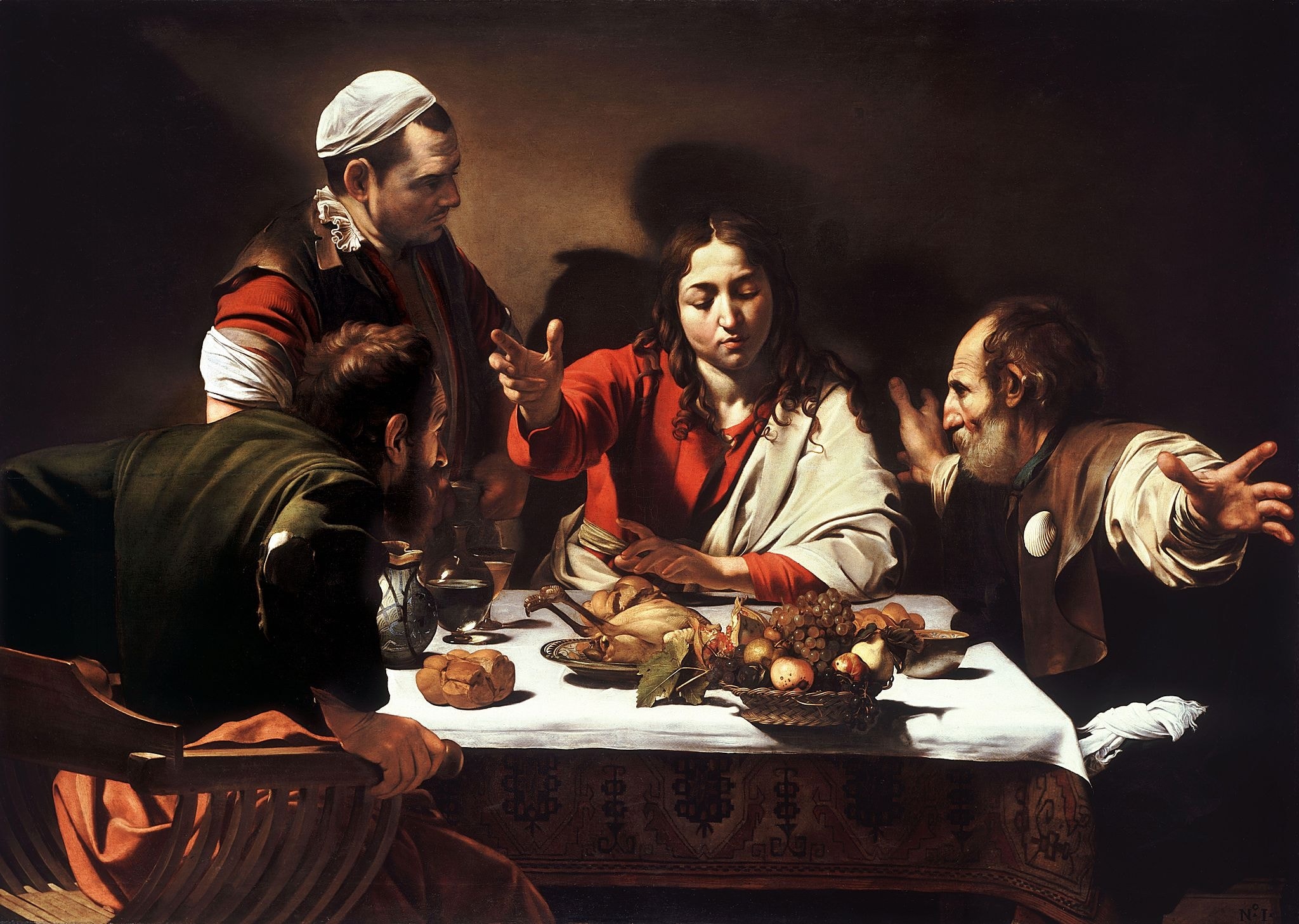
Caravaggio freezes the instant in Luke 24:30–31 when the risen Christ blesses the bread, his right hand thrust toward us as his left hovers over the loaf. The gesture is both a narrative spark—the disciples’ sudden recognition—and a theological proclamation of the Eucharist, staged with startling immediacy for the viewer.
Historical Context
Painted in 1601 for the Roman noble Ciriaco Mattei, The Supper at Emmaus belongs to Caravaggio’s Roman breakthrough, when he sought to make sacred history grippingly present. The National Gallery identifies the precise narrative second from Luke’s Gospel: Christ raises his right arm in blessing while the disciples realize who sits before them 1. This choice gives the composition a clear hinge—recognition at the blessing—and anchors the scene in Catholic sacramental devotion.
Caravaggio’s staging aligns with the Counter‑Reformation program to render divine mysteries immediate and persuasive. By placing the revelation in an ordinary inn and projecting Christ’s blessing hand into our space, he fulfills a pastoral aim: to confirm faith visually through the tangible sign of bread and wine. Smarthistory underscores how these outthrust gestures invite the beholder into the drama, collapsing distance between viewer and miracle 2.
Symbolic Meaning
Christ’s raised hand over the bread announces the Eucharist—the moment when, in Luke’s account, he is recognized “in the breaking of the bread.” The National Gallery reads the blessing explicitly and links it to Catholic belief in the Real Presence; wine sits nearby to complete the sacramental pairing 1. Scholarly commentary frames this as an “Eucharistic manifestation”: through the blessing Christ discloses his identity, so the doctrinal and narrative climaxes coincide 3.
Caravaggio layers signs around the gesture. The strong light from the left throws a shadow behind Christ like a reverse halo, visually ratifying sanctity at the instant of blessing; a fish‑shaped shadow on the cloth alludes to the traditional Christ symbol, reinforcing a Eucharistic reading 1. The artist’s youthful, beardless Christ helps explain the disciples’ initial failure to know him, heightening the shock when the blessing reveals him 1. At the same time, the gesture sits at a threshold of presence and disappearance: in Luke, recognition is followed by vanishing. Art-historical analysis treats this as a hinge between epiphany and withdrawal, sharpening the theological drama concentrated in the blessing itself 45.
Artistic Technique
A raking, directed light isolates Christ’s face and blessing hand against a bare wall, intensifying legibility through Caravaggio’s hallmark chiaroscuro 1. The hand is forcefully foreshortened and thrust toward the viewer, while the disciples’ violently angled arms operate like visual “tram lines” that funnel our gaze to the act of blessing 16.
Color helps stage the sign: the saturated red tunic framed by a pale mantle sets off the raised arm, while the neutral ground prevents distraction 1. Extreme projection—the blessing hand, the basket and roast fowl seeming to burst into our space—belongs to Caravaggio’s immersive realism, which Smarthistory notes as key to the viewer’s felt participation in the scene 26.
Connection to the Whole
The blessing functions as the painting’s visual and theological fulcrum. It locks the composition’s diagonals, draws every look to the table’s center, and triggers the disciples’ explosive reactions—their hands mirroring and amplifying Christ’s outward thrust 16. The empty foreground edge and precarious still life create a place for us at the table, so the blessing bridges painted and real space 12.
By uniting tactile tavern detail with a liturgical action, Caravaggio fuses everyday materiality and sacrament, embodying a post‑Tridentine visual theology. The whole canvas becomes an invitation to witness and share the moment of recognition, with Christ’s gesture of blessing as its decisive key 26.
Explore More from This Painting
This detail is one part of The Supper at Emmaus. Use the links below to return to the full interpretation, browse the full set of details, or view the painting's valuation if available.
Sources
- National Gallery, London — Catalogue entry (NG172), The Supper at Emmaus
- Smarthistory — Caravaggio, The Supper at Emmaus
- Caravaggio: Reflections & Refractions — “Truth in Pointing” (PDF excerpt)
- The Art Bulletin (2007) — Visualizing Appearance and Disappearance: On Caravaggio’s London Supper at Emmaus
- Journal of Early Modern Studies (2023) — Narrative and Temporal Ambiguity in Caravaggio and Rembrandt’s Supper at Emmaus
- National Gallery, London — Picture of the Month (Feb 2020): Foreshortening and projection