The Basket of Fruit in The Supper at Emmaus
A closer look at this element in Caravaggio's 1601 masterpiece
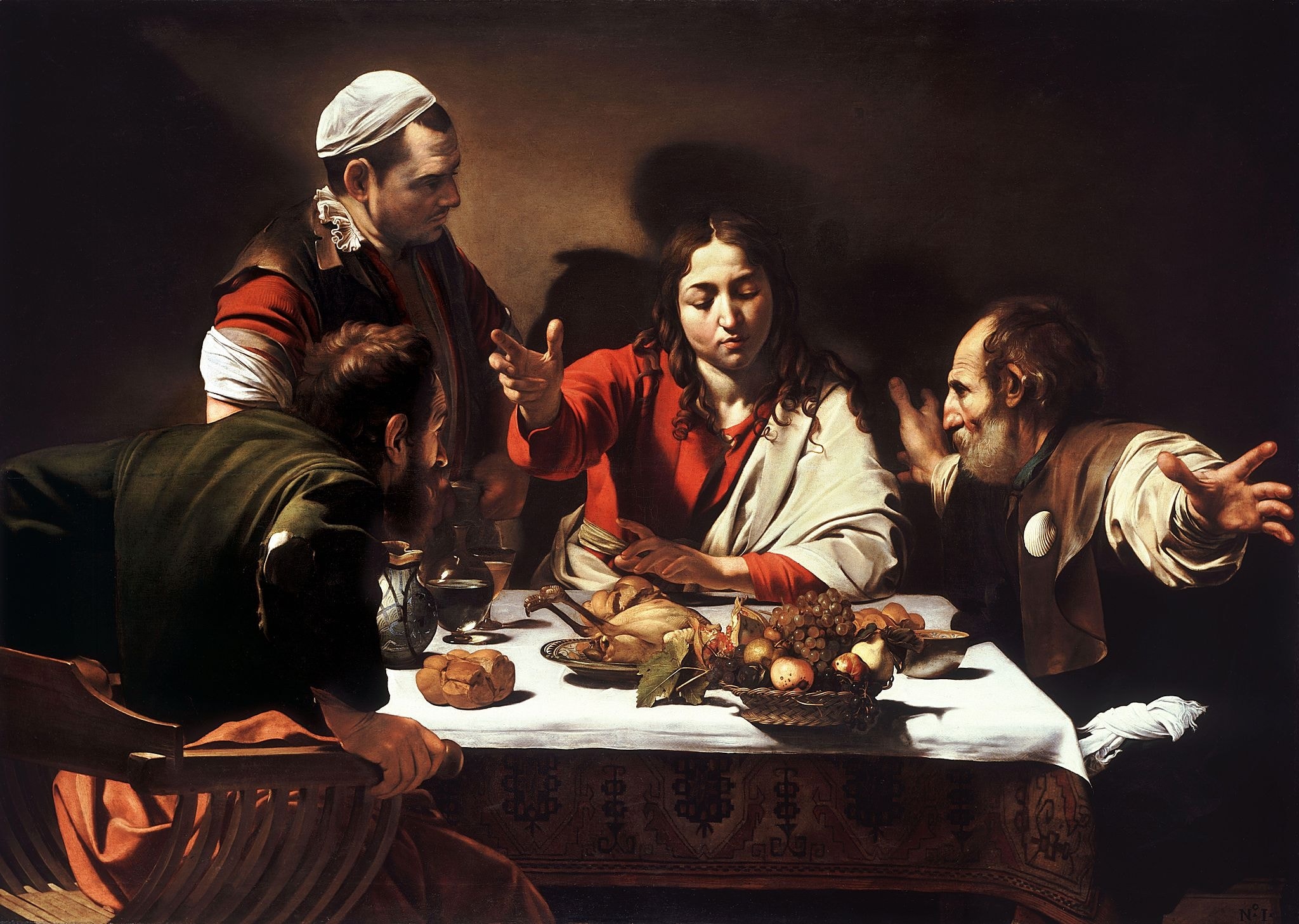
Caravaggio’s basket of fruit in The Supper at Emmaus is a life-size still-life that seems to slide off the table into our space, catching light as vividly as the figures themselves. Loaded with apples, grapes, and a pear, and casting a fish-shaped shadow, it is both a bravura display of illusionism and a concentrated sign of the painting’s theological message.
Historical Context
Painted in Rome in 1601, The Supper at Emmaus belongs to the moment when Caravaggio fused naturalistic still-life with Gospel narrative to meet the Counter-Reformation demand for immediacy and devotion. The National Gallery notes how the tangible food and drink make the miracle of recognition feel present, while the basket is pushed to the very edge of the table to collapse the space between viewer and sacred event 1. Smarthistory similarly emphasizes this come-into-our-space staging as a hallmark of early Baroque Catholic imagery that invites the beholder to witness the sacred now 2.
The basket itself contains apples, grapes, and a pear, struck by the same raking light that models the figures and glinting through nearby glassware. Remarkably, the basket’s shadow reads as a fish—an early Christian sign of Christ—linking the still-life directly to the subject of the scene 1. Technical and curatorial notes also record that Caravaggio adjusted an apostle’s knee to enhance the thrust toward the viewer, evidence that the projecting basket was a carefully planned device rather than an incidental detail 12.
Symbolic Meaning
The basket condenses a network of Eucharistic and Christological signs. Grapes conventionally signify the wine and thus the Blood of Christ; set among bread, wine, and the carafe on the table, they anchor the Emmaus meal in the sacrament of the Eucharist 3. The National Gallery observes that the basket casts a fish-shaped shadow on the white cloth—an ichthys, the earliest Christian emblem of Jesus—so the humble still-life points back to the figure at the center of the revelation 1.
Susanne J. Warma’s influential reading identifies the basket as an emblem of first fruits (1 Corinthians 15:20), aligning its ripe contents with the risen Christ as the pledge of Resurrection. Positioned at the painting’s very threshold, the sign of first fruits is offered to the viewer like an altar piece within the picture, turning the edge of the table into a theological hinge between our space and the scene’s miracle 4. Caravaggio thus mobilizes established still-life conventions—grapes for sacramental wine, fruit as signs of spiritual harvest—within a powerfully illusionistic setup that makes doctrine tactile and immediate 13.
Artistic Technique
Caravaggio engineers the basket to “teeter” over the table’s edge, a compositional gambit that heightens illusionism and invites reach. A sharp left-side light sculpts the fruit, flashes on their skins, and refracts through a carafe and wine glass, binding the still-life optically to the figures around it 1.
National Gallery technical studies show that this realism rides on a warm, transparent ground and a sophisticated paint build: passages of white (notably in the cloth) include egg tempera intermixed with oil, producing crisp highlights against the velvety darks. The result is a basket whose wicker weave, grape bloom, and leaf edges read with minute, observed precision, yet remain integrated into the broader chiaroscuro drama 51.
Connection to the Whole
The Emmaus story pivots on recognition “in the breaking of bread.” Caravaggio places the basket—and with it bread, wine, and fruit—at the contact point between painting and viewer so the disciples’ astonishment unfolds amid objects we could touch. This staging fuses the everyday meal with sacrament, making the miracle feel present-tense 12.
Across Caravaggio’s two treatments, the London canvas is the version where the basket projects most dramatically, confirming its central role in the painting’s choreography of revelation. The later Brera version is more restrained, underscoring how the 1601 composition uses the basket’s forward thrust to bridge sacred time and our space—an embodied invitation to witness the moment of recognition 61.
Explore More from This Painting
This detail is one part of The Supper at Emmaus. Use the links below to return to the full interpretation, browse the full set of details, or view the painting's valuation if available.
Sources
- National Gallery, London — The Supper at Emmaus (object page and curatorial text)
- Smarthistory — Caravaggio, The Supper at Emmaus
- The Metropolitan Museum of Art — Heilbrunn Timeline: Still-Life Painting in Southern Europe, 1600–1800
- Susanne J. Warma, Christ, First Fruits and the Resurrection: Observations on the Fruit Basket in Caravaggio’s London ‘Supper at Emmaus’ (1990)
- National Gallery Technical Bulletin 19 (1998), Larry Keith, Three Paintings by Caravaggio
- Pinacoteca di Brera — Supper at Emmaus (1606 version)