The Disciple's Outstretched Arms in The Supper at Emmaus
A closer look at this element in Caravaggio's 1601 masterpiece
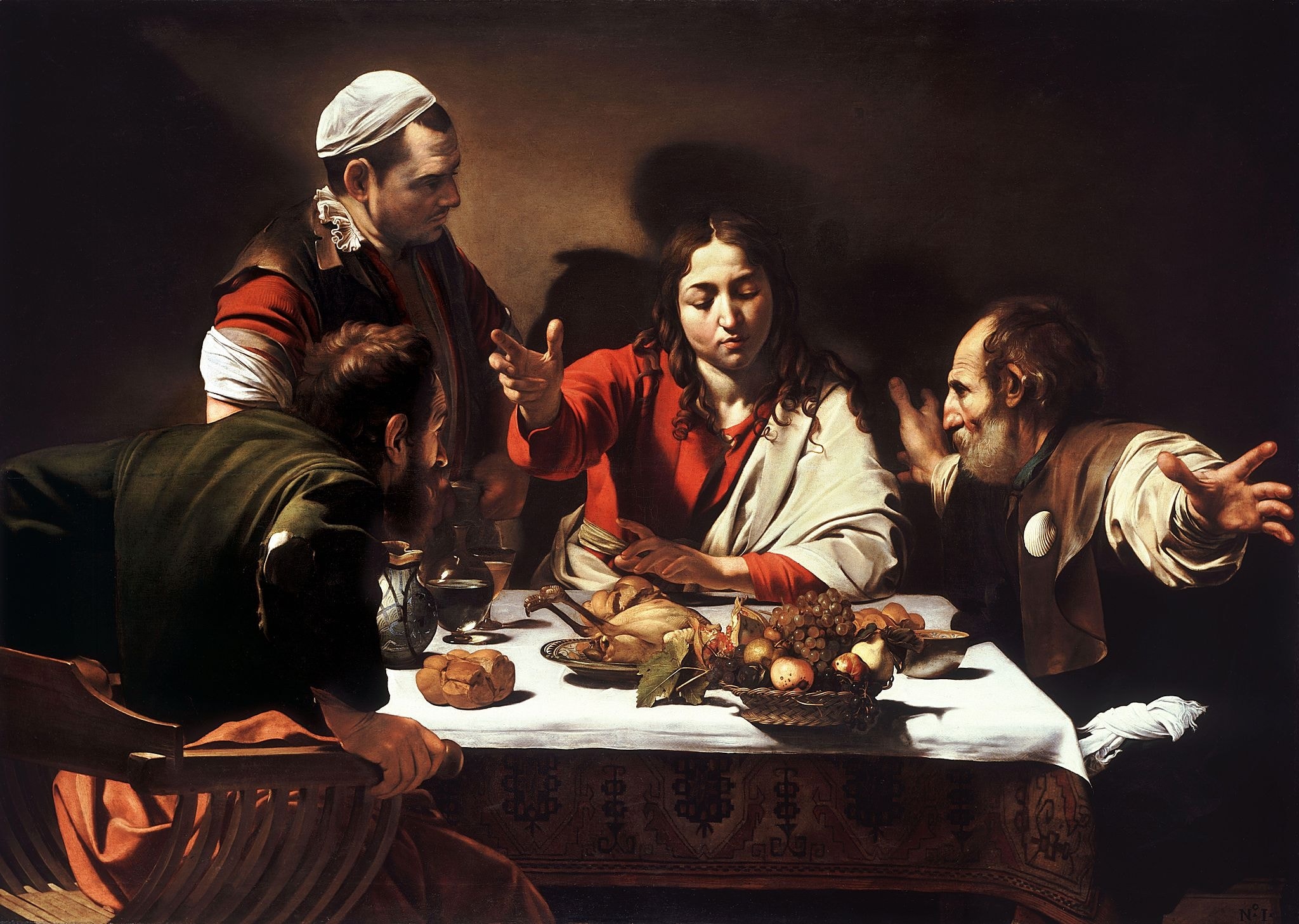
The right-hand disciple’s outflung arms seize the instant of recognition as the stranger at table is revealed as Christ. Caravaggio turns a theological revelation into a bodily shock, projecting the gesture toward us so the miracle erupts into the viewer’s space.
Historical Context
Painted in Rome in 1601 for Ciriaco Mattei, Caravaggio’s The Supper at Emmaus stages the Gospel moment when two followers suddenly recognize the risen Christ as he blesses the bread. The National Gallery pinpoints the dramatic fulcrum of this scene in the disciple at Christ’s right who throws his arms wide in extreme foreshortening, a gesture the museum reads as both disbelief and a visual echo of the Crucifixion 1.
Such insistent immediacy—figures pressed to the picture plane, a single, focused light, and gestures that invade our space—was prized in Counter‑Reformation Rome for its power to engage and persuade. The wide-flung arms operate as a principal device to pull spectators into the event, collapsing sacred time into the present and making us eyewitnesses to revelation, a strategy highlighted by the Visual Commentary on Scripture’s analysis of the painting’s close-up staging and space-breaking movement 2. The figure has often been identified with Saint Peter, although the Gospel names only Cleopas and leaves the second disciple unnamed, underscoring how the charged, cruciform gesture invited layered readings for early modern viewers 1.
Symbolic Meaning
The outstretched arms crystallize anagnorisis—recognition made visible. Caravaggio translates a doctrinal truth into a codified early modern gesture of astonishment: the body bursts open as the mind grasps the risen Lord. The National Gallery’s reading makes the symbolism explicit by noting how the outthrust hand evokes Christ on the Cross, binding the Resurrection’s recognition to the Passion remembered in the Eucharist occurring at the table 1. The disciple’s cruciform silhouette thus fuses memory and presence: sacrifice and glory are held together in one bodily sign.
The Visual Commentary on Scripture emphasizes how these “arms thrown open” participate in the painting’s meditation on seeing and not seeing at Emmaus. Recognition coincides with Christ’s blessing, and the expansive gesture externalizes that inner conversion, while simultaneously projecting into our space to enlist the viewer as witness 2. Smarthistory and the Met further underline the Caravaggist program: by breaking past the picture plane and harnessing concentrated light, the painter makes transcendent truth feel physically near and shareable in ordinary time 34. Lorenzo Pericolo’s study deepens this reading, arguing that the startling amplitude of the disciple’s movement helps stage the painting’s razor-thin instant of appearance and disappearance—the flicker in which faith sees what the eyes had missed 7.
Artistic Technique
Caravaggio engineers the effect through extreme foreshortening: one elbow thrusts toward the spectator, the forearms span the canvas like taut crossbeams, and the plain wall behind isolates the silhouette. The National Gallery notes how these outstretched arms and the counter-diagonal of the opposite disciple act like visual tram lines that drive our gaze to Christ’s face 1. A single, raking light from the left strikes Christ and the right-hand disciple, sharpening contours and dramatizing the gesture through high-contrast chiaroscuro—a hallmark of Caravaggio’s practice highlighted by the Met 4. Smarthistory points out how this bodily projection, echoed by the still life at the table edge, literally pushes beyond the picture plane, converting composition into viewer address 3.
Connection to the Whole
The outspread arms are the painting’s visual and theological pivot. Their powerful diagonal meets the lean of the opposite disciple to funnel attention to Christ blessing the bread—the precise act that reveals his identity 1. In the same stroke, the gesture recruits us: its projection, together with the teetering fruit basket, breaks the boundary between image and spectator so that the Emmaus revelation unfolds in our space and time 23. By giving ordinary working men legible, everyday reactions, Caravaggio welds miracle to the familiar; the disciple’s cruciform astonishment becomes both sign and pathway to the Eucharistic meaning at the picture’s center 1.
Explore More from This Painting
This detail is one part of The Supper at Emmaus. Use the links below to return to the full interpretation, browse the full set of details, or view the painting's valuation if available.
Sources
- National Gallery, London — Michelangelo Merisi da Caravaggio, The Supper at Emmaus (1601)
- The Visual Commentary on Scripture — The Road to Emmaus (Rebecca Quinn Teresi)
- Smarthistory — Caravaggio, The Supper at Emmaus
- The Metropolitan Museum of Art, Heilbrunn Timeline — Caravaggio and His Followers (Keith Christiansen)
- Wikipedia — Supper at Emmaus (Caravaggio, London)
- Wikipedia — Supper at Emmaus (Caravaggio, Milan)
- Lorenzo Pericolo, “Visualizing Appearance and Disappearance: On Caravaggio’s London ‘Supper at Emmaus’,” The Art Bulletin 89, no. 3 (2007): 519–39 (abstract)