The Arched Footbridge in Bridge over a Pond of Water Lilies
A closer look at this element in Claude Monet's 1899 masterpiece
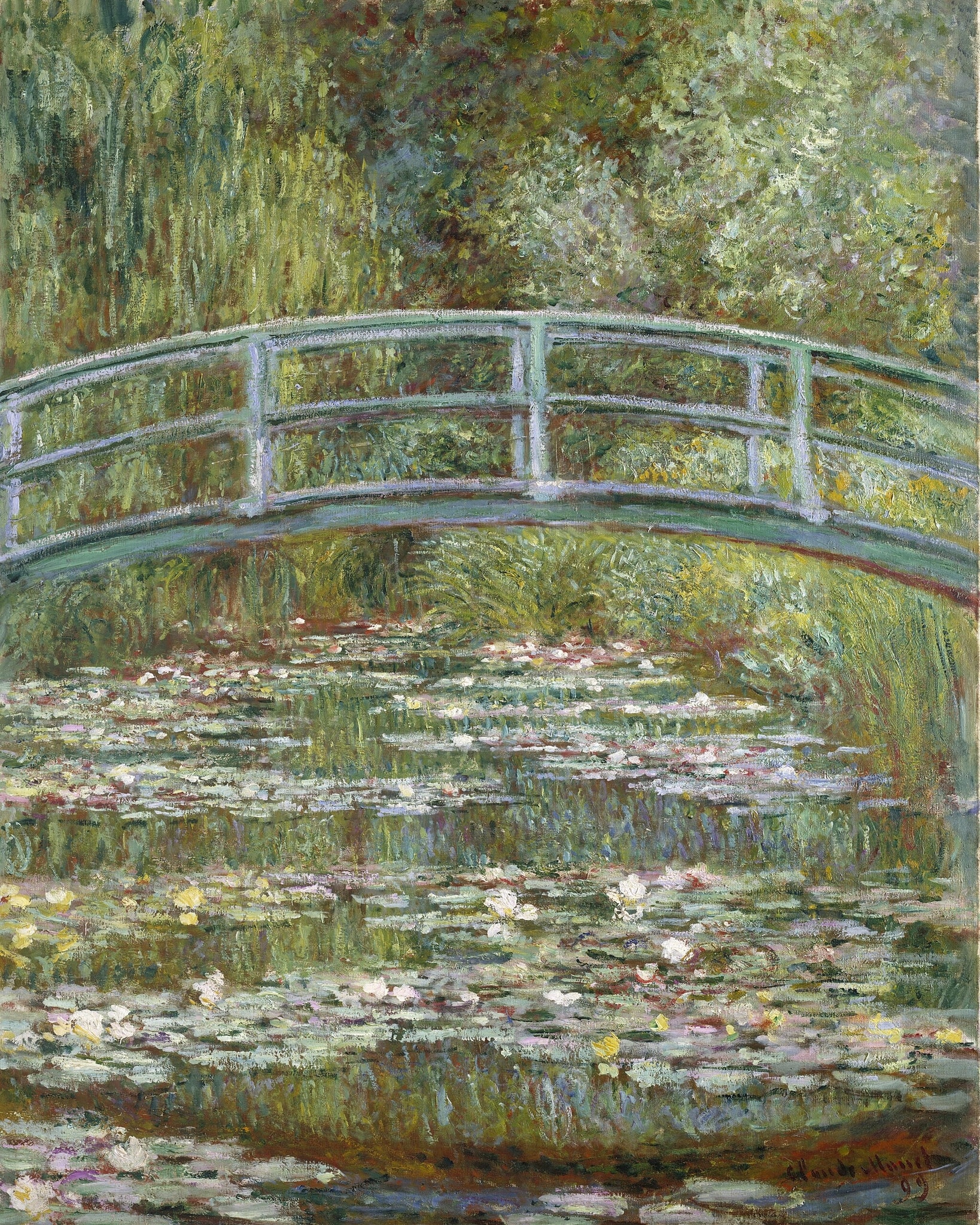
Monet’s arched footbridge is the deliberate, human-made keystone of his water‑garden at Giverny, a Japanese‑style span he built expressly to paint. In Bridge over a Pond of Water Lilies (1899), the bridge crowns a rare vertical composition, stabilizing a shimmering field of lilies and reflections while signaling Monet’s fusion of designed nature and modern vision.
Historical Context
In the early 1890s Monet remade his property at Giverny into a working studio‑garden, securing permission in 1893 to divert a local stream and create a lily pond designed “for the pleasure of the eye and also for motifs to paint.” He soon added a small Japanese‑style wooden footbridge. By the summer of 1899 this bridge became the organizing motif of a new campaign: Monet began a series planned at eighteen canvases and completed twelve, all centered on the bridge from a fixed vantage. The Met’s Bridge over a Pond of Water Lilies represents this effort in an unusual vertical format, with the bridge’s arc set high amid dense foliage and its shadow mirrored at the pond’s edge. In December 1900 Durand‑Ruel exhibited a group of these bridge views in Paris, underscoring the subject’s centrality to Monet’s late practice. Together, the engineered garden and its bridge mark a pivotal moment when Monet not only painted landscapes but authored them—constructing his own modern microcosm to explore light, color, and reflection across changing conditions. 12
Symbolic Meaning
The bridge functions as a cultural and aesthetic threshold. Its Japanese form, consciously modeled on ukiyo‑e precedents Monet collected, embodies Japonisme—a late‑19th‑century current through which Western artists absorbed Japanese design and compositional strategies. In Monet’s garden this imported language becomes native, signaling a cross‑cultural modernity that fuses Eastern asymmetry, high horizons, and surface emphasis with a French site and Impressionist vision. 34
Curators have also read the near‑sealed greenery, with the bridge’s arc grazing the picture’s upper edge, as an evocation of the medieval hortus conclusus—a closed, contemplative garden. Within that frame the bridge outlines a sanctuary of reverie and introspection, a space apart from industrial modernity that nonetheless remains consciously made. 2 Finally, as our gaze toggles between the elevated span and the lilies below, the image oscillates between surface/depth: a perceptual play that the bridge sharpens by acting as a literal and metaphorical span between above and below, culture and nature, looking and reflection. This doubleness—structural and symbolic—helps explain why the bridge became the emblem of Monet’s water‑garden series. 3
Artistic Technique
Monet renders the footbridge with loaded strokes of blue‑greens and pale turquoise, its arc clipped by the canvas edges so it seems to float. Against a tapestry of drooping willows and dense foliage, the bridge’s railings are mapped in broken, varied touches that register light shifts and atmospheric vibration—hallmarks of Monet’s mature Impressionism. The Met’s vertical format lets the span crown the scene while a darkened underside and rippled reflections tether it to the pond’s surface. Across the water, horizontal bands of lily pads and vertical reflections interweave, integrating the structure into a rhythmic lattice of marks. Monet pursued the view as part of a multi‑canvas series, often working en plein air on parallel panels to capture differing times and weather, while the cumulative, layered paint handling anticipates the denser facture of his later Nymphéas. 1365
Connection to the Whole
Within Bridge over a Pond of Water Lilies, the footbridge acts as a compositional lintel: it caps the field of reflections and organizes the eye’s movement between the luminous water surface and the leafy depth beyond. This structuring role produces the painting’s signature oscillation between planar surface and implied space, a dynamic explicitly noted in museum analyses. 3 As the sole conspicuous built form, the bridge also declares Monet’s authorship—nature filtered through design—while anchoring the otherwise immersive environment to a fixed viewpoint documented across the 1899 cycle. 12 In short, the bridge is both architecture and idea: a stabilizing span within the composition and a quiet emblem of modern, artist‑shaped nature that gives the entire work its meditative poise.
Explore More from This Painting
This detail is one part of Bridge over a Pond of Water Lilies. Use the links below to return to the full interpretation, browse the full set of details, or view the painting's valuation if available.
Sources
- The Metropolitan Museum of Art — Bridge over a Pond of Water Lilies (1899), object page and essay
- National Gallery of Art (Washington) — The Japanese Footbridge (1899), object page
- National Gallery, London — The Water-Lily Pond (1899), object page
- The Met Heilbrunn Timeline — Claude Monet (1840–1926) and Japanese print influence
- Princeton University Art Museum — Teaching article on Monet’s Water-Lily Pond series and practice
- Art Institute of Chicago Museum Studies — Gloria Groom, “Water Lily Pond”
- The Met Heilbrunn Timeline — Japonisme