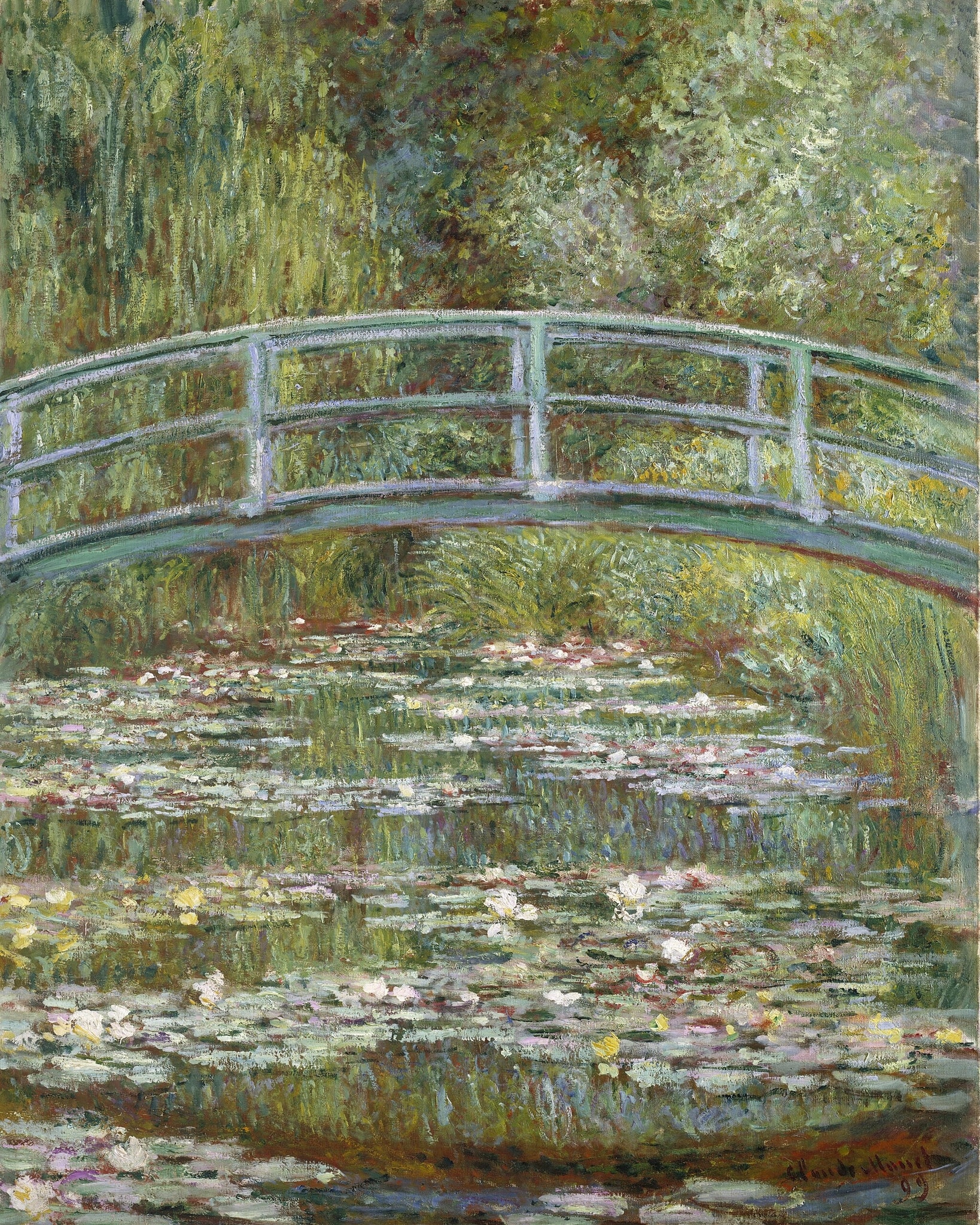
Bridge over a Pond of Water Lilies

by Claude Monet

Claude Monet’s Bridge over a Pond of Water Lilies stages a threshold where garden and reflection merge. The cool arc of the Japanese-style bridge steadies a field of trembling light, while lilies hover between surface and depth, turning perception itself into the subject [1][2].

Fast Facts

Year
1899
Medium
Oil on canvas
Dimensions
92.7 × 73.7 cm
Location
The Metropolitan Museum of Art, New York (Gallery 819)
See all Claude Monet paintings in New York
Bridge over a Pond of Water Lilies by Claude Monet (1899) featuring Japanese-style bridge (arc), Water lilies, Reflections of willows and foliage, Enclosing foliage curtain

Click on any numbered symbol to learn more about its meaning

Meaning & Symbolism

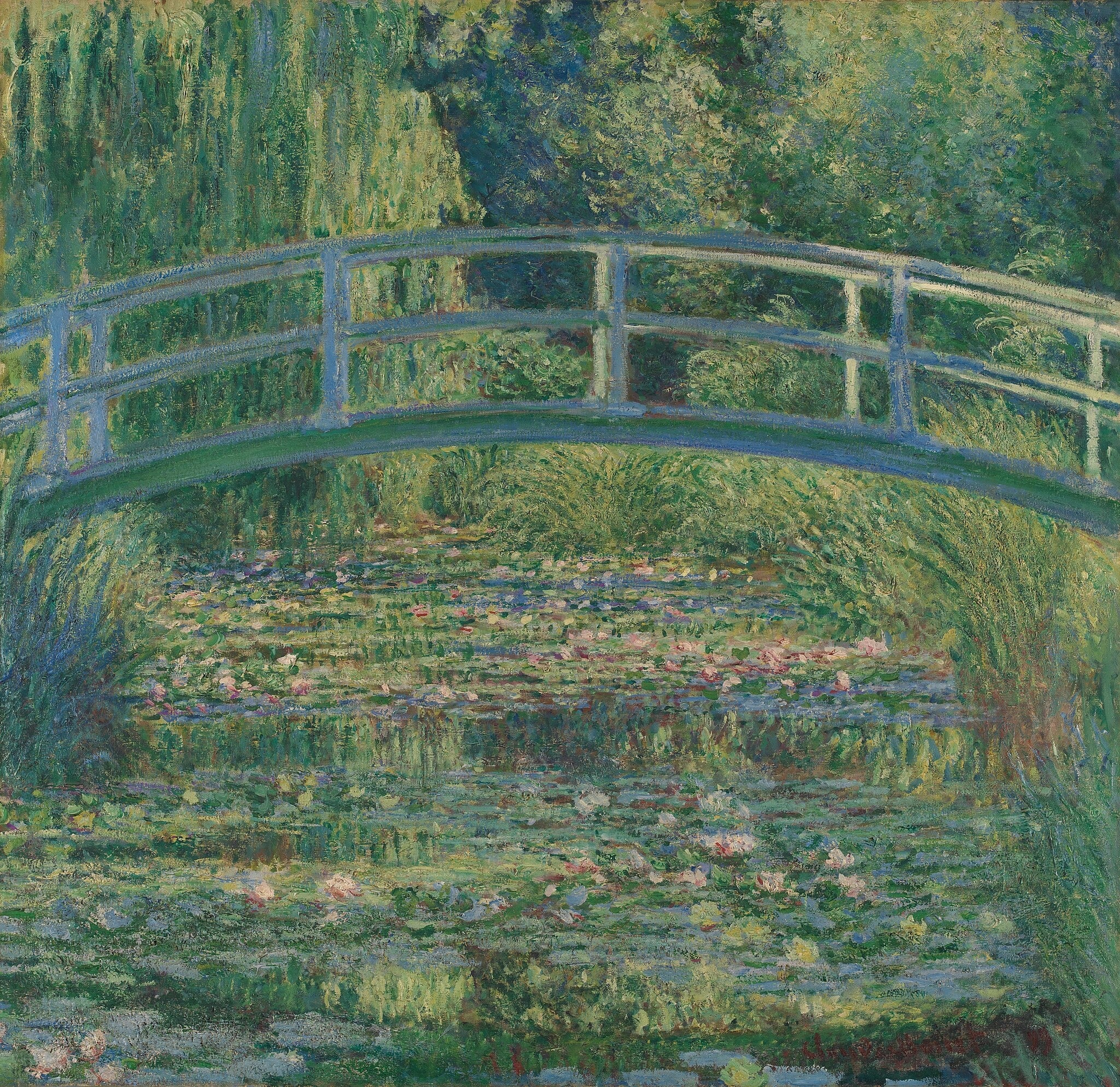
Monet composes the painting around the bridge’s pale blue-green arc, a calm, man-made curve that bisects a near-monochrome world of vibrating greens. In this vertical format, the span sits high, allowing the pond to dominate the lower two-thirds; the choice compresses foreground and background so that lilies, reflections, and the bridge’s own shadow mingle on a single plane 1. The surface becomes a palimpsest—white and lemon blooms ride atop lilac and jade ripples while vertical streaks of reflected willow drag downward, unmooring any firm sense of depth. Monet is not illustrating a garden so much as staging a perceptual experiment: by denying a conventional horizon and saturating the frame with foliage, he encloses the viewer in a hortus conclusus, a contemplative space that Symbolist writers and critics of the time associated with introspection and dream 2. That enclosed sensation was not accidental. Monet had petitioned to divert a local stream to create this water garden “for the pleasure of the eye and in order to have subjects to paint,” then built the Japanese-style footbridge as a pictorial anchor 26. The bridge reads as a threshold—a passage between cultivated earth and the pond’s mirror-kingdom—while its imported form signals the Japonisme that inflects the series. Scholars have framed Giverny as a hybrid environment in which East becomes West and nature becomes art; here, asymmetry, shortened depth, and the dominance of surface echo lessons from Japanese prints even as the facture remains insistently French and painterly 45. The lilies perform the painting’s central drama: their petals are tangible, but their context flickers; each pad alternates between object and light-sign, a sign that Monet’s real subject is mutable appearance itself 1. In 1899 he painted twelve such views from essentially one vantage, and when the works were shown at Durand–Ruel in 1900, critics singled out the pond’s mirrored stillness and “mysterious corollas,” confirming the canvas’s meditative charge 2. Within this series, the Met canvas gains particular force from its verticality. By lifting the bridge and cropping banks and sky, Monet denies external bearings and thickens the impenetrable green enclosure, so the eye must navigate by rhythm rather than by map 12. Broken, tactile strokes of olive, viridian, and violet pull the scene toward near-abstraction, anticipating the vast Water Lilies of the 1910s–20s. Yet discipline underlies the shimmer: the bridge’s measured rails and posts articulate intervals across the center, a quiet metronome against which the pond’s syncopations play. The meaning of Bridge over a Pond of Water Lilies emerges here as a union of designed harmony and natural flux—a place where human intention builds a path and light immediately begins to unmake it. Why Bridge over a Pond of Water Lilies is important is that it condenses Monet’s late project—garden as constructed motif, perception as theme, East/West hybridity as atmosphere—into a single, lucid structure sustained by color and touch 1245.

Explore Deeper with AI

Ask questions about Bridge over a Pond of Water Lilies

Popular questions:

Powered by AI • Get instant insights about this artwork

💬 Ask questions about this artwork!

Interpretations

Symbolist/Psychological Reading

Critics in 1900 praised the pond’s “calm… deep like a mirror” and its “mysterious corollas,” aligning the motif with Symbolist interiority. The dense, hortus conclusus enclosure and the denial of a horizon sequester the viewer within a meditative zone akin to Symbolist poetry (e.g., Mallarmé’s water‑lily imagery). The bridge reads as a threshold between waking perception and dream, while reflections drag downward like thoughts sinking into the unconscious. Rather than narrate the garden, Monet orchestrates an affective setting—muted chroma, recursive patterns, and mirrored depths—that solicits contemplation and introspection in the act of looking 2.

Source: National Gallery of Art

Medium Reflexivity and Perception

Monet stages a perceptual experiment: lilies as objects, reflections as images, and the bridge’s own shadow share a single shimmering plane, so the painting continually toggles between fact and phenomenon. This is painting about seeing—how light and color, not outlines, structure recognition. The canvas thus probes mimesis vs. appearance, insisting that truth in art may lie in capturing change itself. The measured arc of the bridge provides a scaffold for this instability, letting brushwork articulate time (ripples, breeze) without surrendering to formlessness. These procedures anticipate the later Water Lilies cycles, where motif dissolves further into fields of optical experience 15.

Source: The Metropolitan Museum of Art; Met Timeline of Art History

Reception and Series Context

Painted from essentially one vantage in 1899, the bridge canvases were shown at Durand‑Ruel in 1900 (not 1890—a frequent typo), where critics emphasized mirrored stillness and the lilies’ “mysterious corollas,” confirming the works’ meditative charge. The Met’s canvas stands out for its vertical orientation within the set, intensifying enclosure and the fusion of surface and depth that viewers remarked upon. Period responses also noted the Japanese inflection, reading the bridge as a cultural sign as much as a structural one. Together, these factors positioned the series as a pivotal moment in Monet’s late practice: serial vision, designed motif, and concentrated reflection 12.

Source: National Gallery of Art; The Metropolitan Museum of Art

Formal Analysis

The painting’s rare vertical format tightens the motif, lifting the bridge and allowing the pond to overwhelm the picture field; this cropping amplifies the canvas’s planar emphasis and the intervallic rhythm of the bridge’s posts against the pond’s syncopated strokes. The result is a calibrated play of horizontals and verticals that organizes a surface otherwise dissolving into broken color. The format also echoes lessons from Japanese prints—steep asymmetry, abrupt edges, and surface dominance—while remaining insistently tactile in oil. By mixing olive, viridian, and violets into a near-monochrome, Monet courts near-abstraction without abandoning motif, a strategy that anticipates the immersive Water Lilies decades later 15.

Source: The Metropolitan Museum of Art; Met Timeline of Art History

Cross-Cultural/Japonisme Lens

Monet’s bridge is an imported typology, and the surrounding plantings were curated to project an “eastern” character. Paul Hayes Tucker calls Giverny a “hybrid environment” where East becomes West and nature becomes art: the scene fuses ukiyo-e-derived asymmetry, flattened space, and surface dominance with French Impressionist facture. This is not neutral borrowing: it reframes Japanese visual strategies inside a Normandy garden purpose-built for painting, turning cultural translation into a central aesthetic device. The canvas thus models late‑19th‑century Japonisme as both inspiration and appropriation, with authorship anchored in Monet’s designed setting and brush, not in ethnographic fidelity 345.

Source: Paul Hayes Tucker (via Christie's); Princeton University Art Museum; Met Timeline of Art History

Environmental/Engineered Landscape

The water garden is constructed nature: in 1893 Monet petitioned to divert a local stream (the Ru/Epte) to build the pond, explicitly “for the pleasure of the eye” and to supply subjects. The bridge, later trellised with wisteria, functions as both viewing platform and pictorial anchor. Reading the work ecologically, the picture binds aesthetic effect to hydraulic control, horticultural selection, and seasonal flux—an early instance of artist-led environmental design where infrastructure and image co-produce meaning. The shimmering surface records weather and time even as the engineered basin and planted edges enforce stability, making perception itself contingent on a managed ecosystem 236.

Source: National Gallery of Art; Princeton University Art Museum; Maison et Jardins Claude Monet (Giverny)

Related Themes

About Claude Monet

Claude Monet (1840–1926) led Impressionism’s pursuit of open-air painting and optical immediacy, especially during his Argenteuil years focused on modern leisure and light. He later developed serial studies of changing conditions, culminating in the Water Lilies cycle [2].
View all works by Claude Monet

More by Claude Monet

Boating by Claude Monet

Boating

Claude Monet (1887)

Monet’s Boating crystallizes modern leisure as a drama of perception, setting a slim skiff and two pale dresses against a field of dark, mobile water. Bold cropping, a thrusting oar, and the complementary flash of hull and foliage convert a quiet outing into an experiment in <strong>modern vision</strong> and the <strong>materiality of water</strong> <sup>[1]</sup><sup>[2]</sup>.

The Thames below Westminster by Claude Monet

The Thames below Westminster

Claude Monet (about 1871)

Claude Monet’s The Thames below Westminster turns London into <strong>light-made architecture</strong>, where Parliament’s mass dissolves into mist and the river shivers with <strong>industrial motion</strong>. Tugboats, a timber jetty with workers, and the rebuilt Westminster Bridge assert a modern city whose power is felt through atmosphere more than outline <sup>[1]</sup>.

Haystacks Series by Claude Monet | Light, Time & Atmosphere by Claude Monet

Haystacks Series by Claude Monet | Light, Time & Atmosphere

Claude Monet

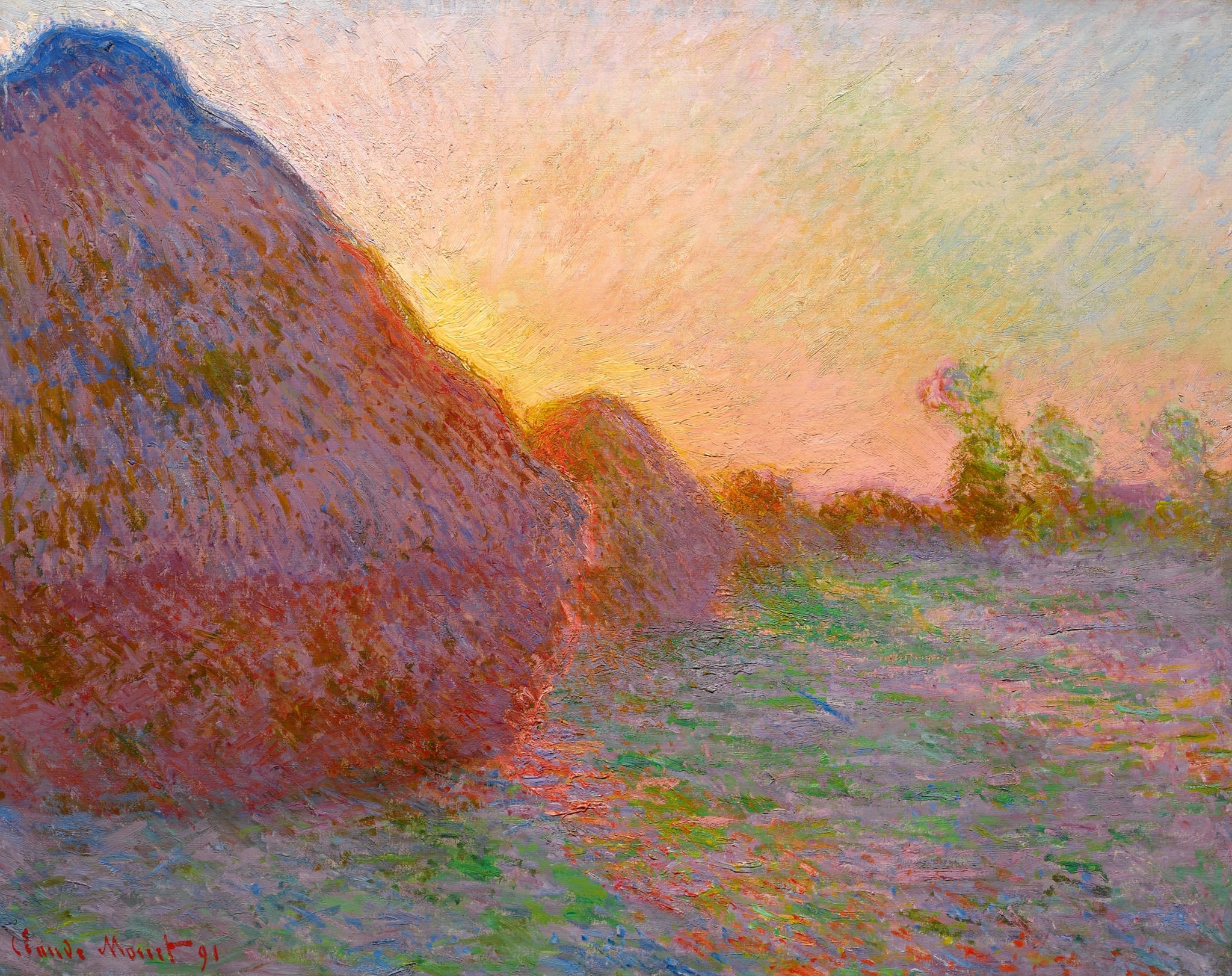
Claude Monet’s <strong>Haystacks Series</strong> transforms a routine rural subject into an inquiry into <strong>light, time, and perception</strong>. In this sunset view, the stacks swell at the left while the sun burns through the gap, making the field shimmer with <strong>apricot, lilac, and blue</strong> vibrations.
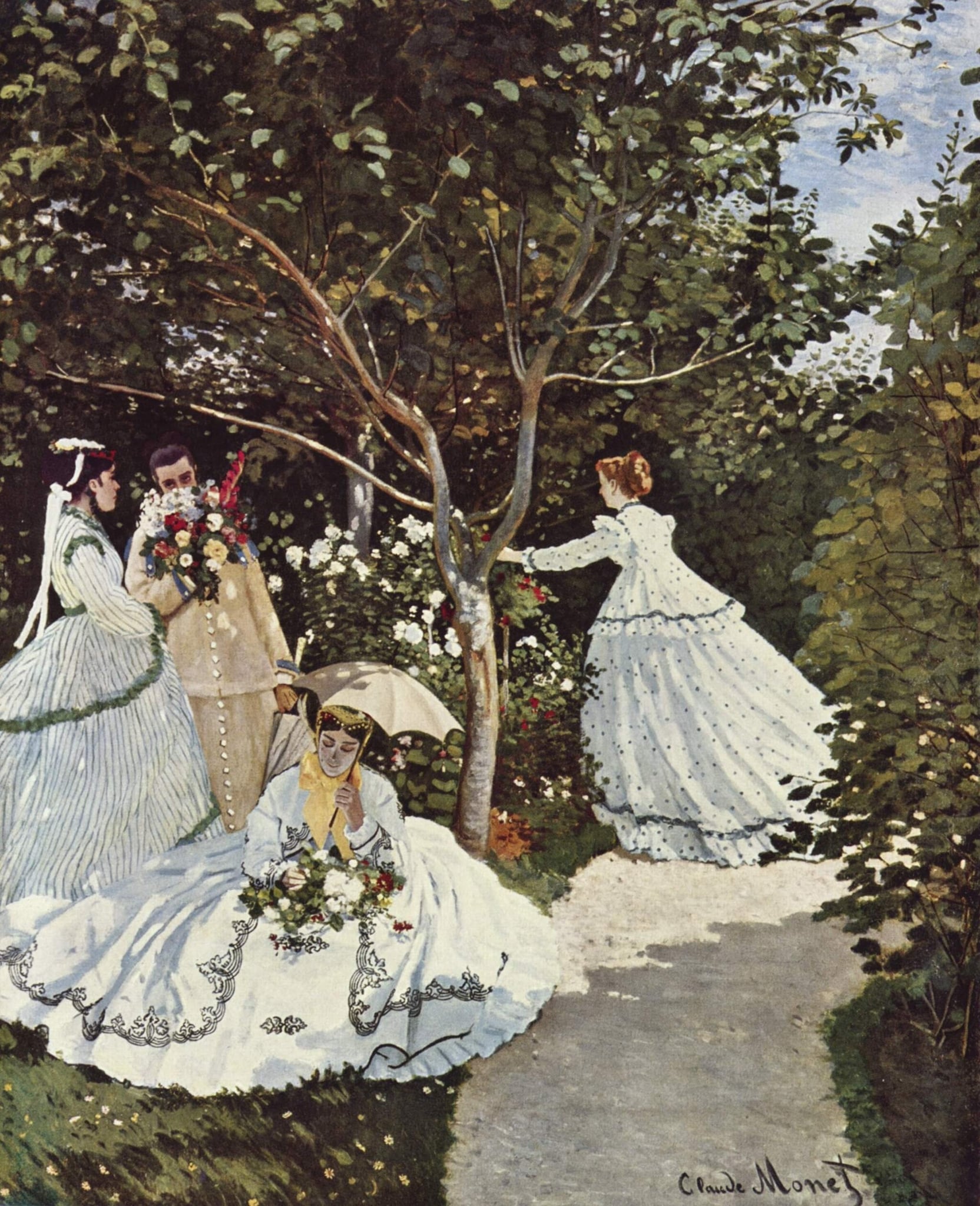
Women in the Garden by Claude Monet

Women in the Garden

Claude Monet (1866–1867)

Claude Monet’s Women in the Garden choreographs four figures in a sunlit bower to test how <strong>white dresses</strong> register <strong>dappled light</strong> and shadow. The path, parasol, and clipped flowers frame a modern ritual of leisure while turning fashion into an instrument of <strong>perception</strong>. The scene reads less as portraiture than as a manifesto for painting the <strong>momentary</strong> outdoors <sup>[1]</sup><sup>[3]</sup>.
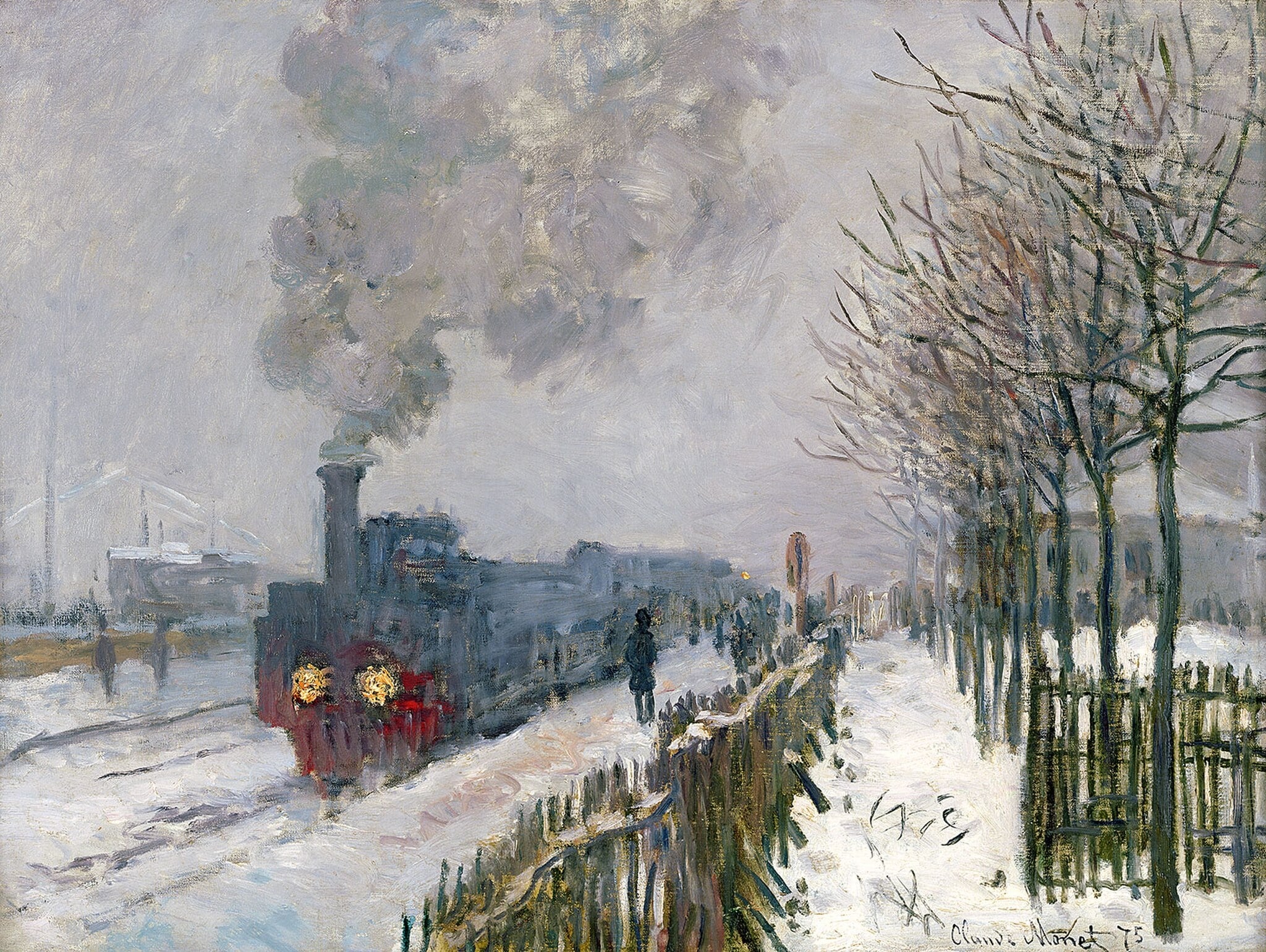
The Train in the Snow (The Locomotive) by Claude Monet

The Train in the Snow (The Locomotive)

Claude Monet (1875)

Claude Monet’s The Train in the Snow (The Locomotive) (1875) turns a suburban winter platform into a study of <strong>modernity absorbed by atmosphere</strong>. The engine’s twin yellow headlights and a smear of red push through a world of greys and violets as steam fuses with the low sky, while the right-hand fence and bare trees drill depth and cadence into the scene <sup>[1]</sup><sup>[4]</sup>. Monet fixes not an object but a <strong>moment of perception</strong>, where industry seems to dematerialize into weather <sup>[1]</sup><sup>[2]</sup>.
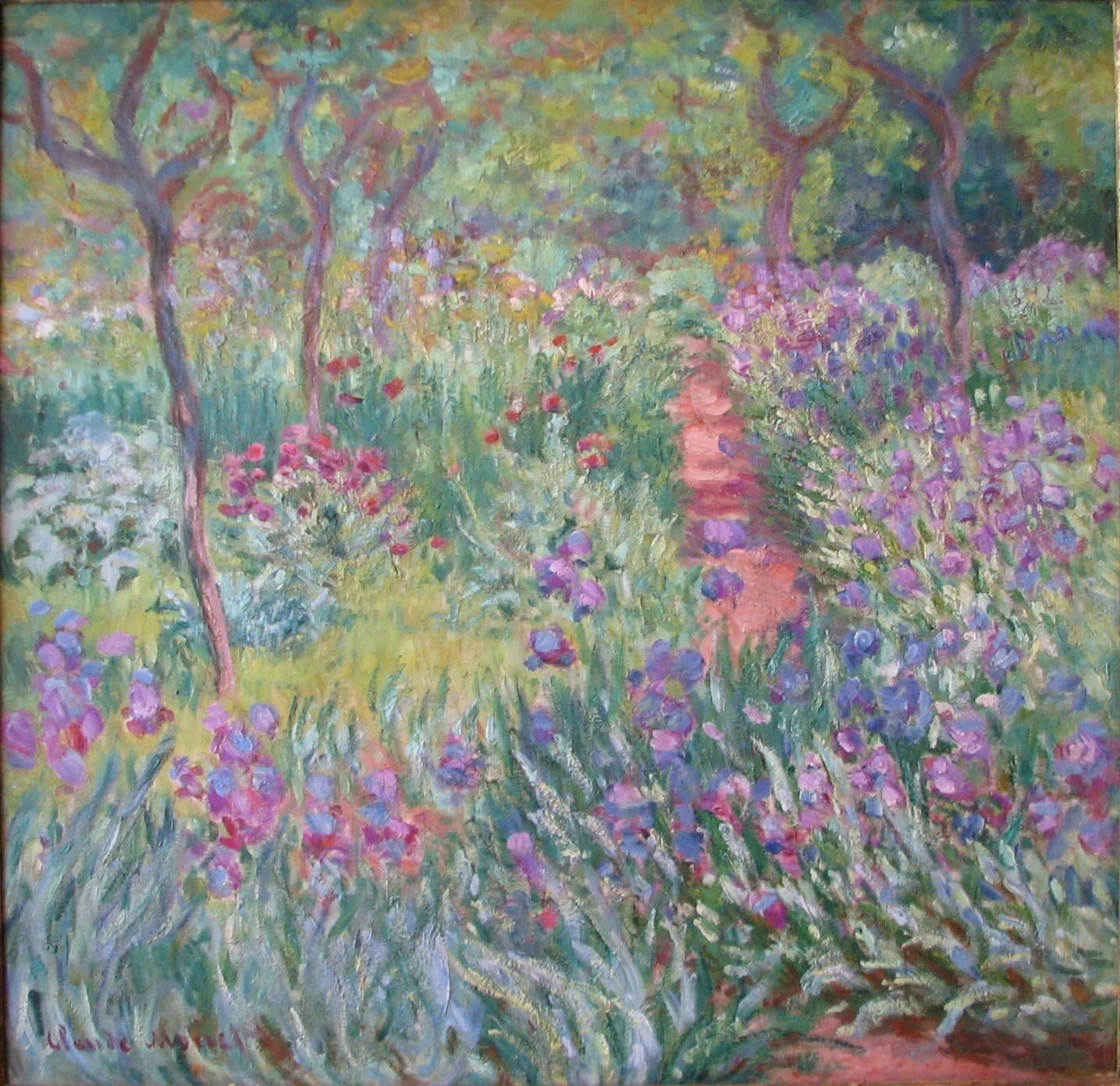
The Artist's Garden at Giverny by Claude Monet

The Artist's Garden at Giverny

Claude Monet (1900)

In The Artist's Garden at Giverny, Claude Monet turns his cultivated Clos Normand into a field of living color, where bands of violet <strong>irises</strong> surge toward a narrow, rose‑colored path. Broken, flickering strokes let greens, purples, and pinks mix optically so that light seems to tremble across the scene, while lilac‑toned tree trunks rhythmically guide the gaze inward <sup>[1]</sup><sup>[3]</sup>.