The Water Lily Reflections in Bridge over a Pond of Water Lilies
A closer look at this element in Claude Monet's 1899 masterpiece
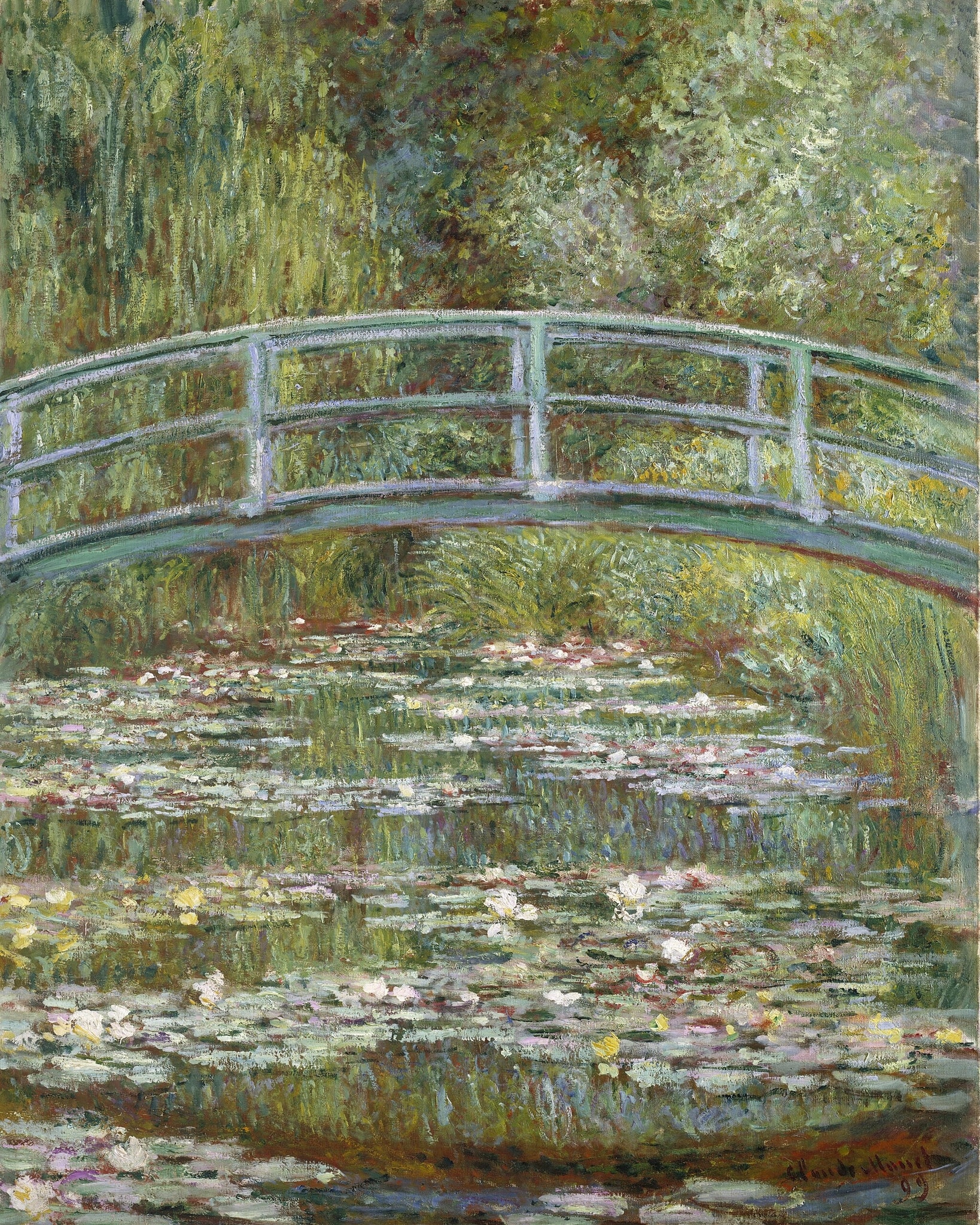
In the lower half of Monet’s Bridge over a Pond of Water Lilies, the pond becomes a mirror-world where willow and bank-side greenery ripple across the surface among pads and blossoms. These water‑lily reflections transform the scene from a view of objects into a field of perception, turning light, color, and time into the true subject.
Historical Context
After settling at Giverny, Monet engineered a water garden by diverting a stream, planting hybrid lilies, and building a Japanese-style footbridge. In the summer of 1899 he painted a focused series from this self-fashioned motif, with the Met canvas adopting a rare vertical format that pushes the bridge high and gives unusual prominence to the pond below. Within that lower half he registers the reflections of willows and bank vegetation and even suggests the dark arc of the bridge’s shadow crossing the water near the bottom edge 1.
This tight vantage coincides with Monet’s late‑century shift from broad landscape views to a microcosm cultivated for sustained looking. Curators emphasize how the composition encourages viewers to read both the water’s surface and a kind of submerged space produced by reflection, a hallmark of the 1899 bridge paintings. The format and subject also align with his interest in Japanese pictorial strategies that favor asymmetry and a surface-oriented design, further validating the painting’s concentration on the reflective plane rather than on a distant horizon 2.
Symbolic Meaning
Monet insisted that the water flowers were not the whole scene; for him, the essence of the motif was the mirror of water. In this canvas the reflections function as a visual metaphor for time and change: shifting light, passing cloud, and patches of sky flicker across the pond, so that the lilies act like accents on a living surface rather than isolated botanical subjects. The oscillation between surface and depth invites viewers to experience perception itself as the subject, not merely the objects depicted 2.
Scholars at the National Gallery of Art connect the enclosing greenery and reflective plane to the idea of a hortus conclusus, a secluded garden associated with retreat and contemplation. Period criticism around 1900 already described the water as immobile and deep like a mirror, acknowledging reflection’s poetic charge as a place of inner vision as much as outer description 3. Later curatorial readings at MoMA extend this to a modern, near-meditative practice: Monet’s insistence on gazing at the pond encourages sustained attention that transfers his concentrated looking to viewers, foreshadowing the immersive abstraction of his final decades 5.
Artistic Technique
Monet builds the reflections as a contrapuntal field: mostly vertical strokes render trees mirrored in the water while broken, horizontal bands describe rafts of lily pads. The vertical cropping elevates the pond as a pictorial field, with a dark, low arc suggesting the bridge’s shadow binding upper structure to lower reflection. A cool, luminous palette of greens, blues, violets, and yellow notes gives the surface a vibrating skin that reads as both surface and depth 12.
By eliminating a stable horizon and compressing space, Monet flattens the picture plane in ways influenced by Japonisme—favoring asymmetry, daring cropping, and surface emphasis. The result edges toward abstraction while remaining rooted in direct optical observation 4.
Connection to the Whole
The water‑lily reflections knit the composition into a single optical system: the arc of the bridge above and the mirrored foliage below are joined across one shimmering plane. Vertical marks pull the eye down the surface while horizontal pads glide across it, producing a dynamic equilibrium that replaces conventional depth with a living, reflective field 2.
Conceptually, this emphasis advances Monet’s project from depiction to perception. In concentrating on the reflective surface, he shifts the work’s meaning from objects to flux—light, color, seasonal change—anticipating the later Water Lilies where the bridge disappears and only water, lilies, and reflections remain. The 1899 series thus becomes a turning point that leads directly to the immersive panoramas of his final years 13.
Explore More from This Painting
This detail is one part of Bridge over a Pond of Water Lilies. Use the links below to return to the full interpretation, browse the full set of details, or view the painting's valuation if available.
Sources
- The Metropolitan Museum of Art – Bridge over a Pond of Water Lilies (object page)
- National Gallery, London – The Water-Lily Pond (catalogue entry)
- National Gallery of Art – The Japanese Footbridge, 1899 (object page)
- The Met – Heilbrunn Timeline of Art History: Claude Monet (1840–1926)
- The Museum of Modern Art – Audio: Monet’s Reflections of Weeping Willows